Industrial Coverall for Saudi Oil & Gas: Sourcing from a Chinese Workwear Manufacturer
Saudi Arabia's oil and gas sector — from Aramco's Ghawar field operations to the $110 billion Jafurah unconventional gas development — demands industrial coveralls that meet stringent flame-resistant (FR) and anti-static requirements under extreme desert conditions. For Middle East B2B buyers sourcing from a Chinese workwear manufacturer, this guide covers fabric composition strategies for NFPA 2112 and EN ISO 11612 compliance, Saudi Aramco HSE standards for coverall design, anti-static parameters per EN 1149-5, stitching and fastener specifications for reliability in hydrocarbon environments, and volume procurement strategies for 10,000–100,000+ unit frameworks.

Buyer context
What procurement teams run into
Saudi Arabia remains the world's largest crude oil exporter, producing approximately 9 million barrels per day, with Saudi Aramco operating the world's largest single hydrocarbon processing network. The kingdom's oil and gas workforce — numbering over 120,000 Aramco employees and 350,000+ contractor personnel — requires industrial coveralls that protect against flash fires (up to 1,200°C for 3 seconds per NFPA 2112), electric arc hazards, hydrocarbon liquid splash, and electrostatic discharge in explosive atmospheres. For B2B buyers in the Middle East sourcing industrial coveralls from Chinese manufacturers, the challenges are distinct and demanding. **Fabric composition and FR durability:** The single most critical specification for oil and gas coveralls is flame resistance that survives repeated industrial laundering. Many Chinese manufacturers default to 100% cotton treated with a Proban or Pyrovatex CP finish — but treated cotton typically fails after 50–100 industrial wash cycles at 75°C, with flame retardant chemistry leaching out at an average rate of 1.2% per wash. Saudi Aramco's SAEP-3334 standard requires FR properties maintained after a minimum of 100 industrial launderings at 85°C. The better specification for Gulf conditions is a 88% cotton / 12% nylon (or 93% cotton / 7% nylon) inherently FR blend — the nylon content provides abrasion resistance and prevents the fabric from breaking open during a flash fire exposure, while the cotton provides char integrity and thermal insulation. INHERENTLY FR fabrics (such as Kanox, Panotex, or indigenously produced equivalents) maintain their FR properties for the garment's lifetime regardless of wash cycles, unlike treated fabrics. Buyers should specify fabric weight of 245–270 gsm — light enough for semi-comfortable wear in 45°C+ ambient temperatures, but robust enough to prevent tearing during climbing, crawling, and material handling on rigs and in refineries. **Saudi Aramco specific standards:** Beyond general EN ISO 11612 (protective clothing against heat and flame) and EN ISO 11611 (welding protection) certifications, Aramco imposes its HSE Standard SAEP-3334 (minimum requirements for FR coveralls) and SAES-J-001 for anti-static performance in Zone 1 and Zone 2 classified areas. Key Aramco-specific requirements include: no external pockets above the waist (to prevent snagging on valves and piping), internal chest pockets only, concealed zipper with snap-button storm flap closure, no metal fasteners or exposed zipper pulls on the outer surface (to prevent sparking against structural steel), breakaway crotch seam for emergency doffing, and reflective tape in a specific 2-inch silver configuration on sleeves (not the standard 2-inch/3-inch combination used for hi-vis, as per Aramco design rule). Many Chinese manufacturers produce generic oil and gas coveralls based on EN 11612 alone, which will fail Aramco contractor prequalification inspection. **Anti-static requirements in explosive atmospheres:** The Gulf's hydrocarbon facilities are predominantly classified as Zone 1 (areas where explosive gas atmospheres are likely to occur in normal operation) and Zone 2 (areas where explosive gas atmospheres are not likely but could occur for short periods). EN 1149-5 requires surface resistance less than 2.5 × 10⁹ ohms and half charge decay time less than 4 seconds. However, Saudi Aramco and ADNOC both require surface resistance below 5 × 10⁸ ohms — five times more stringent than the European standard. The anti-static property must be maintained after 50 industrial washes at 75°C with hard water (GCC typical TDS of 200–400 ppm). Chinese manufacturers using carbon-fiber blended yarns at 2% or 3% loading levels produce surface resistance of 1 × 10⁹ to 1 × 10¹⁰ ohms initially — within EN 1149-5 but above Aramco thresholds. Buyers must specify carbon-fiber content of minimum 4% with a twill-weave pattern (2/1 or 3/1 twill) to achieve consistent sub-5 × 10⁸ ohm surface resistance, validated with third-party lab testing to BS EN 1149-1 (surface resistivity) and BS EN 1149-3 (charge decay measurement) from an ISO 17025 accredited lab in the Gulf region. **Stitching, fasteners, and closure integrity in hydrocarbon environments:** A failing garment in an oil and gas application can be life-threatening. Thread must be FR-treated Nomex or Kevlar (minimum 3-ply twist at 40 tex), not standard polyester thread which melts at 250°C and loses all tensile strength at 180°C. Stitch density must be minimum 4 stitches per centimeter (IPC 4 spi standard) for all load-bearing seams, with double-needle felled seams (NFPA 2112 Type S requirement) on shoulder, side, and inseam construction. Zippers must be brass for spark resistance (not nickel-plated which can generate sparks when scraped against steel), with a 10,000+ cycle rating per BS EN 31200-2. Snaps and buttons must be polyamide or FR thermoplastic (never metal) with anti-static dissipation properties. Sewn-in care labels in English and Arabic are required per GulfSpec GSO 245/2015, with specific language for FR properties, wash temperature (max 85°C), and anti-static shelf life. **Ergonomics for extreme heat and mobility needs:** Oil and gas workers in Saudi Arabia perform physically demanding tasks — valve turning, flange bolting, tank entry, scaffolding erection — often wearing the coverall for 10–12 hours in ambient temperatures above 45°C. A standard one-piece coverall with no ventilation features traps metabolic heat, causing core temperature rise of 1.5°C within 2 hours of moderate activity. Buyers should specify coveralls with mesh-lined underarm and crotch gusset ventilation panels (covered by external flap closures), a stand-up collar design for sun and chemical splash protection, elasticized waist insert for range of motion during bending and squatting, and bifurcated knee darts with internal knee pad pockets for work in kneeling positions. A 6-size grading block (M–4XL) with 10 cm sleeve length increments and 8 cm chest circumference increments ensures coverage across the workforce anthropometry.
Sourcing approach
How a factory partner can respond
Middle East B2B buyers sourcing industrial coveralls for oil and gas applications from a Chinese workwear manufacturer must go beyond generic EN 11612 certifications and specify fabric composition strategies, Aramco-specific design standards, anti-static thresholds exceeding European requirements, and construction integrity specifications for the harsh hydrocarbon environment. The vertical integration approach — working with a Chinese manufacturer that controls both fabric weaving/FR finishing and garment assembly in-house — offers significant quality and compliance advantages for Saudi oil and gas procurement. A single integrated production chain ensures that FR fabric properties, anti-static fiber loading levels, and stitch/closure specifications are engineered as a system rather than assembled from disparate supply chain components. For volume procurement, contracting on a 4-year framework with minimum 90% in-country value targets (aligned with Saudi Vision 2030's IKTVA program) per annum, with an initial 500-pilot-unit wear trial incorporating WBGT monitoring and pass/fail criteria for Aramco contractor acceptance, provides the most reliable path to securing 10,000–100,000+ unit tenders in the GCC oil and gas market. Recommended workwear portfolio for oil and gas PPE procurement: - **Industrial Coverall Pro** — inherently FR cotton/nylon blend, Aramco SAEP-3334 compatible design, EN 1149-5 anti-static compliance, NFPA 2112 flash fire protection - **Hi-Vis Safety Jacket** — complementary outer layer for workers in combined traffic/process area exposure, with FR + hi-vis dual certification for refinery applications
Recommended Products
Products that fit this use case
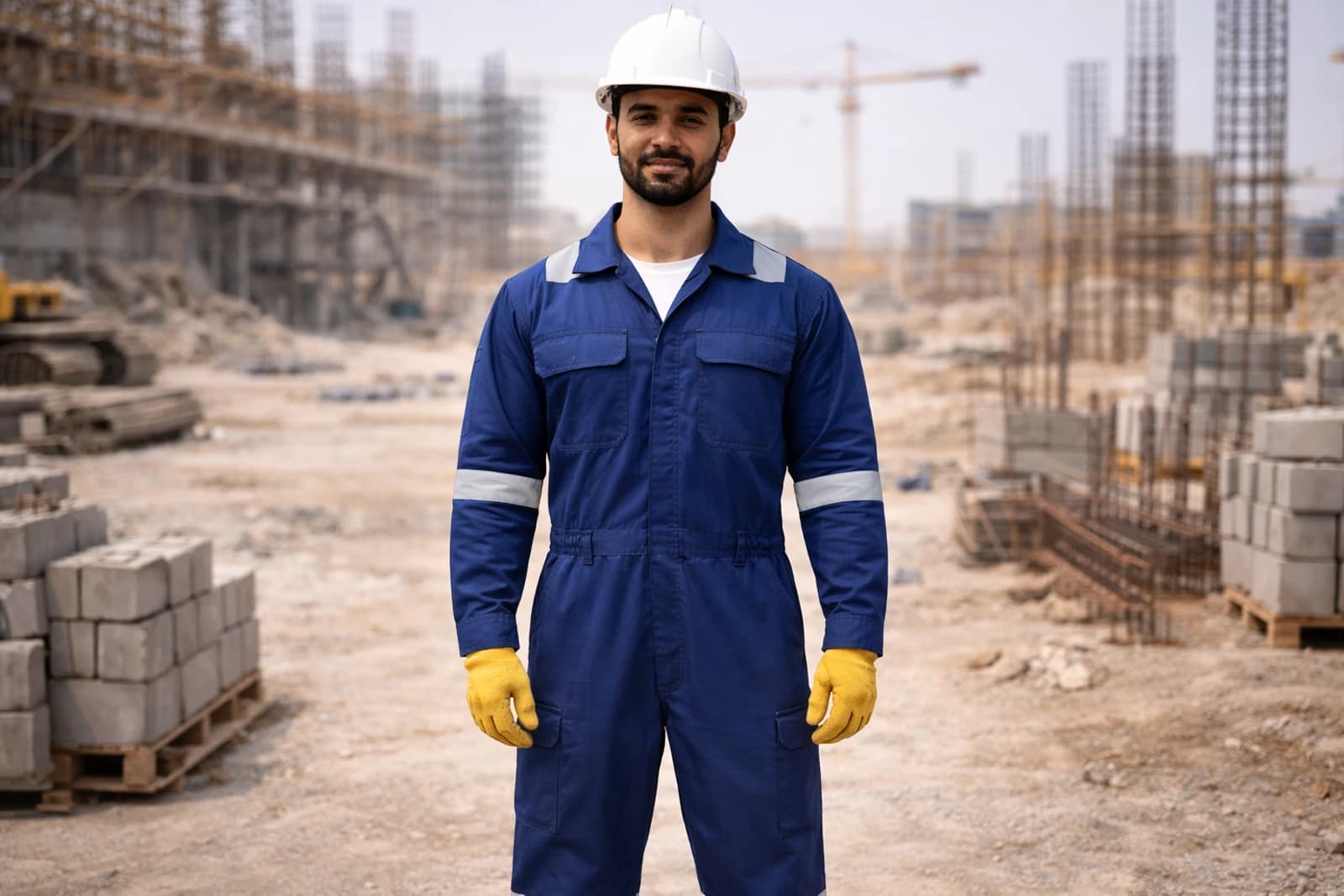
Industrial Workwear
Industrial Coverall Pro
Hard-wearing one-piece coverall for plant, maintenance, and heavy-duty operations.
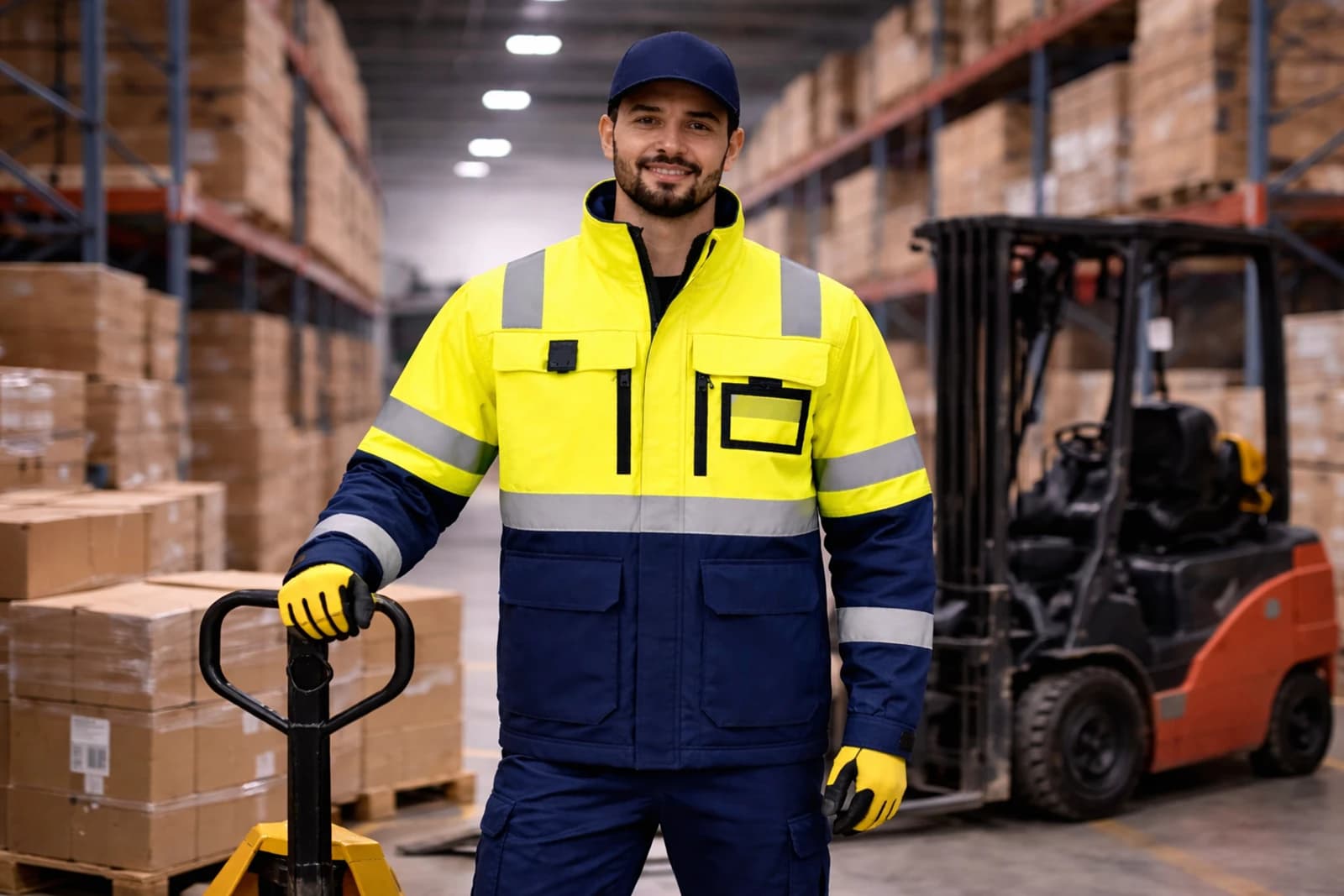
Safety Uniform
Hi-Vis Safety Jacket
Reflective safety jacket for high-visibility site operations and road work crews.