Industrial Coveralls for Middle East Maintenance & Technical Teams: A B2B Sourcing Guide
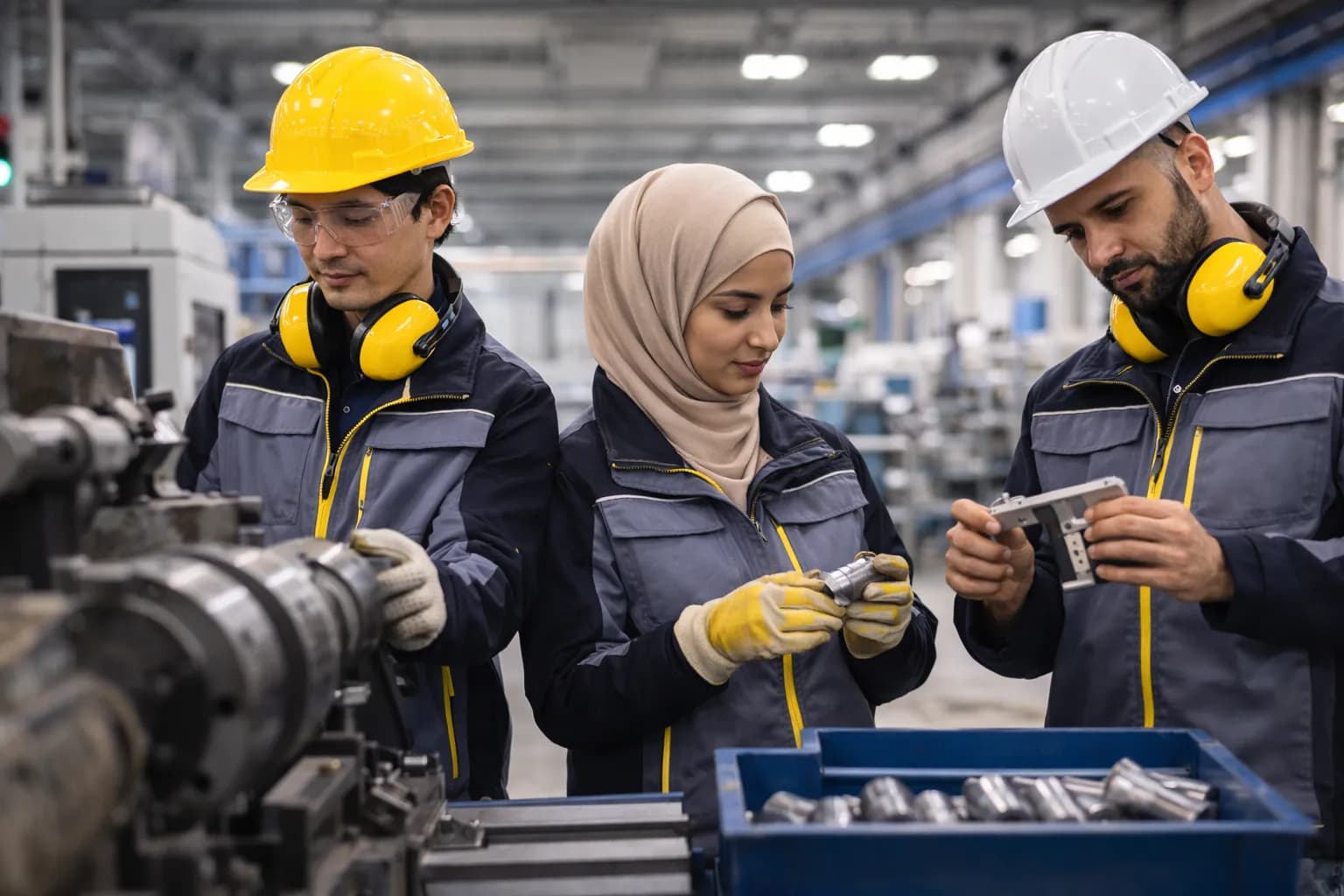
From desalination plants and oil refineries to power stations, cement works, and heavy-engineering workshops, the Middle East runs on continuous maintenance. The technicians, fitters, welders, electricians, and utility crews who keep these facilities running need coveralls that can take daily punishment, resist flame, oil, and abrasion, and stay tolerable in extreme heat. This sourcing guide for Middle East B2B buyers covers FR and general-duty industrial coveralls, fabric weights for Gulf conditions, compliance (EN ISO 11612, EN 1149), fit and sizing at volume, and how to procure them from a Chinese workwear manufacturer.
Buyer context
What procurement teams run into
The Middle East is one of the world's most intensive industrial operating environments. Desalination plants run day and night to supply Gulf cities, refineries and petrochemical complexes operate around the clock, power and water utilities maintain sprawling transmission and distribution networks, and cement, steel, and aluminium plants push equipment hard through punishing dust and heat. Every one of these facilities depends on a maintenance workforce — fitters, electricians, welders, instrument technicians, riggers, and utility crews — many of whose jobs require industrial coveralls.\n\nFor B2B buyers sourcing for these teams, the challenge is twofold: the coveralls must meet real safety standards (especially for flame-resistant and arc-flash roles), and they must be practical for the Middle East, where workshop and plant environments routinely exceed 40°C even in winter months and can pass 50°C on open sites in summer.\n\nThis guide covers how to specify and source industrial coveralls — both FR and general-duty — from a Chinese workwear manufacturer, with an eye on compliance, comfort, durability, and volume procurement.\n\n**1. Know which coverall category you actually need**\n\nNot all industrial coveralls are created equal, and specifying the wrong category is expensive and, worse, dangerous. Two broad types dominate:\n\n- **General-duty coveralls.** For maintenance fitters, workshop mechanics, riggers, and technicians who face abrasion, oil, grime, and dirt but no significant thermal or electric-flash hazard. These are durable, washable cotton or cotton-blend garments that protect the worker's own clothing and skin.\n- **Flame-resistant (FR) coveralls.** For welders, refinery and petrochemical workers, gas-plant crews, and anyone near ignition sources, hot surfaces, or potential flash-fire scenarios. These must be certified to standards like EN ISO 11612 (heat and flame) and often EN 1149 (antistatic) for explosive atmospheres.\n\nA single manufacturer should be able to grade and certify both. Confirm early which category your teams fall into — do not guess. A coverall bought to save a few dollars a unit is not a saving if it fails in an incident.\n\n**2. Fabric and weight: managing Gulf heat**\n\nHeat is the defining condition for Middle East industrial workwear. A heavy 320gsm FR cotton coverall can be dangerously uncomfortable in a summer maintenance job, leading workers to unzip sleeves or remove the garment entirely — which defeats the safety purpose.\n\nFor general-duty maintenance coveralls in the Gulf:\n\n- **Weight:** 245–260gsm twill is a sensible sweet spot — tough enough to resist snags and abrasion, light enough to wear for a full shift. Heavy 300gsm+ cotton duck is overkill for workshop roles and cooks the wearer.\n- **Blend:** Polyester/cotton blends (around 65/35 or 50/50) improve durability, colour retention, and crease resistance, and dry faster after washing. For purely mechanical roles, this is often the best value.\n- **Breathability:** Specify venting features — mesh-lined back vents, underarm eyelets, or a half-mesh lining — that let heat escape when the worker is mobile. This is the single most practical comfort feature for Gulf plants.\n\nFor FR coveralls, fabric choice is constrained by certification, but choices still exist:\n\n- **Inherent vs. treated FR fabrics.** Inherently FR fabrics (e.g., modacrylic blends) retain protection for the garment's entire life, even after many washes; treated cottons lose protection over time and must be re-certified or replaced more often. For long-term Gulf procurement, inherent FR is usually the better total-cost-of-ownership choice, despite the higher unit price.\n- **Multi-norm fabrics.** Look for fabrics that carry both FR and antistatic properties (EN 1149) plus chemical splash resistance (Type 6) in one garment — common in petrochemical environments — so workers don't need to layer.\n\n**3. Fit, mobility, and practical design**\n\nA maintenance coverall that binds at the shoulders or rides up when the wearer crouches is a coverall that gets worn improperly — or not at all. Specify:\n\n- **Action back and articulated knees.** A pleated action back gives freedom of movement for reaching, climbing, and kneeling. Articulated (pre-shaped) knees keep the leg from pulling tight when crouching under plant equipment.\n- **Two-way front zip.** Fitters and electricians bend and kneel constantly; a two-way zip lets them sit and work without popping buttons or riding up.\n- **Pockets that close.** Chest, thigh, and cargo pockets with secure closures (flapped and poppered, or zip) keep tools, bolts, and phones from spilling into machines or machinery gaps.\n- **Multiple tooling pockets.** Hammer loops, rule pockets, and pen slots are cheap to add and make the coverall genuinely useful for technicians.\n- **Reflective trim (optional).** For crews working near mobile plant or vehicle movement on sites, add retroreflective tape strips for visibility — a practical touch even if full hi-vis certification isn't required.\n\n**4. Sizing and grading for Gulf workforces**\n\nIndustrial teams are rarely a neat bell curve of sizes. Welders and fitters skew toward larger builds, technicians vary widely, and long-limbed workers need tall options. When sourcing coveralls at volume from a Chinese manufacturer:\n\n- Confirm a **full size range** (typically 3XS through 5XL or wider) plus **short/regular/tall** length options for key roles.\n- Ask the manufacturer to provide a **physical size spec sheet** (chest, waist, inseam, sleeve length per size) and, ideally, sample garments across sizes so your teams can trial-fit before committing to a bulk order.\n- Provide **real measurement data** where possible. A manufacturer that grades from actual workforce measurements will cut waste and re-order rates — and your need for size exchanges — significantly.\n\n**5. Compliance, certification, and documentation**\n\nFor FR and protective workwear, documentation is non-negotiable. When sourcing from China:\n\n- Require **third-party test reports** from accredited labs (SGS, TÜV, Intertek, BV) certifying EN ISO 11612 (heat and flame), EN 1149 (antistatic), EN ISO 11611 (welding) where relevant, and EN 13034 (chemical splash) if applicable. Ask for the reports for the exact style and batch you are buying, not a generic marketing certificate.\n- Verify **CE marking** and that the product is certified as PPE under the EU PPE Regulation (2016/425), which is the benchmark most Gulf regulatory regimes and HSE departments recognise.\n- Check **product labelling** matches the certification — each garment must carry the relevant pictograms and standards markings.\n- Confirm **washing and care instructions** for FR garments. Correct laundering affects protective performance; supply clear guidance to your HSE team and to the workers.\n- For general-duty coveralls, confirm basic textile quality: colour fastness (EN ISO 105), dimensional stability after washing, and REACH/OEKO-TEX compliance for restricted substances.\n\n**6. Procurement and reorder strategy**\n\nIndustrial coveralls are a recurring spend. Every plant has a replacement cycle — garments wear out, crews grow, and annual PPE procurement comes around. To make volume sourcing work:\n\n- **Standardise on one style and colour** per role across sites, and lock the specification with the manufacturer so every reorder is identical. Pantone-matched colour and a frozen spec sheet prevent drift between batches.\n- **Stock buffer stock.** Cotton coveralls shrink and wear; FR garments have a finite protective life. Work with the manufacturer on a buffer of 10–15% above your annual requirement to cover unplanned growth and damage.\n- **Plan lead times.** Chinese manufacturing plus shipping to Gulf ports typically runs several weeks; align your order cadence with your consumption so you never carry a shortfall on critical safety equipment.\n- **Consider embroidery and name/role identifiers.** Chest logos, site names, and role patches are cheap at volume and add a level of professionalism and accountability that HSE teams and regulators appreciate.\n\n**7. Choosing the right manufacturer**\n\nA good Chinese workwear manufacturer for industrial coveralls should be able to demonstrate, up front: ISO 9001 quality management, in-house or partner-accredited testing, documentation of FR and PPE certification, flexibility on grading and sizing, a consistent track record of exports to the Gulf, and a clear sample-and-approval process before bulk production. Ask for references from buyers in your sector — refineries, utilities, and heavy industry — and, if feasible, order a small pilot run before committing to the full volume.\n\nWith the right specification and partner, industrial coveralls can deliver both serious protection and serious comfort in one of the world's most demanding work environments.
Sourcing approach
How a factory partner can respond
**The practical checklist for Middle East B2B buyers**\n\nWhen sourcing industrial coveralls from a Chinese workwear manufacturer, work through this checklist:\n\n1. **Classify your roles** — general-duty vs. flame-resistant (FR) vs. antistatic. Never guess on safety categories.\n2. **Match fabric to heat** — 245–260gsm twill for general duty, inherent FR fabrics with venting for FR roles. Add back vents and underarm vents for Gulf temperatures.\n3. **Specify mobility** — action back, articulated knees, two-way zip, secured tooling pockets.\n4. **Confirm full grading** — 3XS–5XL plus short/regular/tall, with a physical size spec sheet and trial samples.\n5. **Demand third-party certificates** — EN ISO 11612, EN 1149, EN ISO 11611, EN 13034 as applicable, from accredited labs, with CE marking under the EU PPE Regulation.\n6. **Freeze the spec** — standardise style, colour (Pantone), and measurement across sites for consistent reorders.\n7. **Plan procurement** — 10–15% buffer stock, realistic lead times to Gulf ports, and a small pilot order before full volume.\n\nA disciplined, well-documented sourcing process protects your people, satisfies your HSE and regulators, and keeps recurring PPE spend predictable.
Recommended Products
Products that fit this use case
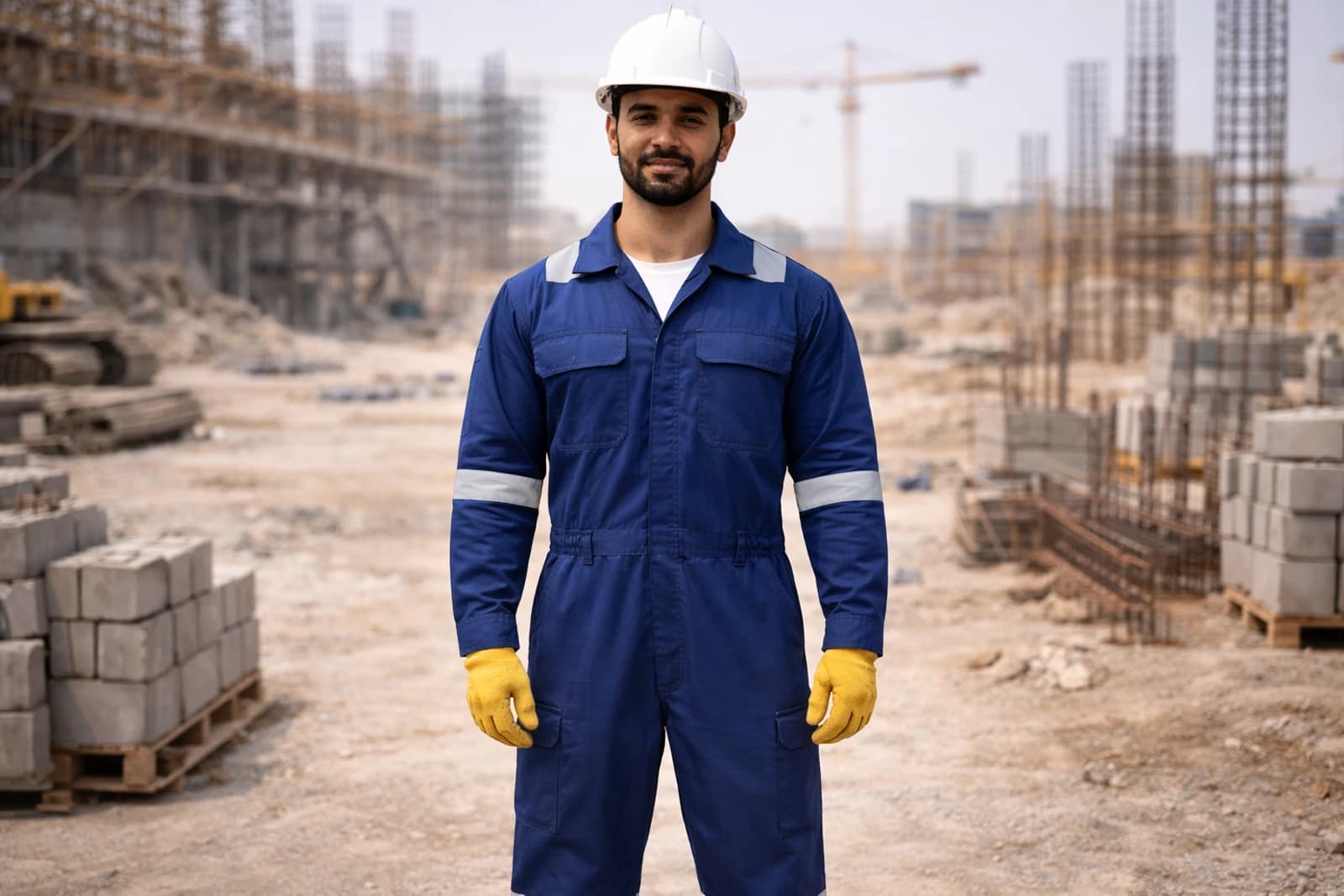
Industrial Workwear
Industrial Coverall Pro
Hard-wearing one-piece coverall for plant, maintenance, and heavy-duty operations.