Industrial Maintenance & Facility Management Workwear for Middle East Plants: Coveralls, Hi-Vis Jackets, Softshell Sets, and Polo Uniforms from a Chinese Manufacturer
Middle East industrial plants — from petrochemical facilities in Jubail and Ruwais to desalination plants, cement factories, and large-scale manufacturing complexes — need workwear that handles heat, chemicals, and varied job roles across a single facility. This guide covers when to spec industrial coveralls, hi-vis safety jackets, construction softshell sets, and logistics polo uniforms for different roles in plant maintenance and facility management, and what B2B buyers should look for when sourcing from a Chinese workwear manufacturer.

Buyer context
What procurement teams run into
Middle East industrial plants and large-scale facility management operations face a unique workwear challenge: they are not single-role environments. A typical petrochemical plant in Jubail or a desalination facility in Ras Al Khair hosts dozens of different job functions — process operators, mechanical maintenance crews, electrical technicians, instrument and control engineers, scaffolding teams, insulation workers, yard and logistics staff, and facility security personnel — each with different exposure levels, safety requirements, and comfort needs. The most common mistake plant procurement teams make is buying one type of workwear for everyone. A full industrial coverall is the correct choice for a mechanical fitter working in a pipe rack with insulation and flange gaskets, but it is overkill for a shift supervisor who walks the plant perimeter checking gauges and log sheets. Conversely, a polo uniform is appropriate for a control room operator or yard storekeeper, but dangerously inadequate for a confined-space entry team or a scaffold erector working at height near hot piping. Heat is the dominant environmental factor across all Gulf industrial plants. From the Eastern Province of Saudi Arabia to the industrial zones of Abu Dhabi and Sohar, summer ambient temperatures routinely exceed 48°C, and surface temperatures on metal structures, pipework, and equipment can reach 65–70°C. Workwear designed for temperate-climate industrial plants (Northern Europe, North America, Northeast Asia) is typically too heavy and insufficiently ventilated for Gulf conditions. The result: workers roll up sleeves, unzip coveralls, or remove outer layers to stay cool — undermining the protection those garments were designed to provide. A second problem is multi-shift and multi-zone exposure. In a single 12-hour day shift, a maintenance technician in a Gulf industrial plant may move between a climate-controlled workshop (20°C), an exposed outdoor pipe rack (50°C+ with sun and wind), and a confined space inside a pressure vessel (45°C with no airflow). No single garment handles all three conditions well without layering or active ventilation features. Workwear programs that fail to plan for this temperature range force workers to carry multiple garments or suffer through uncomfortable extremes. Chemical resistance is a critical but often overlooked issue in Middle East industrial plants. In the Gulf's hydrocarbon, petrochemical, and water treatment sectors, workers encounter chemicals ranging from crude oil fractions and solvents to chlorine, caustic soda, and sulfuric acid. A standard cotton or poly-cotton coverall offers zero protection against chemical splashes — yet many plants specify general-purpose coveralls for all maintenance roles without distinguishing between workers who handle chemicals and those who do not. Finally, colour consistency and role identification across large sites is a persistent headache. Most Gulf industrial plants use colour-coded uniforms to identify roles at a distance: white for supervisors and engineers, orange for mechanical maintenance, blue for electrical and instrumentation, green for safety and environment, and red for emergency response. Maintaining consistent colour across multiple garment types (coveralls, jackets, polo shirts) and across reorders over time is difficult without a manufacturer who can guarantee colour matching across product families and production runs. Plants that switch suppliers or accept loose colour tolerances end up with mismatched uniforms that defeat the purpose of role-based identification.
Sourcing approach
How a factory partner can respond
The most effective workwear strategy for Middle East industrial plants and facility management operations is a multi-garment system that matches each role with the appropriate level of protection, fabric weight, and feature set — all colour-coordinated from a single manufacturer for consistent role identification across the entire facility. **For mechanical maintenance, pipe fitters, and process technicians: the industrial coverall.** The industrial-coverall-pro is the core garment for workers who spend their shift in direct contact with oily, greasy, or abrasive environments. For Middle East industrial plants, specify a lightweight ripstop fabric in the 180–220 gsm range — heavy enough to resist snags on pipe flanges, grating, and threaded fittings but light enough to breathe in Gulf summer heat. Look for: a two-way front zipper for ventilation control (unzip from the bottom to let air circulate without fully removing the coverall); underarm ventilation eyelets or mesh gussets; multiple secure pockets sized for a mobile phone, notepad, and flashlight; and reinforced knee panels for kneeling on concrete and steel grating. For workers in chemical-handling zones, specify a fabric with splash-resistant finish (EN 13034 Type 6) rather than a fully impermeable garment, which traps heat and is only needed for full liquid-tight protection in designated high-risk areas. Ensure EN ISO 13688 certification for the base garment and EN 13034 or EN ISO 11611 if welding or hot work is involved. **For yard, logistics, and general site staff: the logistics polo uniform.** Not every worker in an industrial plant needs a full coverall. Control room operators, material storekeepers, forklift drivers, gate security, and yard marshals are better served by the logistics-polo-uniform — a professional short-sleeve polo shirt in a moisture-wicking 170–190 gsm poly-cotton pique fabric with a contrasting collar for a neat appearance. Polo uniforms keep these staff comfortable in the 50°C outdoor yard environment while allowing full range of motion for driving, walking, and handling paperwork. For yard staff who work in active vehicle movement zones (forklifts, cranes, delivery trucks), layer a lightweight hi-vis safety vest (EN ISO 20471 Class 2) over the polo for visibility without the weight of a full coverall or jacket. **For outdoor maintenance crews, night shifts, and winter months: the construction softshell set.** Industrial plants in the Gulf do experience cooler conditions — December through February night temperatures can drop to 10–15°C in desert-located plants — and workers on overnight shutdowns, turnarounds, and emergency call-outs need a warm layer that doesn't restrict climbing and maneuvering around pipe racks, vessels, and elevated platforms. The construction-softshell-set (jacket and trouser) provides wind resistance and insulation at 280–320 gsm weight, with bonded reflective taping for 360° visibility around mobile plant during night work. The softshell jacket works equally well over a polo uniform for control room and yard staff and under a coverall for mechanical crews who need an extra insulation layer during winter months. Specify a water-repellent finish (DWR) for resistance to light rain and washing-down operations common in plant cleaning and turnaround work. **For all-weather outdoor duty, emergency response, and multi-zone workers: the hi-vis safety jacket.** Workers who move between indoor and outdoor zones — shift supervisors, safety officers, scaffold inspectors, and emergency response teams — need a hi-vis safety jacket that works as both a standalone outer layer and a mid-layer under a coverall when conditions demand. Choose a Class 3 hi-vis safety jacket in 150–180 gsm breathable polyester with reflective tape on torso and sleeves, underarm vent zippers, and a mesh lining. The key advantage of the hi-vis safety jacket for multi-zone industrial use is its quick-doff capability: a supervisor can wear a polo uniform in the control room, add the hi-vis jacket for a walk of the plant (5–15 minutes), and remove it when returning indoors without the full-undress process of a coverall. This flexibility is critical for roles that change zones 10–20 times per shift. **Colour-coded role identification system.** A unified colour-coding system across all four garment types is essential for large Middle East industrial plants. Work with a manufacturer who can match colours across their coverall, softshell, hi-vis jacket, and polo platforms so that a mechanical maintenance worker wearing an orange industrial coverall and an orange hi-vis jacket is instantly identifiable as the same role group. Standard assignments: white for engineers and management, orange for mechanical maintenance, navy blue for electrical and instrumentation, green for HSE and environment, grey for logistics and yard, and red for emergency response and fire teams. **Sourcing from a Chinese manufacturer with industrial plant expertise.** The right Chinese workwear manufacturer for Middle East industrial plants should offer: a multi-garment platform (coverall, hi-vis jacket, softshell set, and polo) with consistent colour matching across all product lines; fabric weight options optimized for Gulf heat (lightweight ripstop for coveralls, breathable pique for polos, ventilated polyester for hi-vis jackets); certification documentation for EN ISO 13688, EN 13034 (chemical splash), and EN ISO 20471 (hi-vis); proportional sizing across extended size ranges for multinational workforces; and the ability to apply custom branding — company logos, role department patches, and name embroidery — without compromising fabric breathability or safety certification. Request pre-production samples in every colour and garment type, and insist on wash-test documentation showing colour retention and reflective tape adhesion after 25+ industrial wash cycles. A manufacturer who cannot deliver consistent colour across coveralls and polos — or who cannot explain how they adapt fabric weight for hot climate use — is not the right partner for a Gulf industrial plant contract.
Recommended Products
Products that fit this use case
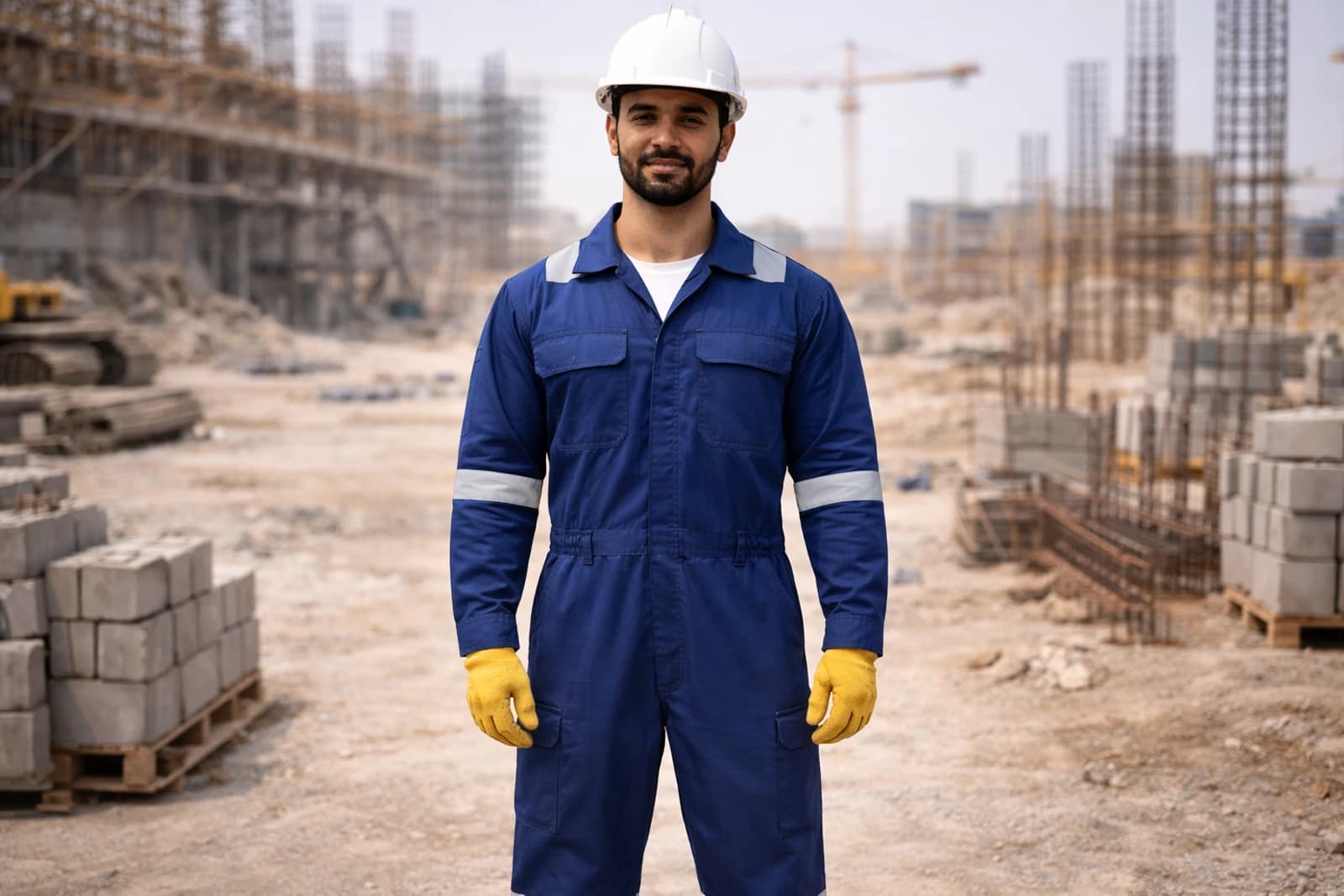
Industrial Workwear
Industrial Coverall Pro
Hard-wearing one-piece coverall for plant, maintenance, and heavy-duty operations.

Logistics Uniform
Logistics Polo Uniform
Breathable uniform polo for warehouse, delivery, and last-mile teams.
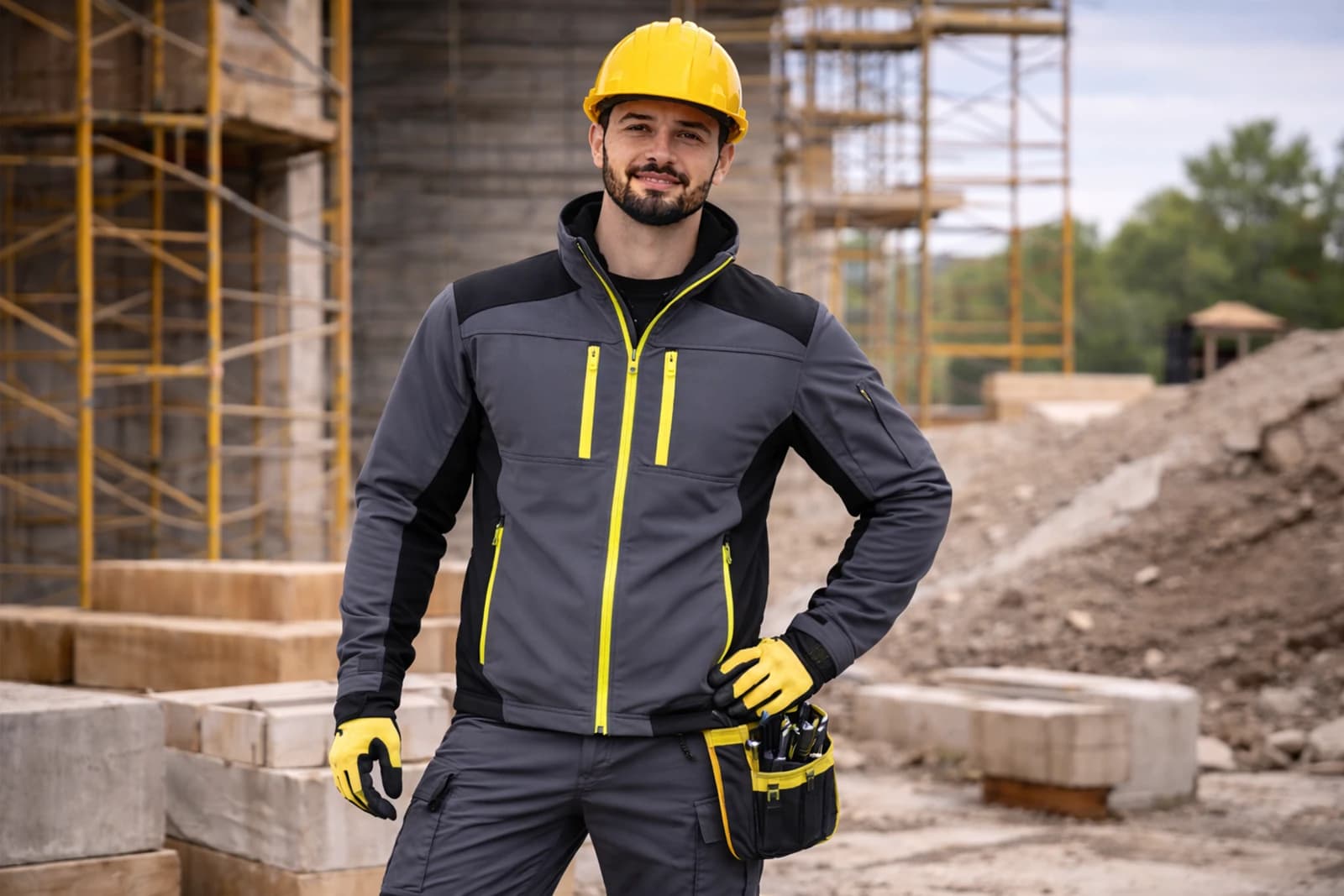
Construction Clothing
Construction Softshell Set
Flexible jacket and trouser set built for crews working across changing weather conditions.
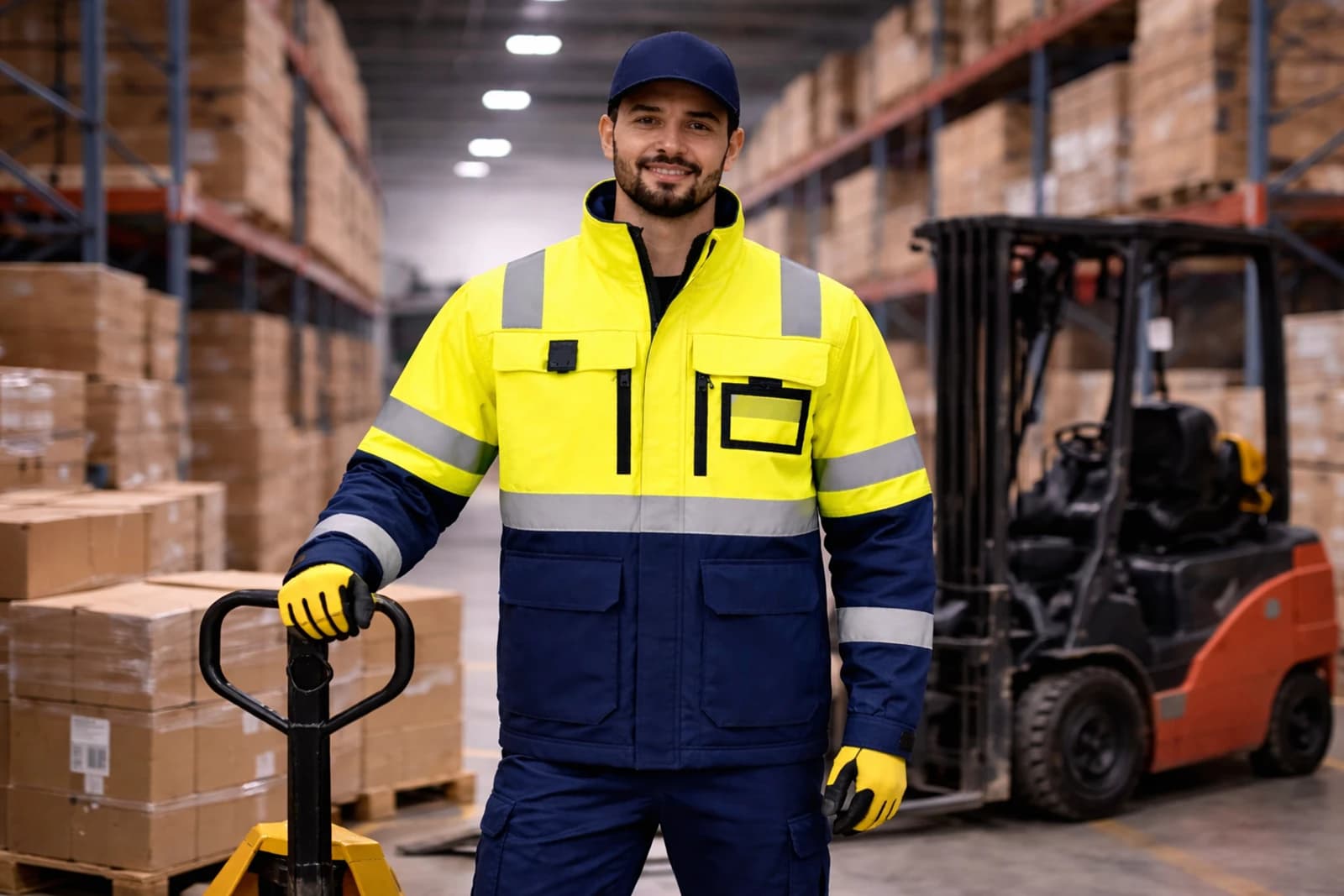
Safety Uniform
Hi-Vis Safety Jacket
Reflective safety jacket for high-visibility site operations and road work crews.