Logistics Polo Uniform for Middle East Warehousing & Transport: B2B Sourcing Guide for Gulf Buyers
Middle East e-commerce logistics, cold-chain warehousing, and last-mile delivery fleets need professional polo uniforms that keep workers cool in 50°C heat while representing the brand. This guide covers what B2B buyers in UAE, Saudi Arabia, Qatar, and Kuwait should know when sourcing logistics polo uniforms from a Chinese workwear manufacturer — from fabric technology and breathability to custom branding and regional sizing.

Buyer context
What procurement teams run into
The Middle East logistics sector is booming. UAE's logistics market is projected to reach $45 billion by 2027, Saudi Arabia's Vision 2030 is driving a $34 billion transformation of its transport and warehousing infrastructure, and Qatar's Hamad Port and Qatar Free Zones are attracting massive distribution centre investments. For B2B procurement managers overseeing uniform contracts for warehouse workers, last-mile delivery drivers, and logistics centre staff, the core challenge is finding a polo uniform that balances professional brand presentation with extreme-heat comfort. A logistics polo uniform for the Gulf region must perform in conditions that most uniform manufacturers don't design for: 45–55°C ambient temperatures during summer peak, warehouse environments that can reach 40°C even with ventilation, and delivery drivers who spend hours transitioning between air-conditioned vehicles and outdoor exposure. The fabric must wick moisture rapidly, resist odour accumulation across a full shift, maintain colour fastness under intense UV radiation, and still look professional enough to carry the company logo prominently. The cost equation matters enormously. For a 1,000-person logistics workforce, a uniform that lasts 8 months versus 14 months before replacement changes the annual clothing budget by 40% or more. For Middle East buyers sourcing from Chinese workwear manufacturers, the question is how to specify a polo uniform that delivers the right balance of thermal comfort, durability, brand representation, and cost-per-wear — without simply defaulting to cheap 100% polyester that turns into a sweatbox in 35°C heat. **1. Fabric technology — the difference between sweat and professionalism.** The most common mistake B2B buyers make when sourcing logistics polo uniforms for the Middle East is choosing fabric based on appearance alone. A thick, brushed cotton-polyester blend that looks crisp in a showroom can become a heat trap within 20 minutes of warehouse work. For Gulf logistics applications, the optimal fabric construction is a 65% polyester / 35% cotton pique or jersey knit in 180–200 gsm weight. Why this specific blend and weight? The polyester content provides moisture wicking (capillary action pulls sweat away from the skin — aim for a wicking rate of minimum 10 mm/30 min per AATCC 197), quick-dry performance (dry time under 60 minutes at ambient 35°C), and colour retention for repeated industrial laundering. The cotton component adds breathability (air permeability of minimum 150 l/m²/s), natural feel against the skin, and better odour management than pure synthetic. The 180–200 gsm range is light enough for Gulf summers yet substantial enough for modest air-conditioned warehouse temperatures. Many leading Chinese workwear manufacturers offer this fabric as a standard SKU, with optional anti-static fibre integration for logistics environments handling sensitive electronics or flammable goods. For buyers wanting a premium option, consider fabrics with integrated silver-ion or zinc-based odour control treatment — these are particularly valuable for logistics personnel who spend entire shifts in the field and may not have access to shower facilities between deliveries. The treatment should withstand 50+ industrial washes per ISO 20645 (antibacterial activity assessment). Coolmax or similar channel-fibre blends offer another upgrade path, providing 20–30% faster moisture evaporation compared to standard polyester-cotton, though at a 15–25% unit cost premium. **2. Fit, cut, and sizing for the multinational workforce.** One of the most persistent sourcing pain points for Middle East uniform buyers is sizing consistency across a multinational workforce. A logistics company in Dubai may employ drivers from India, Pakistan, Bangladesh, the Philippines, Egypt, and Jordan — all with distinct average body proportions. Standard Asian sizing (which most Chinese manufacturers default to) tends to run shorter in the torso and narrower in the shoulders compared to what a workforce with South Asian or African body types needs. The solution is to request a custom sizing matrix from your Chinese manufacturer, mapping their standard size chart against the actual anthropometric measurements of your workforce. Key measurements to specify: chest (circumference at full expansion), waist (natural waistline), hip (fullest point — critical for a polo that stays tucked during bending and lifting), sleeve length (from shoulder seam to wrist bone), and torso length (nape of neck to waist — particularly important for taller workers). Request that the manufacturer supply size-run garments for a 50-person fit trial before committing to full production. A well-fitting logistics polo should have: (a) 2–3 cm ease at the chest for movement without billowing; (b) extended tail hem that stays tucked when the wearer reaches overhead or bends forward — a 5–7 cm differential between front and back hem lengths; (c) slightly longer sleeve length than standard dress polos — a ¾-length sleeve that hits mid-bicep provides a professional look while allowing full arm mobility for lifting and carrying; (d) reinforced shoulder seams with flat-lock stitching to prevent chafing when wearing safety vests or high-visibility tabards over the polo. **3. Brand visibility and customisation that withstands Gulf conditions.** For logistics companies, the polo uniform is a mobile brand asset. Every delivery driver in a branded polo is a moving advertisement. This makes customisation quality — embroidery, screen printing, or heat-transfer branding — a critical specification point. In Gulf conditions, the failure mode for uniform branding is UV degradation: a logo that looks vibrant in week one can fade to a washed-out shadow after three months of outdoor exposure. Specify thread-in logos using polyester embroidery thread with UV stabilisation (minimum 500 hours of UV resistance per ISO 105-B02), or for larger logos and back-of-polo prints, use silicone-based screen printing inks that resist cracking and fading at temperatures up to 80°C. Avoid PVC-based heat transfers — they delaminate within 6–8 weeks in Gulf summer conditions. For the highest durability, recommend DTG (direct-to-garment) digital printing with UV-cured inks, which bonds directly to the fabric fibres and maintains colour integrity through 30+ industrial launderings. The placement matters too: the chest logo should be positioned 10–12 cm below the collar seam on the left chest (standard for uniform consistency), and the back print should be 8–10 cm below the collar for maximum visibility when the driver is viewed from behind — essential for delivery personnel working near traffic. For companies operating in Qatar or Saudi Arabia, ensure branding placement does not conflict with any mandatory safety identification badges or reflective strips required by local labour regulations. **4. Durability specifications for industrial laundering.** Logistics polo uniforms for the Middle East typically require industrial laundering at 60–75°C with heavy-duty detergents, bleach, and high-alkalinity wash cycles. The typical failure modes are: collar curling (the collar band loses its shape after 10–15 washes), seam puckering (especially at shoulder and side seams), pilling on the fabric surface (particularly in the high-friction zone between a delivery driver's seatbelt and the side seam), and colour fading. Specify the following durability requirements to your Chinese manufacturer: collar construction with a fusible interlining that has been pre-shrunk and tested to withstand 60 industrial washes at 75°C without bubbling or distortion; shoulder and side seams constructed with three-thread overlock using textured polyester thread (not cotton-wrapped — the cotton sheath degrades in high-alkalinity wash); anti-pilling finish rated minimum 3.5 per ISO 12945-2 (modified Martindale method — 7,000 rub cycles); colour fastness minimum 4 per ISO 105-C06 (washing colourfastness) and ISO 105-B02 (lightfastness). Request the wash-test report from the manufacturer showing after 25 industrial launderings: colour change ≤1 step on the grey scale, seam puckering ≤1.5 mm deviation, no visible pilling, and fabric shrinkage ≤3% in both length and width. **5. Pocket configuration and functional details for logistics roles.** The logistics polo should not be a simple fashion polo — it's a functional work garment. Key details for logistics roles: a pen pocket on the left sleeve (positioned 5 cm above the cuff — essential for drivers who need to sign delivery manifests); a small zipped chest pocket on the front (large enough for a smartphone or ID card, positioned in the seam between the chest logo and the access for right-handed wearers); a mobile radio clip attachment point on the shoulder seam or collar (for dispatch communication); and a loop for a safety lanyard or ID badge holder on the collar or front seam. For warehouse-specific roles, consider adding reflective tape across the back and upper sleeves — 50 mm wide silver retroreflective tape per EN ISO 20471 ensures the polo doubles as a class 1 high-visibility garment for roles that involve forklift traffic or pedestrian movement in loading zones. This is particularly relevant for companies sourcing a single uniform for mixed logistics/warehouse workforces. **For B2B buyers in the Middle East, the recommended approach is to start with a minimum order of 100–200 pieces for a 60-day field trial, then scale to full contract quantities of 1,000–10,000 units after validating fit, comfort, and durability. The best Chinese workwear manufacturers offer graded pricing with 10–20% discounts at 5,000+ unit volumes, free pattern-making and size-run samples for orders above 1,000 units, and 12–18 month fabric and workmanship warranties.**
Sourcing approach
How a factory partner can respond
Professional polo uniforms from a Chinese workwear manufacturer offer Middle East logistics companies the ideal balance of thermal comfort, professional branding, and cost efficiency. By specifying the right fabric blend (65/35 polyester-cotton pique, 180–200 gsm), choosing UV-stabilised embroidery or silicone-based screen printing for logos, and configuring functional details like sleeve pen pockets, zipped chest pockets, and radio clip points, buyers can reduce uniform replacement cycles from 8 months to 18+ months while keeping workers comfortable in extreme Gulf heat. Custom sizing for multinational workforces and pre-production fit trials eliminate the most common sourcing frustration — poor fit across diverse body types.
Recommended Products
Products that fit this use case

Logistics Uniform
Logistics Polo Uniform
Breathable uniform polo for warehouse, delivery, and last-mile teams.
Safety Uniform
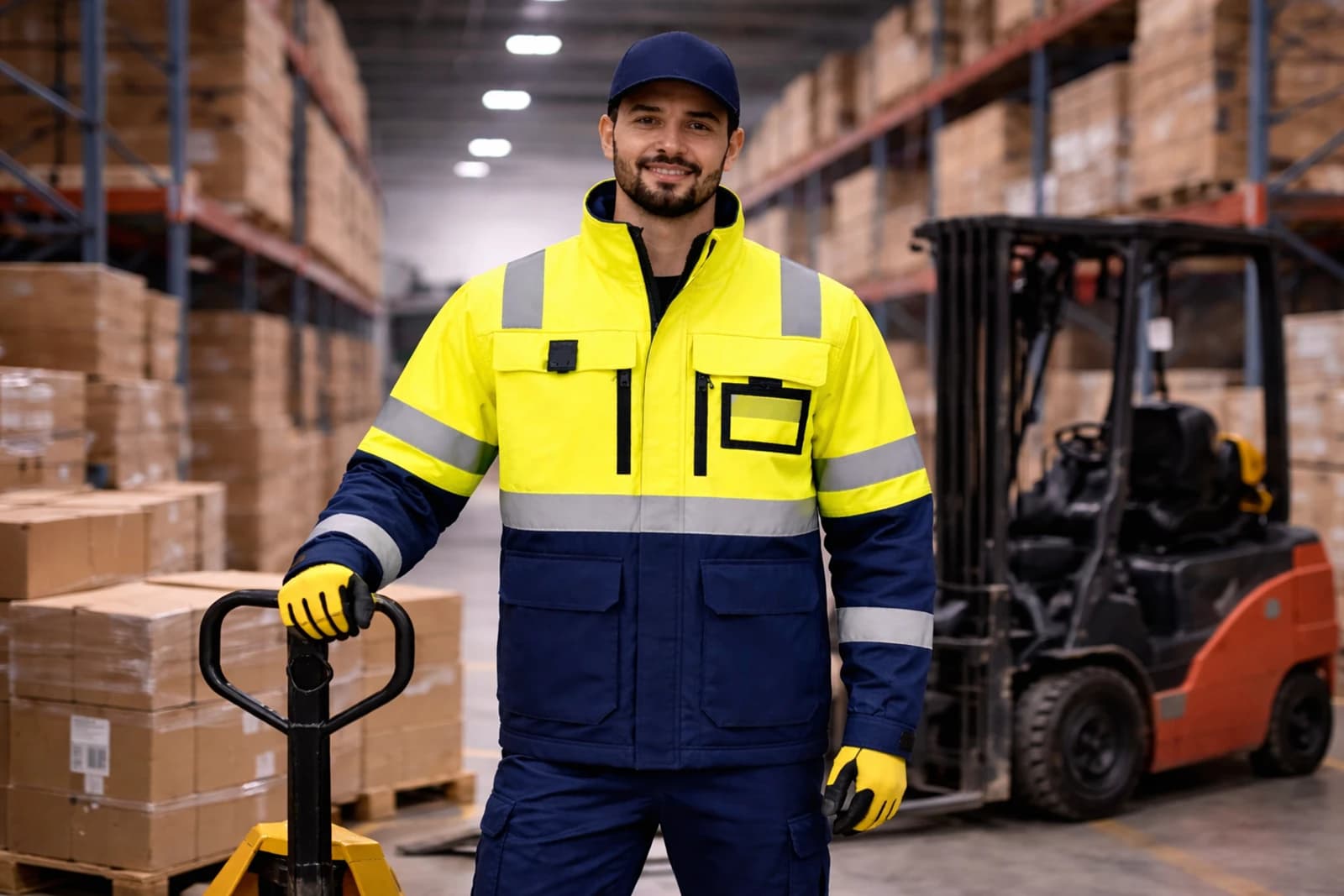
Hi-Vis Safety Jacket
Reflective safety jacket for high-visibility site operations and road work crews.