Logistics Polo Uniform & Construction Softshell Set for Middle East: B2B Sourcing from China
The Middle East logistics and construction sectors are booming — from Dubai's expanding ports and Saudi Arabia's NEOM projects to Qatar's ongoing infrastructure and UAE's industrial zones. This guide helps B2B buyers source logistics polo uniforms and construction softshell jacket/trouser sets from a Chinese workwear manufacturer, covering fabric specifications for extreme heat and dusty environments, brand-representative uniform design, layering strategies for winter construction work, and bulk procurement considerations for 1,000–10,000+ worker deployments.

Buyer context
What procurement teams run into
The Middle East is undergoing a historic infrastructure and logistics transformation. Saudi Arabia's Vision 2030 has committed over $1 trillion to giga-projects including NEOM, the Red Sea Project, Diriyah Gate, and ROSHN communities. The UAE's logistics sector alone is valued at over $50 billion, driven by Dubai's Jebel Ali Port (the 9th busiest container port globally), Abu Dhabi's Khalifa Port, and expanding free zones. Qatar continues its post-World Cup development with new industrial zones and logistics parks. These mega-projects employ hundreds of thousands of workers across two distinct but overlapping workwear categories: logistics and warehousing staff who need professional, breathable polo uniforms, and construction workers who require durable cold-weather layering during the region's winter months.\n\nFor B2B procurement managers sourcing for 1,000–10,000+ workers, these categories present specific challenges:\n\n**Logistics polo uniforms in extreme heat:** Warehouse and logistics workers across the GCC — from Jebel Ali's container terminals to Saudi Arabia's King Abdullah Port — work in non-air-conditioned environments where temperatures inside metal-roofed warehouses can reach 45–55°C (113–131°F). Standard 100% polyester polo shirts (a common budget choice) trap heat and moisture, leading to heat stress, reduced productivity, and worker dissatisfaction. A logistics polo needs to maintain professional appearance while keeping workers cool during 8–10 hour shifts.\n\n**Professional representation requirements:** For logistics companies serving international clients — including DP World, Agility, and CEVA Logistics — uniforms are a brand touchpoint. Uniforms that fade after 5 washes, develop pilling on the collar, or lose their shape create a poor brand impression during client visits, audits, and media appearances. The white, light blue, or branded-colour polo must remain crisp and professional through at least 50 industrial launderings.\n\n**Winter construction work in desert climates:** While Middle East winters are mild compared to Europe or North America, nighttime and early morning temperatures in desert construction sites — including NEOM's Tabuk region, Saudi Arabia's AlUla, and UAE's inland desert developments — can drop to 5–12°C (41–54°F) from December through February. Morning shifts starting at 5–6 AM expose workers to this cold for the first 2–3 hours before temperatures rise. Standard summer workwear (cotton t-shirts, thin trousers) is inadequate, while heavy winter jackets are too warm by 10 AM. Workers need a lightweight, packable layering solution like a softshell jacket that can be worn during cool morning hours and removed as the day heats up.\n\n**Dust and sand abrasion in construction work:** GCC construction sites are notoriously dusty — fine silica-rich sand and dust particles are airborne constantly. These particles act as abrasives on fabric fibres, accelerating wear on softshell's outer membrane, zippers, and fabric seams. A softshell jacket that loses its water repellency or abrades at the elbows and cuffs within 2–3 months of daily construction use creates replacement costs and gaps in worker protection.\n\n**Sizing across multinational workforces:** Construction and logistics workforces in the Middle East draw heavily from South Asia (India, Pakistan, Bangladesh, Nepal) and Southeast Asia (Philippines, Sri Lanka). A polo shirt that fits a 175 cm South Asian worker may be too short in the body for a 190 cm Egyptian worker, and too loose in the shoulders for a lean Filipino worker. Proper grading across these body types requires careful consideration of torso length, shoulder width, and arm length proportions specific to these populations. Ill-fitting polos (too short, riding up) cause worker discomfort and an unprofessional appearance; ill-fitting softshells (too restrictive in the shoulders) reduce mobility and safety during construction tasks.\n\n**Embroidered versus screen-printed branding:** Logistics companies typically require company logos, employee names, and sometimes department identifiers on polo uniforms. Screen printing fades on high-contact areas (collar, chest) within 15–20 washes in the GCC's hot-water laundry cycles. Embroidery, while more durable, adds weight, reduces breathability, and can cause skin irritation if directly against the chest. Choosing the right branding method and placement is a practical but important procurement decision.
Sourcing approach
How a factory partner can respond
**1. Fabric specifications for logistics polo uniforms in Middle East heat**\n\nThe ideal logistics polo for GCC use balances professional appearance, breathability, durability, and ease of care:\n\n**Fabric composition:** 65% polyester / 35% cotton pique knit, 180–200 gsm. This blend offers:\n- The cotton component absorbs moisture and provides natural breathability (critical in 45°C+ warehouse environments)\n- The polyester provides dimensional stability — the polo retains its collar shape, resists pilling, and dries quickly after washing\n- Pique knit structure creates air channels for ventilation, reducing heat buildup compared to jersey knit\n\n**For higher-end logistics brands:** 92% polyester / 8% elastane with moisture-wicking finish, 160–180 gsm — this offers a more modern, slim-fit professional appearance with stretch for mobility. The moisture-wicking finish (typically a hydrophilic coating) pulls sweat to the fabric surface where it evaporates. This is superior for warehouse workers performing physical tasks but requires careful specification: cheap moisture-wicking finishes wash out after 20–30 cycles; specify a permanent or durable finish tested to 50+ industrial washes.\n\n**Colour fastness:** Specify ISO 105-C06 colour fastness to washing at 60°C (minimum rating 4 out of 5). This is critical for white, light blue, and branded-colour logistics polos that show fading visibly. For bright branded colours (e.g., DP World red, Aramco orange), request the manufacturer's test reports showing colour fastness to light (ISO 105-B02) — in UAE and Saudi sun, poor dye quality can shift branded colours significantly within 2–3 months.\n\n**Specification checklist for your Chinese manufacturer:**\n- Fabric: 65/35 polyester-cotton pique, 180–200 gsm\n- Collar: Knitted pique collar with ribbed cuffs (prevents collar curling)\n- Placket: 3-button or 4-button with reinforced buttonholes\n- Side vents: 3–4 cm hem vents at side seams (ventilation)\n- Logo: Embroidery on left chest preferred (durability); screen printing acceptable for temporary/promotional uniforms\n- Sizing: Graded S-5XL covering chest 88–145 cm (see sizing section below)\n- Packaging: Individual polybag with size and barcode label for warehouse distribution\n\n**2. Softshell construction set for Middle East winter layering**\n\n**Jacket specification:**\n- **Shell fabric:** 3-layer bonded softshell — 94% polyester / 6% elastane outer + breathable TPU membrane + 220–240 gsm brushed microfibre backing. Total weight: 300–350 gsm.\n- The outer layer provides abrasion resistance against sand and rough surfaces\n- The TPU membrane is windproof and water-resistant (5,000–10,000 mm head pressure) — essential for morning cold and unexpected winter rain\n- The brushed backing traps body heat for warmth with minimal bulk\n- **Zipper:** YKK or equivalent front zip with inner storm flap (prevents wind penetration)\n- **Pockets:** Two zip hand pockets + one zip chest pocket (internal or external) + one internal media pocket — this keeps phones, ID cards, and small tools secure on construction sites\n- **Hem:** Adjustable drawcord hem and adjustable cuffs (Velcro or snap-button) to seal out dust and wind\n- **Reflective detailing:** Minimum 2 cm wide reflective piping or trim on front zip and back yoke for low-visibility construction site safety (EN ISO 20471 Class 1 optional but recommended)\n\n**Trouser specification (matching softshell set):**\n- Same 3-layer fabric: 300–350 gsm\n- **Knee reinforcement:** Double-layer fabric overlay or external kneepad pockets with kneepad inserts (this is the single most important durability feature for construction workers who kneel — standard softshell fabric abrades through in 2–3 months without reinforcement)\n- **Pockets:** Two side pockets, two back pockets, one thigh cargo pocket with Velcro closure\n- **Waist:** Elastic waistband + belt loops + button closure with zip fly\n- **Hem:** Adjustable hem (snap-button gusset) to fit over boots and seal out dust\n\n**Layering strategy:**\n- Summer (April–October): Polo uniform alone\n- Transition months (March, November): Polo + softshell jacket (unzipped during midday)\n- Winter (December–February): Polo + softshell jacket + optional thermal base layer\n\n**3. Sizing for Middle East multinational workforces**\n\nWork with your Chinese manufacturer to develop graded sizing based on the actual anthropometric data of the workforce population:\n\n**Asian-fit (preferred for majority South Asian workforces):** Shorter torso length, narrower shoulders, proportional arm length. Typical S–5XL range covering 160–190 cm height, chest 84–130 cm, waist 72–120 cm.\n\n**Universal-fit:** If the workforce includes a 50/50 mix of South Asian and Arab/Egyptian workers, ask for an extended sizing table with longer torso and arm length measurements in bigger sizes. Note that many Chinese manufacturers have Asian-fit as default — specific the graded measurement table in your purchase order.\n\n**Fit testing:** Before placing a bulk order (5,000+ pieces), request a size set (S/M/L/XL/2XL/3XL) in the actual production fabric. Have 10–20 workers from the target workforce try on each size and provide feedback on fit. Adjust the size grading table based on feedback before production.\n\n**4. Bulk procurement and logistics**\n\nTypically the manufacturing and shipping timeline for a bulk polo or softshell order from China to a Middle East destination (Jebel Ali, Dammam, Hamad) looks like:\n\n- **Bulk production:** 30–45 days for first order (includes fabric sourcing, pre-production samples, production, quality inspection); 20–30 days for reorders\n- **Sea freight:** 18–22 days from Shanghai/Ningbo to Jebel Ali; 12–15 days from Shanghai/Ningbo via dedicated services\n- **Total lead time:** 50–70 days for first order; 35–50 days for reorders\n\n**Minimum order quantities (MOQ):**\n- Custom polo uniforms: 500–1,000 pieces per colour per style (custom woven label, embroidery)\n- Custom softshell set: 300–500 sets per style (custom fabric colour, branded zip pulls)\n- Stock service: Some Chinese workwear manufacturers offer 200–500 pieces in standard sizes (M/L/XL/2XL) as stock for fast delivery — ask about managed inventory programmes where the manufacturer holds 3–6 months of your uniform stock and ships against weekly call-offs
Recommended Products
Products that fit this use case

Logistics Uniform
Logistics Polo Uniform
Breathable uniform polo for warehouse, delivery, and last-mile teams.
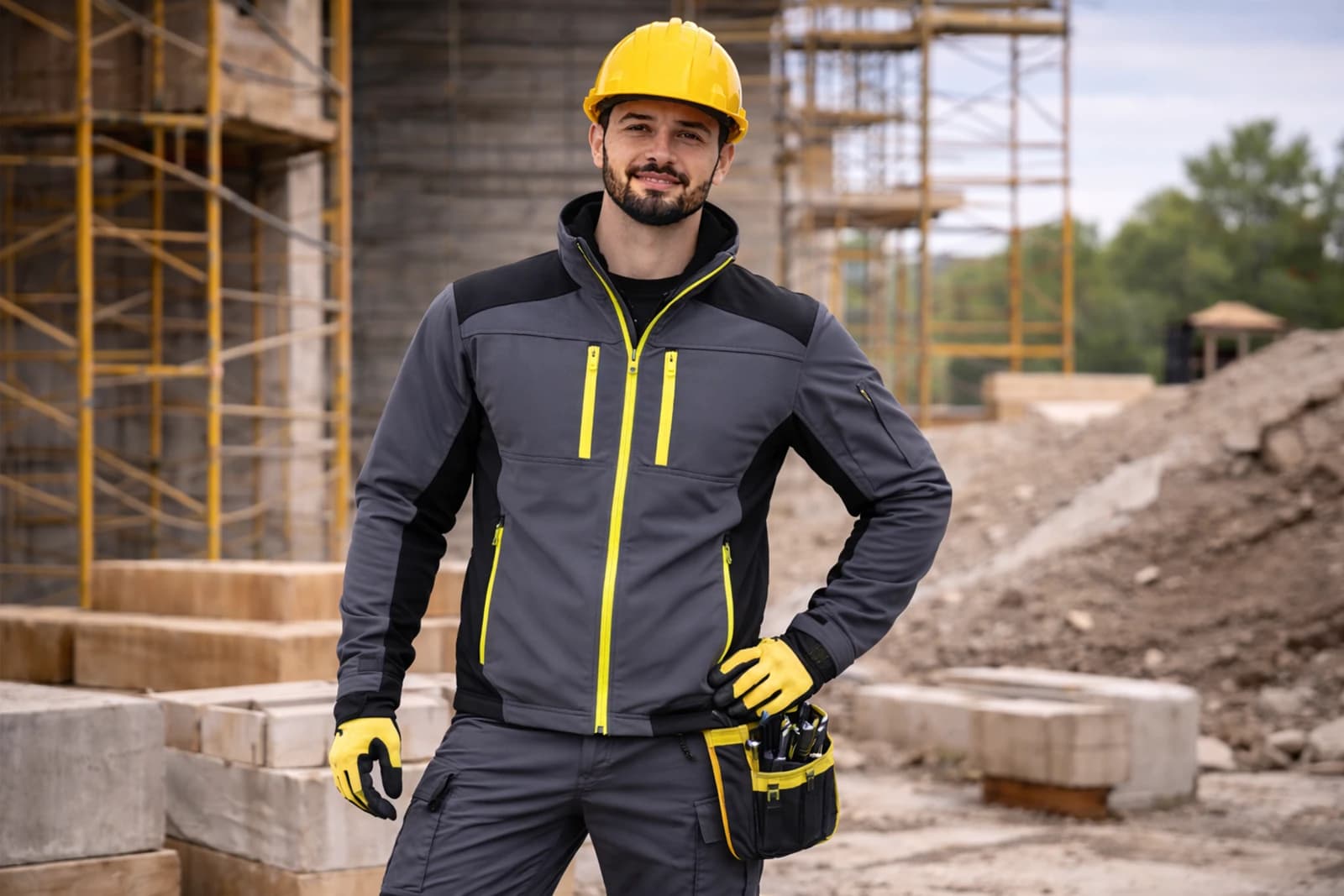
Construction Clothing
Construction Softshell Set
Flexible jacket and trouser set built for crews working across changing weather conditions.