Logistics Polo Uniforms for Dubai, Qatar & Saudi Arabia: A B2B Buyer's Guide for Sourcing from China
From Dubai's $1.4 billion Logistics Corridor expansion to Saudi Arabia's King Salman Airport logistics zone and Qatar's Ras Bufontas Free Zone, the Middle East logistics sector is adding 50,000+ warehouse and last-mile delivery workers annually — each requiring durable, climate-appropriate polo uniforms. For B2B procurement officers sourcing from a Chinese workwear manufacturer, this guide covers fabric selection for 45°C+ warehousing environments, breathability vs. durability tradeoffs, hi-vis integration for apron/ramp workers, customization options for fleet branding, and bulk pricing breakpoints for orders of 2,000–100,000+ units.

Buyer context
What procurement teams run into
The Middle East logistics sector is experiencing explosive growth that is fundamentally reshaping uniform demand. Saudi Arabia's King Salman International Airport in Riyadh — a planned 57 km² logistics hub targeting 120 million annual passengers by 2030 — will alone require 15,000+ uniformed logistics workers across warehousing, cargo handling, apron services, and last-mile delivery. Dubai's $1.4 billion Logistics Corridor expansion connecting Jebel Ali Port, Al Maktoum International Airport, and Dubai South's 8 km² logistics district is projected to add 20,000 logistics jobs by 2028. Qatar's $700 million Ras Bufontas Free Zone expansion near Hamad International Airport adds another 7,000 logistics positions as the nation pivots from World Cup infrastructure to become a regional transshipment hub (targeting 2.5 million TEUs annual throughput by 2030). Each logistics worker requires 8–12 polo shirts per year — replaced every 4–6 weeks due to sweat degradation, frequent industrial laundering (3–5 washes per week), and visual wear-and-tear from constant movement, lifting, and carrying. For a workforce of 50,000 across a single GCC operator (e.g., Saudi Logistics & Transport Co.), this means 400,000–600,000 polo shirts annually. For Middle East B2B buyers — whether sourcing for a 500-worker warehouse in Dubai South, a 5,000-worker cargo terminal at Hamad International, or a 20,000-worker logistics park in Riyadh — the key technical decisions span five critical areas. **1. Fabric selection for GCC logistics environments** The default mistake is ordering standard 180–200 gsm cotton polo fabric (65/35 cotton-polyester pique) designed for office or hospitality. In GCC logistics environments, these fabrics fail in three specific ways: - **Moisture saturation:** Cotton absorbs 20–25% of its weight in moisture. In 45°C warehouses with 60–80% humidity (Dubai summer conditions), a cotton-blend polo becomes sweat-logged within 2 hours. Saturation marks (visible sweat patches) on chest, back, and underarms violate the professional appearance standards many GCC logistics operators mandate (especially at airline cargo terminals and high-end cold chain facilities). - **Color fading:** GCC UV index reaches 9–11 in summer months (May–September). Standard direct dyes used in low-cost cotton polos fade 40–60% within 50 hours of cumulative sun exposure — turning navy to dusty grey, red to pink, and black to charcoal. Uniform inconsistency across a workforce is a visible quality signal for B2B buyers. - **Shrinkage:** Cotton-rich polo fabrics shrink 5–8% after the first industrial wash (typically 75°C, with chlorine bleach). A size L polo that shrinks to size M creates compliance issues: workers reject undersized shirts, leading to 15–25% uniform waste within the first 3 months. **Recommended GCC logistics polo fabric hierarchy:** The best all-rounder for GCC logistics is a **65/35 polyester-cotton pique knit, 190–210 gsm** with moisture-wicking finish. This fabric provides: - 2–3x better UV fade resistance than pure cotton (disperse dyes on polyester retain 85%+ color after 100 hours of QUV accelerated weathering per AATCC TM16) - 3–4x less shrinkage (polyester stabilizes the knit structure; pre-shrunk T/C pique achieves a shrinkage rate of 2–3% max per ISO 6330) - 25–30% faster drying time (polyester wicks moisture from the skin to the fabric surface, where it evaporates 3x faster than from cotton) - Abrasion resistance of 25,000+ Martindale cycles (ISO 12947-2) vs. 10,000–15,000 for standard cotton For premium cold-chain logistics operators (e.g., Aramex Fresh, Majid Al Futtaim's Carrefour cold chain, Almarai's distribution centers), a **100% polyester microfiber pique, 150–170 gsm** with antimicrobial and wicking treatment is increasingly specified. This ultra-lightweight fabric: - Weighs 25% less than T/C pique, reducing thermal load in sub-zero cold storage zones (workers moving between -25°C freezers and 45°C loading bays experience less thermal shock) - Achieves moisture wicking Grade 4–5 per AATCC 197 (sweat moves from skin to fabric surface within 30 seconds vs. 2+ minutes for cotton) - Dries in 30 minutes at room temperature (critical for multi-shift operations where polos are washed and reissued within the same day) **Warning on Chinese polo fabric labeling:** Some factories label 80/20 CVC (chief value cotton) pique as "cotton-polyester performance fabric." CVC pique has significantly lower abrasion resistance (12,000–15,000 Martindale cycles) and higher shrinkage (4–6%). For heavy-use logistics environments where workers are lifting, carrying, and moving constantly, specify: Martindale abrasion ≥ 25,000 cycles, pilling resistance Grade 4–5 (ISO 12945-2), and shrinkage ≤ 3% in both warp and weft. **2. Hi-vis integration for apron and ramp logistics workers** A growing requirement across GCC airports and cargo terminals is the integration of hi-vis elements directly into logistics polo uniforms. Unlike full hi-vis vests (which add a separate layer and are often removed or forgotten), integrated hi-vis polos reduce non-compliance from 30% (separate vest systems) to under 5%. For apron logistics workers at DXB (DXB handled 2.3 million tonnes of cargo in 2025), DOH (Hamad International's 2.1 million tonnes), and RUH (King Khalid's logistics zones), key specifications include: - **Hi-vis background:** Class 2 per EN ISO 20471, with fluorescent yellow or orange ground fabric covering at least 0.50 m². For polo shirt construction, this typically means the full body of the polo in fluorescent color, with contrasting bands on sleeves and body. - **Retroreflective tape:** Silver 3M™ Scotchlite™ 8910 or equivalent, 50 mm wide, applied as one horizontal band around the torso and two vertical bands on the front. Sleeves get one band each (horizontal, 50 mm). Minimum retroreflection: 330 cd/(lx·m²) at 5° observation angle per EN 20471. - **Fabric breathability for hi-vis polos:** The fluorescent dye and retroreflective tape reduce fabric breathability by 15–25%. To compensate, specify: open pique knit structure with 200–250 g/m²/h MVTR minimum (ISO 2528), mesh vent panels under the arms (contrast color mesh fabric, 120–150 gsm), and taped seams only at tape attachment points (not full body taping, which reduces breathability by 40%). **Pricing note:** A hi-vis integrated polo typically costs 30–50% more than a standard logistics polo. However, when factoring in the cost of separate hi-vis vests ($8–12 each, replaced every 6 months due to tape degradation in UAE sun), the total cost of ownership over 12 months is 15–20% lower for integrated hi-vis polos. **3. Sizing and fit for GCC workforces** GCC logistics workforces have different anthropometric profiles than East Asian or European workers — a critical consideration when sourcing polos from a Chinese manufacturer that primarily produces for domestic or Western markets. Key sizing differences: - **Shoulder width:** GCC male workers have average biacromial breadth of 41–43 cm (vs. 38–40 cm for Chinese reference populations). Specifying polos with extended shoulder seams (raglan or saddle shoulder construction) reduces shoulder stress and seam failure at this critical point. - **Torso length:** GCC workers typically need 2–3 cm additional body length vs. standard Chinese sizing (a 70 cm length for size L vs. 67–68 cm standard). Short torso length causes polos to untuck during bending — a common complaint and uniform appearance issue in GCC logistics. - **Sleeve length:** For 3/4 sleeve polos (preferred by many GCC logistics operators for the balance of sun protection and airflow), specify: 18–20 cm sleeve length from shoulder seam for size L. Standard Chinese manufacturing often produces 15–16 cm sleeves that ride up and expose arms to UV. **Custom sizing programs:** Reputable Chinese workwear manufacturers offer custom grading tables for Middle East markets. For B2B buyers ordering 5,000+ units, request a fit sample with GCC-specific grading. The incremental cost is typically only 2–5% of the total order but reduces return/rejection rates from 15–20% (off-the-shelf sizing) to 1–3%. **4. Embroidery and branding for fleet uniformity** Logistics polo uniforms in the GCC are not just workwear — they are mobile brand assets visible across airports, warehouses, and delivery routes. Branding requirements typically include: - **Left chest logo:** 8–10 cm flat embroidery, 45,000–60,000 stitches (12-color max for complex logos like Saudi Aramex or Qatar Airways Cargo). Spec: Chenille embroidery for a premium 3D effect is popular in GCC logistics but adds 30–40% to embroidery cost. - **Back branding:** Large back logo or text (e.g., "Saudia Cargo" or "Dubai Express") in reflective heat-transfer vinyl (HTV) — 20–25 cm height, with 3M™ reflective properties (330 cd/(lx·m²) minimum). Reflective HTV retains 80%+ reflectivity after 25 industrial washes vs. 50–60% for screen-printed back logos. - **Sleeve branding:** Left sleeve with company tag or small logo woven label (3×1 cm, 2-color) — also serves as size indicator for industrial laundry sorting. **Pricing breakout for typical 5,000-unit logistics polo order:** | Specification | Cost per unit (FOB Shanghai) | |---|---| | 65/35 T/C pique 200 gsm, basic left chest embroidery | $8.50 – $10.00 | | As above + back reflective HTV branding | $10.50 – $12.00 | | 100% polyester microfiber pique 160 gsm, full branding | $12.00 – $14.00 | | Hi-vis integrated (EN ISO 20471 Class 2), full branding | $14.00 – $17.00 | Volume orders of 20,000+ units typically achieve 12–18% discount from these base prices. **5. Pilling, laundry, and long-term quality standards** The single biggest quality complaint from GCC logistics operators about Chinese polo uniforms is **pilling** — the formation of small fabric balls on the surface after 10–15 industrial washes. In a logistics setting where polos rub against cardboard boxes, plastic totes, and conveyor belts, pilling transforms a professional-looking uniform into a shabby one within weeks. To prevent pilling: - Specify anti-pilling finish on the fabric (a resin coating that bonds loose fibers to the fabric surface, reducing fuzz formation by 60–80%) - Set a minimum pilling resistance of Grade 3–4 per ISO 12945-2 (Martindale method after 12,000 rubs) - Require 50 industrial wash tests (ISO 15797) before bulk production approval — polos that pass 50 washes without Grade 3 pilling will typically last 8–12 weeks in service For seam quality on logistics polos, specify: double-needle stitching on all major seams (shoulder, armhole, side seams), 4+ stitches per cm, with bar-tack reinforcement at the bottom of the placket and pocket corners. Elastomeric thread in the collar (5% spandex) prevents the dead collar syndrome — when the polo collar loses its shape and lies flat vs. standing up — which is a fast visible quality cue in GCC logistics settings.
Sourcing approach
How a factory partner can respond
For Middle East B2B buyers sourcing logistics polo uniforms from a Chinese workwear manufacturer, the optimal specification for GCC conditions is a 65/35 polyester-cotton pique knit at 190–210 gsm with moisture-wicking finish, anti-pilling treatment, and custom GCC grading for shoulder width (+2–3 cm) and torso length (+2–3 cm). Add hi-vis integration (EN ISO 20471 Class 2, 3M™ reflective tape) for apron and ramp workers, and specify full fleet branding via chest embroidery + back reflective HTV. For cold-chain logistics, upgrade to 100% polyester microfiber pique at 150–170 gsm with antimicrobial treatment. Pair logistics polos with hi-vis safety jackets (EN ISO 20471 Class 3, breathable fabric, 310–350 gsm) for workers who operate outdoors or in mixed zones, ensuring a complete, consistent uniform system that withstands the GCC's heat, UV, and industrial laundry demands while projecting professional brand image across the region's rapidly expanding logistics infrastructure.
Recommended Products
Products that fit this use case

Logistics Uniform
Logistics Polo Uniform
Breathable uniform polo for warehouse, delivery, and last-mile teams.
Safety Uniform
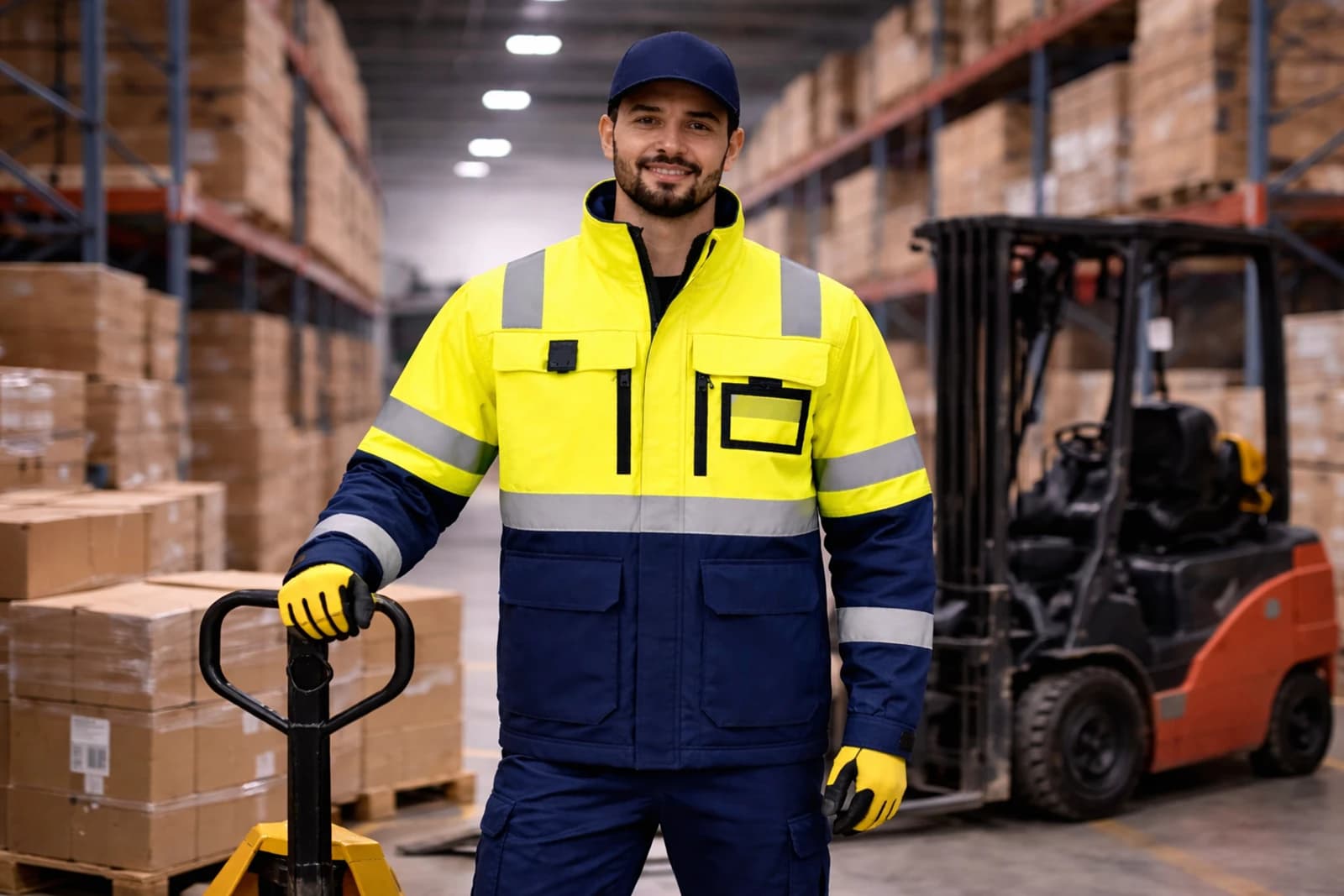
Hi-Vis Safety Jacket
Reflective safety jacket for high-visibility site operations and road work crews.