Logistics Polo Uniform: Sourcing Durable & Professional Work Polo Shirts for Middle East Warehousing, Shipping & E-Commerce Fulfilment
Middle East logistics and warehousing operators — from DP World and Dubai South to Saudi Arabia's Dammam Logistics Zone — require polo uniforms that balance professional appearance, heat-adapted fabric, and bulk durability for distribution centre crews. This article covers what B2B buyers in the GCC and wider MENA region should look for when sourcing logistics polo uniforms from a Chinese workwear manufacturer: fabric weight and breathability for 50°C warehouse floors, anti-pilling performance over repeated industrial wash cycles, colour-fastness under intense UV, custom-branded embroidery options for company logos, and inclusive sizing for multinational crews. Includes recommended product pairings for a complete logistics uniform programme.

Buyer context
What procurement teams run into
Middle East logistics operators — from port-side distribution centres at Jebel Ali Free Zone (JAFZA), Dubai South's Logistics District, and Saudi Arabia's Dammam Logistics Zone to last-mile fulfilment hubs in Riyadh, Jeddah, Doha, and Abu Dhabi — face a set of persistent uniform challenges that a retail-grade cotton polo shirt simply cannot solve. The polo uniform in a logistics setting is not a casual Friday garment. It is a functional uniform worn 10–12 hours per day, six days a week, by warehouse pickers, inventory clerks, forklift operators, shipping coordinators, and gate security personnel in ambient temperatures that regularly hit 45–50°C, often in non-air-conditioned warehouse bays, container yards, and truck loading docks. **1. Heat and sweat management — the core fabric challenge.** The most common failure point for polo uniforms in Middle East logistics environments is fabric weight and breathability. Standard 200–220 gsm cotton or cotton-polyester blend polo shirts absorb sweat, trap heat against the skin, and become heavy and uncomfortable within the first two hours of a shift. When a warehouse picker in a 48°C Dubai summer afternoon wears a polo that does not wick moisture, productivity drops, heat stress incidents rise, and uniform replacement requests increase. The solution is a lightweight (160–180 gsm), high-wicking performance fabric — typically 65% polyester / 35% cotton pique knit or 100% moisture-wicking polyester with a matte finish — that draws perspiration away from the skin and dries quickly. For B2B buyers sourcing from China, specifying the exact GSM, fibre blend, and moisture-wicking standard (e.g. AATCC 195 or JIS L 1096) in the technical specification sheet is essential to get consistent fabric quality across bulk production runs of 1,000–10,000 units. **2. Anti-pilling and wash durability under industrial laundering.** Logistics polo uniforms at distribution centres are typically industrially laundered 2–3 times per week, which means a uniform polo experiences 100+ industrial wash cycles per year. At 30–50 wash cycles (roughly 5 months for a daily-worn polo), pilling appears on the collar, cuffs, and torso seams of low-grade fabric — giving the uniform a worn-out, unprofessional appearance. Warehouse shift managers in Dammam have reported needing to replace polo uniforms every 6 months purely because the fabric pills and fades, despite the garment being structurally intact. The procurement fix is to specify anti-pilling fabric treatment (e.g., enzyme bio-polishing or singeing + mercerisation for cotton-rich blends, or textured filament polyester for synthetic blends that resist fibrillation), paired with a flatlock or taped collar seam construction that resists fraying. Asking the Chinese manufacturer for Martindale abrasion test results (minimum 25,000 cycles for logistics-grade fabric) and wash-fastness certificates (ISO 105 C06 for colour change after 20 washes at 60°C) allows the B2B buyer to validate fabric performance before committing to a bulk order. **3. UV and colour-fastness under Gulf sun.** A logistics polo uniform worn at outdoor loading docks, container yards, and gate checkpoints in Saudi Arabia, UAE, Qatar, or Oman is exposed to high-UV solar radiation for 6–8 hours per day. Standard reactive-dyed polo shirts — especially in dark navy, black, and royal blue (the most common corporate colours for logistics operators) — fade visibly within 3–4 months, turning navy to a patchy purplish-grey and turning black to a washed-out charcoal. This is not just an aesthetic issue: faded company colours reduce the professional first impression that logistics operators want to project to visiting clients and 3PL partners. The solution is to specify vat dyes or reactive dyes with a minimum light-fastness rating of ISO 105 B02 Blue Wool Scale 5–6, and to request a Xenon-arc accelerated light-fastness test report from the manufacturer. An additional practical measure is double-needle stitching on the collar and placket, which prevents the collar warping and fading at the fold line — a common failure mode even when the main fabric retains its colour. **4. Logo embroidery and branding quality.** Logistics operators invest heavily in brand recognition — every truck, warehouse, and uniform is a moving billboard. The uniform polo is typically embroidered with the company name or logo on the left chest (and sometimes the right sleeve) using a multi-head embroidery machine. The challenge with mass-produced polo uniforms from low-cost suppliers is that embroidery quality varies: thread tension loosens after 10–20 washes, causing the logo to pucker, fray, or detach; poor digitisation results in uneven stitching on the company's Arabic or English brand name; and oversized embroidery hoops stretch the fabric permanently around the logo zone. For a B2B buyer sourcing 2,000–5,000 polo uniforms for a logistics hub like Dubai South or Riyadh's Second Industrial City, the solution is threefold: (a) specify a woven or embroidered logo patch (sewn-on rather than direct embroidery) for thicker polyester-based polo fabric that resists puckering; (b) set maximum embroidery dimensions (e.g. 100 mm width × 40 mm height, with density ≤ 5,000 stitches per square inch) to avoid distorting the fabric; and (c) request a pre-production sample of the embroidered logo in the specified colour Pantones so the procurement team can approve the appearance before production begins. **5. Sizing for multinational logistics crews.** Middle East logistics centres draw labour from a broad geographic pool — loaders and forklift drivers from India, Pakistan, Bangladesh, Nepal, and Sri Lanka; supervisors and coordinators from Egypt, Jordan, Lebanon, and the Philippines; and management and safety officers from local Gulf nationals, Europe, and North America. Body proportions across this workforce vary enormously: a loader from Nepal (160 cm, 55 kg) and a shift manager from Canada (188 cm, 100 kg) both need to wear the same uniform model with a proper fit. If the polo sleeves are too long for the Nepali loader, the cuffs hang over the wrist and can get caught in conveyor belts. If the collar is too tight for the Canadian manager, it creates pressure marks and visible discomfort during client meetings. The procurement fix is inclusive sizing from XS to 5XL with proportional grading — meaning the chest, waist, sleeve length, and body length all scale together rather than simply widening the garment — and to request a size-run sample set (smallest, median, and largest size) before mass production. A Chinese manufacturer with experience in Middle East uniform contracts will typically have size charts that align with GCC sizing standards (e.g. Saudi SASO sizing guidelines) and can adjust body-length-to-sleeve-length ratio for different nationality profiles. **6. Compliance with UAE & Saudi uniform regulations.** While polo uniforms for logistics staff do not require the flame-resistant or hi-vis certifications needed for oil and gas coveralls, they must nevertheless comply with applicable UAE, Saudi, and GCC standards for garment safety: non-flammable fabric certification for materials used in environments where the garment must meet low-flammability requirements (e.g. EN ISO 14116 or Saudi SASO 2883 for non-FR workwear); lead, nickel, and azo-dye content compliance for occupational garments (OEKO-TEX Standard 100 Class II certification is the accepted benchmark); and — if the polo is worn on the tarmac near aircraft — anti-static classification per EN 1149-5 (for staff working at cargo terminals and apron areas in DWC, AUH, and RUH airports). The uniform polo itself does not need to pass NFPA or EN ISO 11612 flame standards, but every B2B buyer should request a compliance documentation pack from the Chinese manufacturer: a Supplier Declaration of Conformity (SDOC), the OEKO-TEX certificate, and the fabric test report for non-flammability and wash-fastness, in English and ideally Arabic translation, so that the procurement team can submit the dossier to the facility's HSE department. The combined requirement for Middle East logistics operators: a 160–180 gsm moisture-wicking polo, anti-pilling rated to 25,000+ Martindale cycles, UV light-fastness grade 5+, with an embroidered or sewn-on logo option, inclusive sizing XS–5XL with proportional grading, and a full compliance pack in English/Arabic — delivered at a bulk CIF cost per unit that fits within the operator's uniform budget line, on a 30–45 day production-to-delivery timeline to Jebel Ali, Dammam, or Hamad Port.
Sourcing approach
How a factory partner can respond
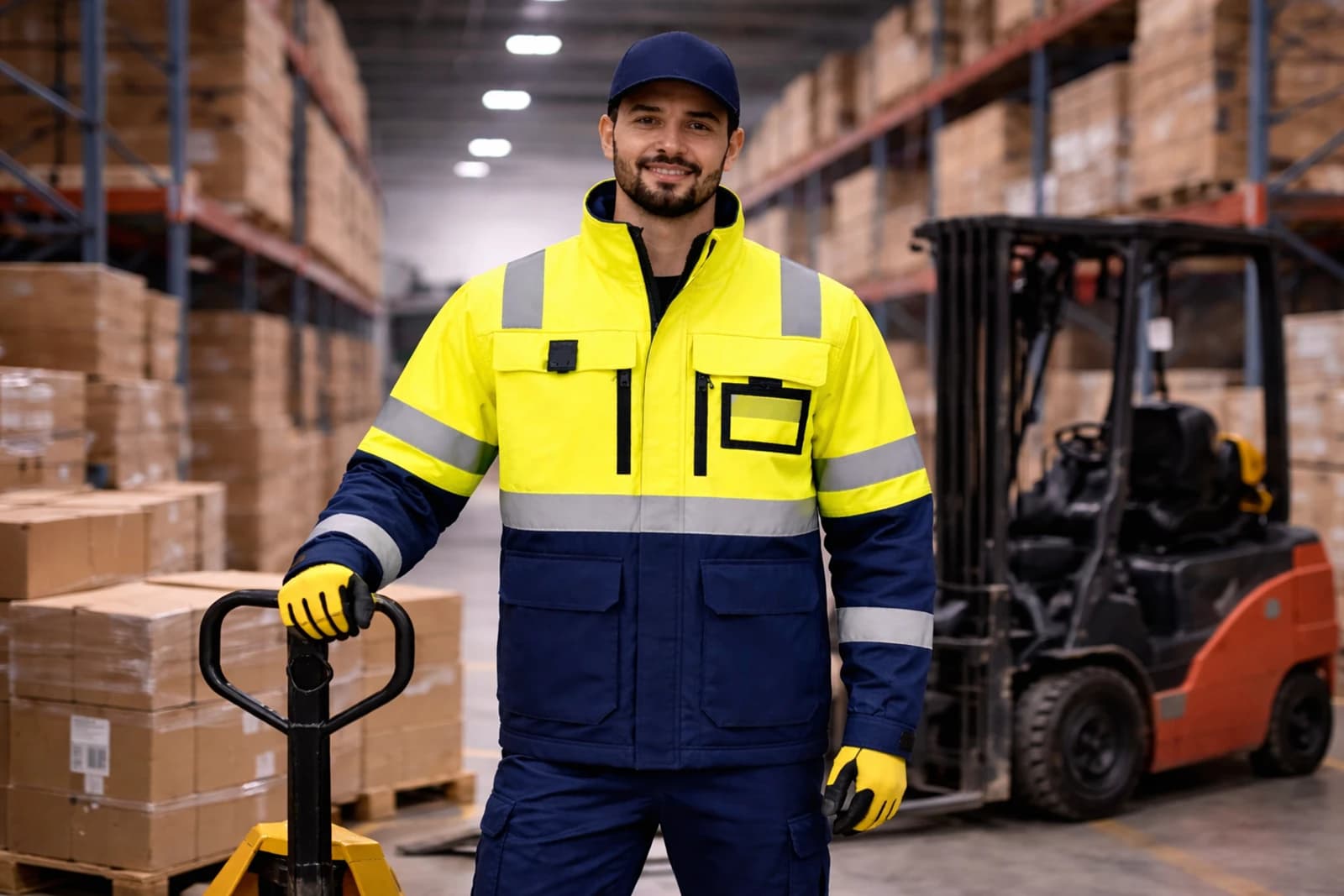
Sidaier's logistics polo uniform is purpose-built for the rigours of Middle East warehousing, shipping, and e-commerce fulfilment. At 160–180 gsm with a 65% polyester / 35% cotton pique knit or 100% moisture-wicking performance fabric, the logistics polo keeps crews cool on 50°C warehouse floors and loading docks. Anti-pilling fabric treatment and double-needle stitching deliver 100+ industrial wash-cycle performance without visible wear. UV light-fastness grade 5+ (ISO 105 B02) ensures that navy, black, royal blue, and charcoal company colours stay true under Gulf sun. Custom logo embroidery or woven patches, inclusive sizing from XS to 5XL, and a full compliance pack (OEKO-TEX Class II, non-flammability test report, Supplier Declaration of Conformity in English and Arabic) make this a turnkey polo solution for logistics operators across the GCC and wider MENA region. Pair with the hi-vis safety jacket for yard and loading area staff who need high-visibility compliance when working near moving vehicles, forklifts, and container-handling equipment. The combination of a comfortable, professional polo base with a certified hi-vis outer layer creates a complete tiered uniform programme for any logistics facility.
Recommended Products
Products that fit this use case

Logistics Uniform
Logistics Polo Uniform
Breathable uniform polo for warehouse, delivery, and last-mile teams.
Safety Uniform
Hi-Vis Safety Jacket
Reflective safety jacket for high-visibility site operations and road work crews.