Logistics Polo Uniforms That Survive Gulf Heat & Warehouse Work: A B2B Sourcing Guide from a Chinese Manufacturer
Warehouse and logistics workers across the Middle East — from Dubai's Jebel Ali port to Dammam's King Abdulaziz Port and the sprawling e-commerce fulfilment centres of Riyadh — wear polos every single shift. But a standard office polo is not a logistics polo. Logistics work means forklift operators climbing in and out of cabs, dock workers bending and lifting in 45°C heat, and pickers in non-air-conditioned warehouses sweating through eight-hour shifts. This guide for Middle East B2B buyers sourcing from a Chinese workwear manufacturer covers polo fabric selection for Gulf humidity and heat, durability standards for industrial laundering, colour and branding considerations for fleet identity, sizing across diverse workforces, and volume procurement strategies for teams of 100 to 10,000+ workers.

Buyer context
What procurement teams run into
The Middle East logistics sector is booming. Jebel Ali alone handles over 14 million TEU annually, Saudi Arabia's logistics sector is projected to grow to nearly $32 billion by 2030, and e-commerce fulfilment is expanding rapidly across the GCC. That means hundreds of thousands of warehouse operators, dock workers, drivers, and supervisors all need uniforms that can take a beating.\n\nMost procurement managers default to whatever polo their office staff wear — and that's a mistake. A logistics polo faces completely different demands: frequent industrial washing, heat and humidity, abrasion from equipment and packaging, and the need to project brand identity while remaining comfortable enough for physical work.\n\n**1. Fabric selection — the Gulf heat challenge**\n\nThe single biggest factor in logistics polo performance in the Middle East is fabric. Gulf warehouses are often not fully air-conditioned, dock doors open constantly, and summer ambient temperatures hover near 45°C with humidity above 60% in coastal cities like Dubai, Dammam, and Muscat.\n\nFabric options from Chinese manufacturers:\n\n- **65/35 polyester-cotton piqué (180-210 gsm):** The most common choice for Middle East logistics polos. The cotton provides moisture absorbency and comfort; the polyester adds durability, colour retention, and quick-drying properties. Piqué knit structure enhances airflow versus flat jersey. This blend survives industrial washing well and resists the pilling that kills cheaper polos.\n- **100% polyester moisture-wicking knit (140-160 gsm):** Best for extreme heat performance. Hydrophobic fibres wick sweat to the surface where it evaporates, keeping the worker drier than cotton. But pure polyester can trap odours and requires antimicrobial or silver-ion treatment. Many Gulf buyers choose this for outdoor yard workers and drivers rather than indoor pickers.\n- **Cotton-rich piqué (90/10 or 85/15 cotton-poly):** Premium option for supervisor and management roles. Softer against skin and more breathable in dry heat, but shrinks more and holds strains from oil and grime. Not recommended for frontline warehouse roles that face frequent washing.\n- **Mesh-back or vented polos:** For the hottest roles (dock workers, yard operations, outdoor drivers), a mesh panel under the arms and across the back dramatically improves airflow. Chinese manufacturers can add mesh panelling to a standard piqué polo at minimal cost — a feature Gulf buyers increasingly specify.\n\n**2. Durability — surviving industrial laundering**\n\nLogistics uniforms get washed harder than office uniforms. GCC hospitality laundries and in-house industrial wash programs use higher temperatures (60-75°C), strong detergents, and heavy mechanical agitation. A polo that lasts 50 washes in an office setting may survive only 20 in a warehouse laundry.\n\nKey durability factors to specify:\n\n- **Reinforced collar and placket:** The collar and button placket are the first failure points. Specify a collar with a fused interlining that won't curl after repeated washing, and bar-tacking at the placket base. Seamless (knitted) collars hold shape better than cut-and-sew collars.\n- **Pearl or metal buttons instead of plastic:** Plastic buttons crack, melt, or discolour in industrial washing and ironing. Pearl-effect buttons (polyester-resin, not real shell) or coated metal buttons survive hundreds of cycles. For safety-critical zones, specify breakaway buttons that snap under tension — required in some environments to prevent strangle hazards.\n- **Double-needle stitching on all major seams:** Side seams, shoulder seams, and hem should be double-needle or coverstitch. Cheap single-needle seams unravel after 15-20 washes.\n- **Sublimation-free colour:** Dark colours like navy and black hide grime but can fade to grey after industrial washing. Specify reactive-dyed or pigment-dyed fabric with a tested wash-fastness of 4+ on the grey scale. For high-visibility elements, ensure the print or embroidery doesn't crack and flake.\n\n**3. Hi-vis — the non-negotiable layer**\n\nLogistics environments mix pedestrians with moving equipment — forklifts, pallet jacks, yard trucks, and port equipment. EN ISO 20471 hi-visibility requirements apply to workers exposed to vehicle traffic, and many GCC logistics operators now mandate hi-vis polos for all warehouse staff, not just yard teams.\n\n- **Class 2 hi-vis polo:** Standard for warehouse and dock work. Requires a minimum area of fluorescent background material plus retroreflective tape. In polo form, this means fluorescent body panels (usually the torso and sleeves in hi-vis yellow or orange) with reflective tape across the chest and shoulders.\n- **Combining hi-vis with corporate colours:** Logistics operators often want their brand colours preserved. A common compromise: fluorescent body with corporate-colour collar, cuffs, and side panels. Ensure the fluorescent background still meets the minimum area requirement after adding brand elements — a common spec failure.\n- **Hi-vis for drivers:** HGV and light-vehicle drivers need EN ISO 20471-compliant garments too, but mobility in the cab matters. A short-sleeve hi-vis polo is usually sufficient for drivers who don't leave the vehicle; those who make frequent deliveries need the full vest or jacket layer.\n\n**4. Sizing and fit for a diverse workforce**\n\nThe Middle East logistics workforce spans dozens of nationalities and body types — tall and broad-shouldered European supervisors, compact South Asian pickers, and everything in between. A uniform programme that fails on fit creates discomfort, low morale, and uneven brand presentation.\n\n- **Offer a wider size range:** XS through 4XL, plus short and tall variants for key sizes. Chinese manufacturers can produce a size-run matrix that covers most GCC workforces. Ask for a graded size specification table so you can verify the increments are consistent.\n- **Relaxed-fit vs. slim-fit:** Logistics workers perform physical tasks — bending, reaching, lifting. Slim-fit polos restrict movement and look bad after a day's work. Specify a regular or relaxed fit with adequate sleeve length and a longer back hem that stays tucked in.\n- **Regional sizing standards:** Gulf buyers often find that Asian-size charts run smaller than EU/US expectations. Specify sizing based on actual garment measurements (chest, waist, length) rather than nominal size labels, and ask your Chinese manufacturer to accommodate both Asian and Western size profiles if your workforce is mixed.\n\n**5. Branding — logo placement and durability**\n\nFor logistics companies, the polo is a mobile billboard. Every employee on every shift carries the brand. But branding that fails looks worse than no branding at all.\n\n- **Embroidery vs. sublimation vs. heat transfer:** Embroidery (left chest, back, or sleeves) is the most durable for industrial washing but adds weight and can pucker on light fabrics. Sublimation printing is permanent — the dye becomes part of the fabric — but limited to lighter-coloured garments. Heat-transfer vinyl is cheapest but cracks after repeated washing. Most Gulf logistics operators choose embroidery for the chest logo and heat-transfer for smaller brand marks.\n- **Placement:** Standard placement is left chest (80-120mm wide), with back prints (200-300mm) for visibility in traffic or warehouse environments. Add reflective or hi-vis trim around printed logos when the polo is exposed to vehicle zones.\n- **Consistency across reorders:** Insist on brand approval of the first article before bulk production, and require your manufacturer to freeze the logo artwork and placement specifications for all future reorders. Colour drift across production batches is a common problem — specify Pantone values and require in-line QC on colour.\n\n**6. Procurement strategy — volume, lead time, and quality**\n\nA logistics uniform programme is a recurring spend, and smart Middle East buyers treat it as such.\n\n- **Volume breaks:** Chinese manufacturers offer meaningful per-unit price reductions at 500, 1,000, and 5,000-piece thresholds. For fleets of 100, a single bulk order of 300-400 pieces per style (accounting for sizing distribution) makes sense. For fleets of 1,000+, negotiate 12-month frame agreements with staggered deliveries.\n- **Sea freight vs. air freight:** Polo shirts are light and compressible. A 20-foot container holds roughly 15,000-25,000 polos depending on packing. Sea freight from China to Jebel Ali or Dammam takes 15-25 days; air freight takes 3-5 days but costs 4-5× more. For urgent top-ups, many Gulf buyers keep a small air-freight buffer stock.\n- **QC and audit:** Insist on pre-shipment inspection (PSI) from a third-party agency or your manufacturer's own QC team with written reports. Verify wash-fastness, colour consistency, sizing, and stitch quality on a random sample of 5-10% of each batch. A Chinese manufacturer with ISO 9001 and a documented QC process is worth the premium.\n- **Seasonal rotation:** Gulf logistics uniforms typically run on a 12-18 month replacement cycle, sometimes two uniforms per year per worker for heavy-use roles. Build the replacement cadence into your contract so you're never caught short during Ramadan or peak e-commerce seasons (Black Friday, summer sales) when the whole workforce is deployed.\n\n**Bottom line for Gulf buyers**\n\nThe right logistics polo is not a commodity — it's a performance garment with different specs from an office polo. Fabric weight and blend, collar construction, button quality, hi-vis compliance, sizing range, and branding durability all matter. A Chinese manufacturer that understands Gulf heat, industrial washing, and the logistics environment can deliver a polo that looks professional shift after shift, keeps workers comfortable in 45°C heat, and survives 100+ industrial washes — at a unit price that makes sense for fleets of any size.
Sourcing approach
How a factory partner can respond
The right logistics polo is a performance garment engineered for warehouse and port environments, not a repurposed office uniform. Spec a 65/35 poly-cotton piqué (or moisture-wicking polyester for extreme-heat roles), reinforced collar and placket, metal or pearl buttons, double-needle stitching, and EN ISO 20471 hi-vis compliance where workers mix with vehicles. Offer relaxed-fit sizing across a wide range, use durable embroidery for branding, and build a volume-based procurement plan with pre-shipment inspection and seasonal replacement cadence. A Chinese manufacturer with Gulf experience can deliver polos that survive 100+ industrial washes and keep workers comfortable and on-brand across every shift.
Recommended Products
Products that fit this use case

Logistics Uniform
Logistics Polo Uniform
Breathable uniform polo for warehouse, delivery, and last-mile teams.
Safety Uniform
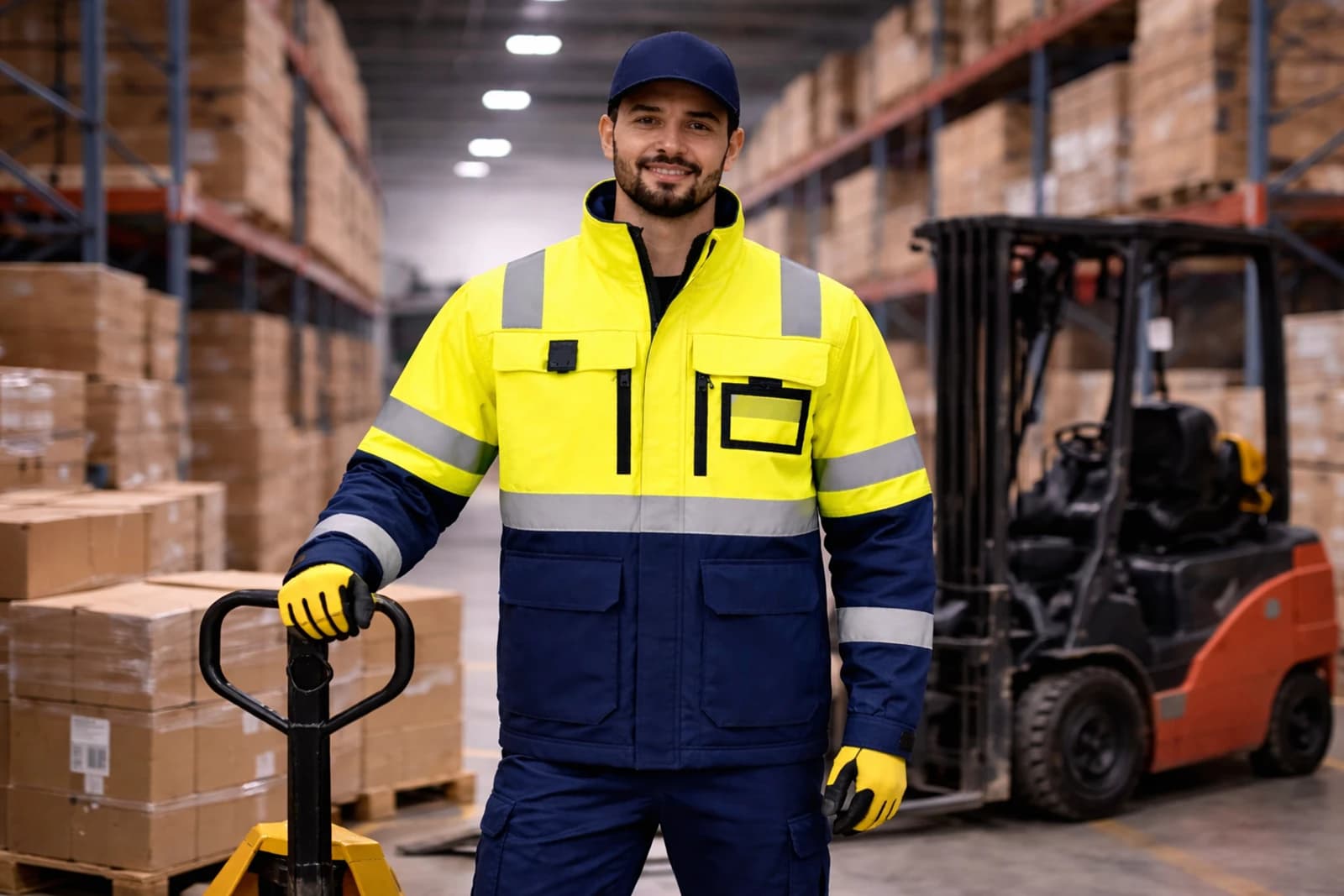
Hi-Vis Safety Jacket
Reflective safety jacket for high-visibility site operations and road work crews.