Logistics Polo Uniform for GCC Warehousing & Supply Chain: A B2B Sourcing Guide
From Dubai's JAFZA warehouses and Riyadh's logistics parks to Doha's Hamad Port container terminals and Abu Dhabi's Khalifa Industrial Zone, the Logistics Polo Uniform is the most-worn garment across the Middle East's logistics workforce. This guide helps GCC B2B buyers source moisture-wicking, durable, brand-able polo workwear from a Chinese manufacturer — covering fabric performance for 35°C–50°C warehouse and outdoor logistics environments, anti-static and FR compliance for hazardous zones, fleet branding longevity, and bulk procurement for national logistics operators.

Buyer context
What procurement teams run into
The GCC logistics and supply chain sector is one of the fastest-growing in the world, with the regional logistics market valued at over $60 billion in 2026. Saudi Arabia's Vision 2030 logistics ambitions (targeting 5th place globally on the Logistics Performance Index), UAE's massive investments in Jebel Ali Port expansion and Dubai South logistics corridor, and Qatar's Hamad Port-driven trade growth have created unprecedented demand for uniformed logistics workers — warehouse operators, forklift drivers, cargo handlers, delivery personnel, and cross-dock supervisors. For B2B buyers sourcing the Logistics Polo Uniform from a Chinese workwear manufacturer, several specific challenges emerge: **Extreme heat in warehouses and outdoor yards:** GCC warehouse interiors routinely reach 38°C–45°C even with ventilation — outdoor container yards, tarmac areas, and loading docks can exceed 50°C in summer months (May–September). Standard 100% cotton polo shirts absorb sweat, become heavy and saturated within 30–45 minutes, fail to dry during shift, and cause heat-related discomfort, reduced concentration, and increased accident risk. Workers in non-breathable synthetics face skin irritation and overheating. **Anti-static and FR compliance for hazardous zones:** Logistics workers in chemical warehouses, fuel depots, oil & gas logistics compounds, and airport ground handling require anti-static properties (EN 1149-5) and/or flame-resistant performance (EN ISO 11612) in their uniform. Many GCC free zones and industrial cities (JAFZA, KIZAD, King Abdullah Economic City) mandate these standards for any worker entering classified hazardous areas. Generic polo uniforms from non-specialised suppliers fail these certifications, forcing operators to issue separate garments for different zones. **Fleet branding retention through industrial laundering:** Logistics companies operate their own or contracted industrial laundries with high-temperature washing (85°C), aggressive detergents, and heavy spin cycles. Logo embroidery on collars, chest heat-transfer prints, and company colour-matching must survive 50–80 industrial wash cycles without cracking, peeling, fading, or shrinking. Standard screen-printed or low-temp heat-transfer logos on budget polo shirts fail within 15–25 washes, creating unprofessional fleet appearance and rebranding costs. **Moisture management and odour control across 12-hour shifts:** GCC logistics shifts for warehouse and delivery operations often run 10–12 hours in peak season (Ramadan, Eid, Black Friday, Hajj logistics). Polo uniforms must manage moisture continuously, resist odour buildup from bacterial growth in humid conditions (60–90% relative humidity in coastal ports and warehouses), and maintain a professional appearance through to the end of shift. Sweat-stained, odorous uniforms are a hygiene complaint and a brand liability for logistics companies with customer-facing delivery staff. **Sizing consistency across diverse workforces:** GCC logistics workforces are multicultural — South Asian, Southeast Asian, Arab, African, and expatriate workers from Europe and the Americas with significantly different body proportions. Standard single-market sizing (e.g., Asia or Europe-only) leads to poor fit: sleeves too short for long-armed workers, torsos too short for tall workers, collar gaping on shorter-necked workers. Returns, exchanges, and ill-fitting uniforms reduce workforce morale and increase procurement costs.
Sourcing approach
How a factory partner can respond
A properly specified Logistics Polo Uniform from an experienced Chinese workwear manufacturer addresses each of these GCC logistics challenges: **High-performance moisture-wicking pique knit fabric:** Specify a 65% polyester / 35% cotton pique knit fabric at 210–230 gsm with moisture-wicking treatment. The polyester content provides wicking capability (vertical wicking height above 80 mm per 30 minutes per AATCC 197), while the cotton content maintains the professional, non-shiny appearance required for customer-facing logistics roles. Request interlock knit for collar and cuffs (to prevent curling and stretching after laundering) with a minimum of 80% polyester / 20% cotton blend. Chinese manufacturers using Turkish or domestic combed cotton yarns with moisture-wicking treatment can achieve drying time under 3 hours (JIS L 1096) — a critical performance metric for warehouse and outdoor logistics workers in 40°C+ heat. **EN 1149-5 anti-static and FR options integrated into polo design:** For buyers requiring zone compliance, specify the polo with carbon-fibre anti-static yarn (5 mm grid spacing, EN 1149-5 certified) woven into the fabric during knitting, eliminating the need for a separate garment layer. For flame-resistant requirements, specify a 60% modacrylic / 38% cotton / 2% carbon fibre anti-static FR fabric at 240–260 gsm, certified to EN ISO 11612 (A1 B1 C1) and ASTM D6413. The key advantage is a single polo that passes both workplace dress code and hazardous zone entry requirements — reducing the garment SKU count for warehouse operators who manage mixed-zone logistics parks. Chinese workwear manufacturers offering EN 1149-5 and EN ISO 11612 test reports from CNAS-accredited labs (equivalent to UKAS or DAkkS) provide documentation accepted by GCC regulatory authorities. **Industrial-laundry-grade logo durability with silicone heat-transfer:** Require silicone-based heat-transfer logos (not PVC or screen-print) applied at 160°C–180°C with 20–25 second dwell time, achieving adhesion strength above 15 N/25 mm (ISO 8510-1). For embroidered logos, specify minimum 12,000 stitches per logo with non-shrink polyester embroidery thread and backing material that withstands 85°C industrial washing (ISO 15797). Request 50-cycle industrial wash test samples before production — Delta E colour fastness below 2.0 (ISO 105 C06), shrinkage under 3% in both directions (ISO 5077). Chinese manufacturers with dedicated industrial-laundry test facilities can provide pre-production wash-test reports within 5 working days. **Silver-ion antimicrobial odour control with 50+ wash durability:** Specify a zinc-pyrithione or silver-zeolite antimicrobial finish (Oeko-Tex Standard 100 and EU BPR compliant) applied during the garment's final dye bath, not as a topical spray. The finish should achieve over 99% bacterial reduction against Staphylococcus aureus and Klebsiella pneumoniae (AATCC 100) and retain efficacy through 50 industrial washes. For the most demanding logistics operators (Hajj & Umrah logistics, perishable cold-chain, pharmaceutical distribution), specify additional UPF 50+ sun protection and moisture-activated temperature regulation (PCM phase-change microcapsules) for workers operating in direct outdoor sun during 45°C–50°C summer months. **Multi-market size grading system:** The ideal Logistics Polo Uniform supplier offers a combined size matrix covering Asian (S-5XL), European (XS-4XL), and US (S-5XL) sizing with sleeve-length options (regular/tall) and torso-length grades (short/regular/long). Propose production based on comprehensive measurement charts collected from actual GCC workforce anthropometric data — chest 88–152 cm, waist 72–120 cm, sleeve length 74–94 cm — rather than standard single-market size tables. Chinese manufacturers experienced in Middle East apparel export maintain size-block libraries specific to Gulf workforces, reducing fit-related returns to under 2% compared to the industry average of 8–12% for non-specialised sizing.
Recommended Products
Products that fit this use case

Logistics Uniform
Logistics Polo Uniform
Breathable uniform polo for warehouse, delivery, and last-mile teams.
Safety Uniform
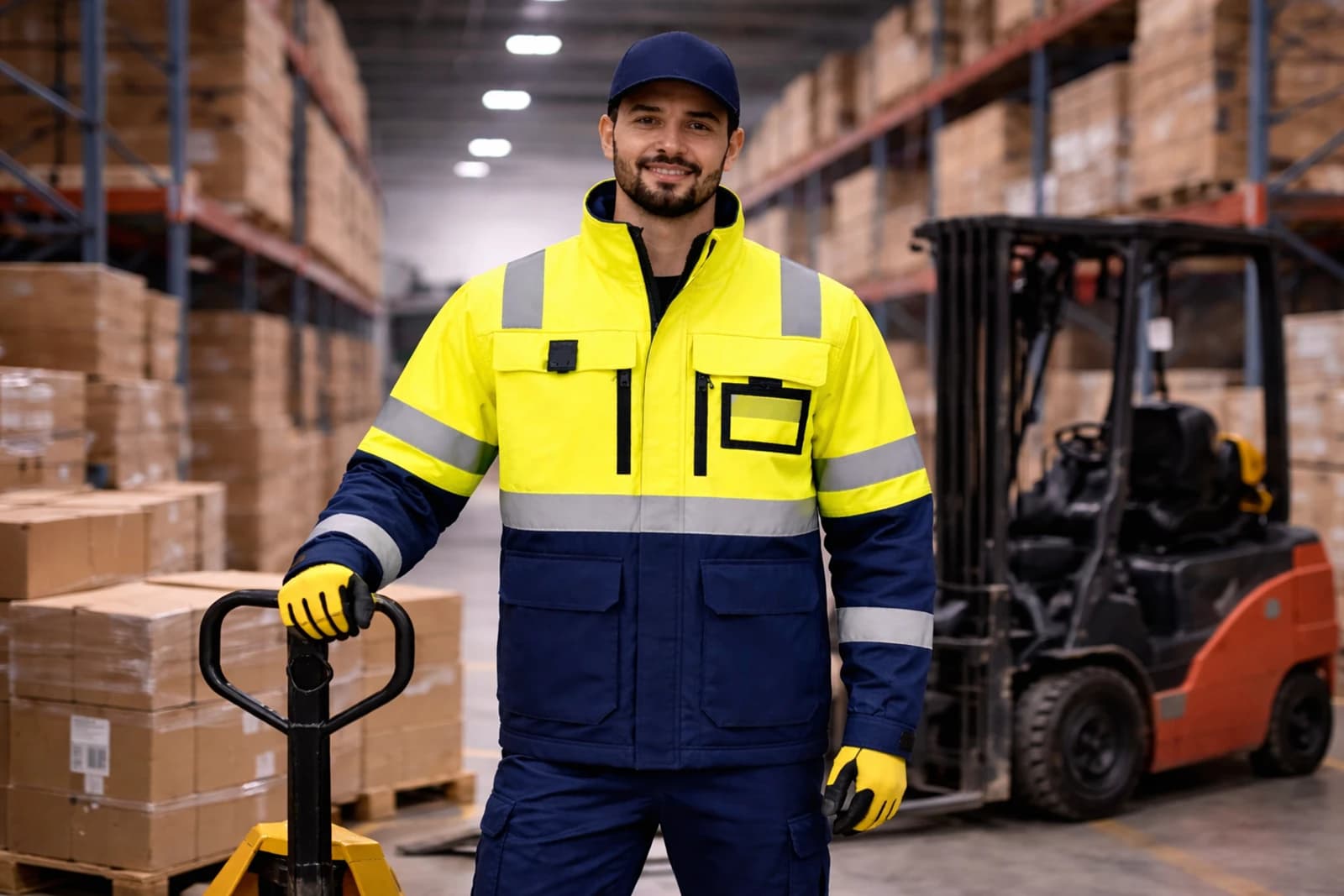
Hi-Vis Safety Jacket
Reflective safety jacket for high-visibility site operations and road work crews.