Logistics Polo Uniforms & Hi-Vis Safety Jackets for Middle East Warehouses: A B2B Sourcing Guide from a Chinese Manufacturer
The Middle East logistics sector is booming — Dubai's Jebel Ali, Saudi Arabia's new 3PL corridors, and Qatar's growing cold-chain networks are driving massive demand for warehouse workwear. Unlike construction sites, logistics environments have their own demands: indoor-outdoor temperature swings, hi-vis compliance near forklift traffic, breathability for fast-paced picking work, and the need for professional uniforms that double as company branding. This guide for Middle East B2B buyers sourcing from a Chinese workwear manufacturer covers fabric selection for polo uniforms across GCC climates, hi-vis jacket standards (EN ISO 20471 Class 2 and Class 3), layering strategies for warehouse staff moving between cold storage and outdoor loading docks, embroidery and branding options, and bulk procurement considerations for logistics operators of 100-10,000+ workers.

Buyer context
What procurement teams run into
Logistics is one of the fastest-growing sectors in the Gulf. Dubai's Jebel Ali Free Zone alone hosts over 8,700 companies and handles roughly 12 million TEUs annually. Saudi Arabia's Vision 2030 is building out new logistics corridors connecting Riyadh, Jeddah, and the Eastern Province. Qatar's growing cold-chain infrastructure and Bahrain's expanding warehousing capacity all point the same direction: there are hundreds of thousands of warehouse workers across the GCC who need proper uniforms. Unlike construction garments, logistics workwear has a different set of requirements that Middle East B2B buyers need to understand: - **Indoor-outdoor temperature variance:** Warehouse workers move between air-conditioned storage halls (often 18-22°C) and outdoor loading docks (35-50°C in summer). A single garment that works in both environments is the challenge. - **Forklift and vehicle traffic:** EN ISO 20471 hi-vis compliance is critical wherever forklifts, pallet jacks, or delivery trucks operate. Visibility saves lives. - **Professional branding:** Logistics companies in the Gulf compete heavily on service quality. Uniforms with embroidery or logo prints are a direct reflection of company professionalism to clients. - **High-frequency washing:** Warehouse uniforms get washed frequently (often daily in summer). Fabric and trim must survive 50+ industrial washes without degrading. **1. Polo uniforms — the GCC logistics staple** The performance polo has become the default upper garment for Middle East logistics staff. Here's why it works: - **Climate comfort:** A quality polo in a 200-220 gsm piqué knit (65% polyester / 35% cotton or 100% polyester with moisture-wicking finish) offers breathability for fast-paced work while looking professional enough for client-facing roles. - **Fabric choices:** For GCC summers, specify moisture-wicking polyester or polyester-rich blends with anti-odour treatment. Cotton-rich polos breathe well but hold sweat longer and are heavier when wet. Many Gulf logistics companies now standardise on 100% polyester with a honeycomb or bird-eye knit structure for superior airflow. - **Collar and cuffs matter:** Ribbed collars with a structured inner band keep their shape through repeated washing. Many cheap polos collapse at the collar after 10 washes — a visible sign of poor quality on a warehouse floor. - **Colour fastness:** Over 50% of GCC logistics polo uniforms are dark-coloured (navy, black, deep green) or feature company accent colours. Specify colour fastness to ISO 105-C06 (washing) and ISO 105-B02 (light) at Grade 4 or higher. The Gulf sun is brutal on dyes — dark navy can fade to purple after a few months of outdoor work if the dye quality is poor. **2. Hi-vis jackets — EN ISO 20471 compliance for the Gulf** Wherever warehouse staff work near vehicle traffic, hi-visibility clothing is mandatory. The governing standard is **EN ISO 20471**, which defines three classes of visibility based on the amount of fluorescent and retroreflective material: - **Class 1:** Minimum area — suitable for low-risk, off-road environments. Rarely sufficient for active forklift zones. - **Class 2:** The Gulf logistics default for warehouse and dock workers. Requires at least 0.50 m² of fluorescent material and 0.13 m² of retroreflective tape (for garments with sleeves). Appropriate for workers who operate near forklift traffic but not on public roads. - **Class 3:** The highest level — 0.80 m² fluorescent and 0.20 m² retroreflective material. Required for workers on or adjacent to public roads (e.g., delivery drivers and those who exit vehicles on highways). Gulf safety regulations (UAE OSHAD, Saudi SASO, Qatar Civil Defence) generally require Class 2 or Class 3 hi-vis for anyone working in vehicle-active zones. A common error is buying cheap Class 1 vests and assuming they cover forklift zones — they typically do not. **3. The layering system — solving the indoor-outdoor problem** The smart procurement strategy for GCC warehouses is a two-piece layering system: - **Base/mid layer: Polo uniform** — worn in air-conditioned halls and as the professional uniform layer. - **Outer layer: Hi-vis softshell jacket or lightly padded hi-vis jacket** — worn when moving outdoors, in cold storage areas, or in early morning/late evening shifts when temperatures drop. For summertime outdoor work, a lightweight **hi-vis mesh or air-weave jacket** (unlined, with hi-vis fabric panels and retroreflective tape) is the workhorse. In winter (November-February), a **lined hi-vis softshell or padded jacket** with a water-repellent outer shell handles the 15-25°C daytime range and cooler nights. Key design details for Gulf hi-vis jackets: - **DWR (durable water repellent) finish** on the outer shell — especially for ports and coastal operations where humidity and sea spray are constant. - **Ventilation:** Underarm mesh gussets and a breathable back panel convert a standard hi-vis jacket into something wearable at 40°C. This is the single most specified upgrade in Gulf logistics tenders. - **Phone and radio pockets:** Warehouse floor workers need secure pockets for scanners, radios, and phones. Reinforced and flap-secured pockets are a practical must-have. - **Retroreflective tape quality:** Specify tape with a certified EN ISO 20471 rating (the reflective backing must meet the standard's minimum retroreflection values). Cheap tape loses reflectivity after 10-20 washes — the standard requires the tape to remain functional for the garment's rated wash cycle. **4. Branding — embroidery and print that survives** Logistics companies across the Gulf use uniforms as mobile advertising. Branding requirements to specify with your Chinese manufacturer: - **Embroidery:** Chest logos and back branding in polyester thread. Specify a minimum of 40,000-50,000 stitches per logo for durability on polo fabric. Embroidery on the left chest of a polo is the industry standard placement. - **Heat-transfer or PVC print:** For numbers, names, and rear jacket branding, heat-sealed transfer prints are durable and cost-effective at scale. Specify transfers rated for 50+ industrial washes. - **Placement compliance:** On hi-vis jackets, branding must not cover or reduce the effective fluorescent or retroreflective area below the EN ISO 20471 minimums. Your manufacturer should work within these constraints — a good one will flag the issue before production. **5. Bulk procurement strategy for 100-10,000+ worker fleets** When sourcing logistics uniforms from a Chinese workwear manufacturer for GCC operations, structure your tender around these points: - **Tiered sizing:** GCC logistics workforces include significant South Asian, Filipino, Egyptian, and Levantine labour. Specify size mapping that covers up to 3XL-4XL with chest/waist/inseam measurements, not just label sizes. Require your supplier to provide size spec sheets before production. - **ISO 9001 factory certification** at minimum, with documented QC checkpoints (fabric inspection, colour checking under D65 light, seam strength testing, and finished-garment dimensional checks). - **MOQ flexibility:** For pilot programs of 100-500 units, expect MOQs of 300-500 pieces per SKU. For fleet-wide programs of 5,000+, negotiate lower per-unit pricing with scheduled production releases. - **Delivery lead times:** Typical production for polo uniforms is 30-45 days, and hi-vis jackets 45-60 days, from confirmed order to FOB Chinese port. Factor in GCC import and customs time (5-14 days depending on destination). - **Replacement stock agreements:** Negotiate a standing agreement for 10-15% replacement stock availability — warehouse turnover means lost and damaged uniforms are a constant cost. **6. Why source from China for Middle East logistics workwear** Chinese workwear manufacturers have become the preferred source for Gulf logistics operators for several reasons: - **Cost competitiveness:** Production costs for polo uniforms and hi-vis jackets in China remain 30-50% lower than equivalent EU or Turkish production, even after shipping and duties. - **Certification experience:** Leading Chinese factories already hold EN ISO 20471, EN ISO 13688, and ISO 9001 certifications — they know how to document compliance for Gulf tenders that require third-party test certificates. - **Flexibility at scale:** From 200-unit pilot runs to 50,000-unit fleet programs, Chinese factories can scale production without sacrificing quality control. - **Customisation depth:** Embroidery, printing, custom colours, custom fabrics, and even custom sizing charts are all standard offerings — not premium add-ons. **7. Common pitfalls to avoid** - Buying Class 1 vests for forklift zones — insufficient for vehicle-active areas - Skipping third-party certification requests — supplier self-declarations are not enough for Gulf tenders - Ordering Asian-only sizing without providing a full size-mapping sheet - Selecting non-wicking fabrics for summer polos — staff will switch to personal T-shirts if official uniforms are too hot - Not specifying wash-cycle ratings for hi-vis tape and reflective materials - Ordering branded hi-vis jackets without checking that logos don't reduce the effective reflective area
Sourcing approach
How a factory partner can respond
For Middle East B2B buyers sourcing logistics workwear from a Chinese manufacturer, the winning approach combines the right garments with the right specifications: **1. Standardise on a two-piece uniform system.** A moisture-wicking performance polo (200-220 gsm, polyester or poly-cotton blend, in company colours with embroidery) serves as the base layer for indoor and client-facing work. A certified hi-vis jacket (EN ISO 20471 Class 2 as the Gulf logistics standard, Class 3 for road-adjacent roles) provides the outer layer for forklift zones, loading docks, and outdoor movement. **2. Insist on EN ISO 20471 third-party certification.** Do not accept supplier self-declarations. Request the actual SGS, TÜV, or Intertek test certificates for both fluorescent material area and retroreflective tape performance before bulk production. This is non-negotiable for Gulf tenders. **3. Specify GCC-specific fabric treatments.** For polos: moisture-wicking finish, anti-odour treatment, and colour fastness Grade 4+ to ISO 105-C06/B02. For hi-vis jackets: DWR finish on the shell, underarm mesh gussets, and a breathable back panel for summer wearability. These specifications separate quality suppliers from commodity sellers. **4. Build a layering strategy, not a single-garment solution.** Warehouse staff need different coverage at different times of day and in different zones. A polo + hi-vis vest/jacket system covers the full range of indoor, dock, cold-storage, and outdoor conditions across the GCC year. **5. Plan for fleet scale.** Structure your tender with tiered pricing for 100-500 (pilot), 500-5,000 (standard program), and 5,000+ (fleet rollout) unit volumes. Negotiate replacement stock at 10-15% of the initial order to cover turnover. Allow 30-60 days production time plus 5-14 days for GCC import and customs. **6. Work with a certified Chinese manufacturer that knows Gulf tenders.** The right partner offers EN ISO 20471 and ISO 9001 certifications, documents compliance with third-party test reports, provides full size-mapping for multi-national Gulf workforces, and flags compliance issues (like logo placement on hi-vis areas) before production rather than after delivery.
Recommended Products
Products that fit this use case

Logistics Uniform
Logistics Polo Uniform
Breathable uniform polo for warehouse, delivery, and last-mile teams.
Safety Uniform
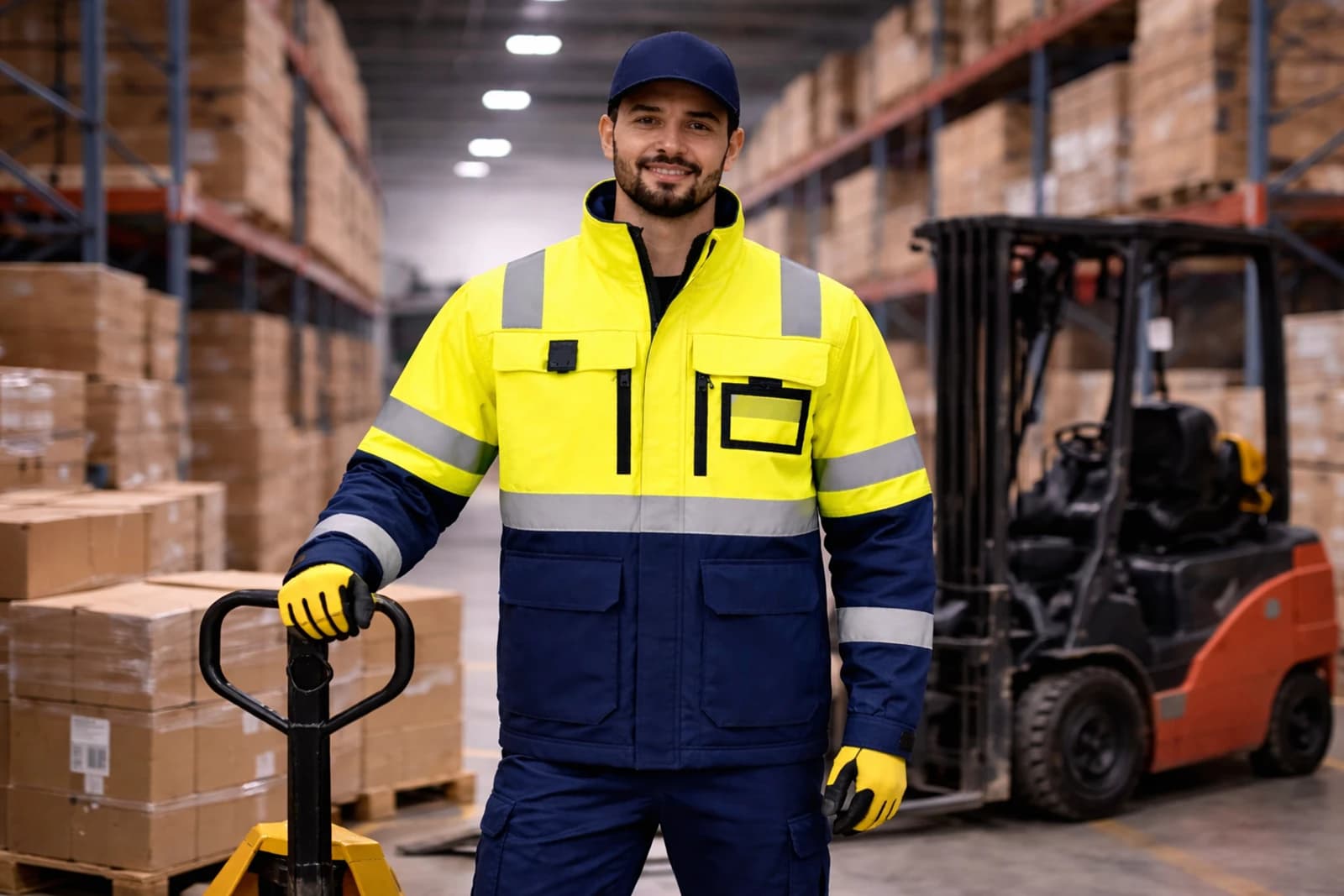
Hi-Vis Safety Jacket
Reflective safety jacket for high-visibility site operations and road work crews.