Logistics Polo Uniform & Hi-Vis Safety Jacket: B2B Sourcing Guide for Middle East Buyers
From Dubai's Jebel Ali Port and Saudi Arabia's logistics mega-cities like Riyadh and Jeddah industrial zones to Qatar's Hamad Port operations and Kuwait's Shuwaikh cargo hubs — the Logistics Polo Uniform paired with a Hi-Vis Safety Jacket is the go-to warehouse and yard workwear combination across the Gulf. This guide helps Middle East B2B buyers source high-visibility, breathable, professional-grade logistics uniforms from a Chinese workwear manufacturer, covering fabric specifications for hot-climate warehouse environments, modular layering systems for yard-to-office transitions, custom branding for fleet identity, and bulk procurement strategies for 3PL operators, port authorities, and express logistics companies.

Buyer context
What procurement teams run into
The Middle East logistics sector is experiencing explosive growth — the GCC logistics market is projected to exceed $95 billion by 2027, driven by e-commerce expansion, mega-infrastructure projects, and the region's strategic position as a transshipment hub between Asia, Europe, and Africa. For B2B buyers sourcing the Logistics Polo Uniform and Hi-Vis Safety Jacket from a Chinese workwear manufacturer, several distinct challenges emerge: **Extreme heat in warehouse and yard environments:** Gulf summer temperatures exceed 50°C, with warehouse interiors (even those with cooling systems) regularly hitting 35–40°C. Standard polyester-cotton polo shirts (typically 65/35 or 80/20 poly-cotton at 180–220 gsm) trap heat and moisture, leading to heat stress and reduced worker productivity. Workers in logistics yards and loading docks wearing non-breathable hi-vis vests over standard polos report 25–40% lower performance during peak afternoon hours (12:00–16:00). The challenge is finding a polo that combines moisture-wicking performance, UV protection, and professional presentation in a single garment. **Hi-vis durability in sun-exposed yards:** Hi-Vis Safety Jackets and vests in the Middle East face relentless UV exposure — Saudi Arabia and the UAE average 3,500+ sunlight hours per year. Standard EN ISO 20471-compliant hi-vis materials (fluorescent yellow/orange polyester with retroreflective tape) degrade rapidly: background fluorescence drops by 40–60% within 3–4 months of daily outdoor exposure per ISO 105-B02 (xenon-arc lightfastness testing), putting workers at risk during night-shift operations when visibility is most critical. **Layering that works for indoor-to-outdoor transitions:** Logistics workers constantly move between air-conditioned offices/warehouses (18–22°C) and sun-exposed yards/loading docks (40–50°C). A single-layer polo is too cold indoors; a jacket alone is too hot outdoors. The ideal system requires a breathable lightweight base layer (the polo) and a modular, packable outer layer (the hi-vis jacket) that can be donned/doffed in seconds without interrupting workflow. Most standard hi-vis jackets marketed to the region are either too heavy (300+ gsm winter-weight) or too flimsy (single-skin mesh that offers no wind or dust protection). **Professional image for client-facing logistics operations:** Third-party logistics (3PL) providers, courier companies, and port operators send workers directly into client warehouses, retail loading bays, and residential delivery zones. A faded, pilled, or mis-fitting polo projects an unprofessional brand image. For Saudi Vision 2030 logistics cities (King Abdullah Economic City, Jeddah Islamic Port, Riyadh Dry Port) and UAE free zones (JAFZA, Dubai South, KIZAD), uniforms must maintain crisp appearance through 50+ industrial wash cycles at 60–75°C. **Sizing diversity in multi-national workforces:** The Middle East logistics workforce includes South Asian, Southeast Asian, Arab, and African workers — spanning vastly different body types. Standard Asian or Western sizing charts fail to accommodate this diversity. A Nepali warehouse picker and a Sudanese forklift operator may wear the same size code but have completely different shoulder-to-waist ratios, arm lengths, and torso heights. **Compliance fragmentation across free zones and ports:** Middle East logistics operators must navigate multiple jurisdictions: Dubai's Trakhees and Dubai Municipality standards, ADNOC yard requirements, Saudi SASO certification, Qatar's MME (Ministry of Municipality and Environment), and individual free zone authority specs. A hi-vis garment that meets EN ISO 20471 Class 3 for a JAFZA warehouse may not meet the additional spark-resistant requirements for a Ruwais industrial zone yard. Buyers need a single supplier whose garments satisfy multiple overlapping compliance frameworks.
Sourcing approach
How a factory partner can respond
A properly specified Logistics Polo Uniform and Hi-Vis Safety Jacket system from an experienced Chinese workwear manufacturer addresses each of these logistics-sector challenges directly: **Performance-fabric polo for hot-climate logistics:** The ideal polo fabric for Middle East logistics is a 65% polyester / 35% cotton pique knit at 180–200 gsm with moisture-wicking finish. This construction delivers: - Moisture management class 3–4 per AATCC 195 (MMT test — liquid moisture transport) — sweat is wicked from skin to fabric surface within 3–5 seconds - UV protection UPF 50+ per AS/NZS 4399 for outdoor yard workers - Air permeability above 200 mm/s per ISO 9237 — critical for 40°C+ warehouse environments - Anti-pill rating of 4 (ISO 12945-2, 2,000 cycles) — polos stay crisp through 50+ washes - Dimensional stability within ±2% after 5 wash cycles (ISO 6330) — no collar curling or sleeve shrinkage Request also a salt-water perspiration fastness test (ISO 105 E04) — Gulf workers perspire heavily, and poor fastness causes neckline staining and colour bleeding that makes uniforms look worn after just 2–3 wear cycles. Fastness should be grade 4–5 for both colour change and staining across all colours including dark navy and black (commonly used for logistics branding). **UV-resistant hi-vis with certified fluorescence retention:** Specify hi-vis background fabric with UV-stabilised polyester yarn (UV absorber additive at 1.5–2.5% of polymer weight, or UV-stabilised masterbatch integrated during fibre extrusion). Request these specific performance metrics: - Fluorescence retention: minimum 85% of initial luminance after 100 hours xenon-arc exposure per ISO 105 B04 (vs. standard 40–50% retention without UV stabilisers) - Colour fastness to light: minimum grade 5 per ISO 105 B02 (blue wool scale) for background fluorescent material - EN ISO 20471 Class 3 certification — minimum 0.80 m² of fluorescent background material for complete jacket coverage - Retroreflective tape: EN 471 class 2 with 50 mm minimum tape width, 360° circumferential coverage for 24-hour visibility operations **Modular layering system for indoor-outdoor transitions:** The Logistics Polo + Hi-Vis Jacket should function as a true layering system: - The polo has a single-stitch collar stand and flat-knit cuffs — slim enough to sit comfortably under the jacket without bunching - The hi-vis jacket is a 2.5-layer bonded construction: 100% polyester micro-ripstop outer shell (120 gsm), breathable TPU membrane (water column 5,000 mm, MVTR 5,000 g/m²/24h), and soft mesh lining — packable into a built-in pocket bag (26 cm × 20 cm × 8 cm compressed) - Full front YKK #5 vislon zip with chin guard; 270° reflective tape configuration (two horizontal bands at chest and waist, one around each sleeve, one at shoulder) - Hidden napoleon pocket for mobile devices/scanners, D-ring attachment point for keys/badge reels - Ventilation grommets (8 mm, nickel-free) under both arms for heat release during loading tasks - Detachable hood with stow-away collar — hood deploys for unplanned rain or dust storms in GCC desert yards (sandstorms, shamal winds) **Professional brand presentation through garment construction details:** Logistics uniforms serve as mobile brand assets. Specify these construction details for premium appearance: - Herringbone twill tape inside back neck seam (covers raw edge, prevents fraying, accepts woven brand label) - Reinforced four-needle flat-bed shoulder seams for yoke-shaped back — prevents delamination under backpack/gadget belt wear - Pearlised snap button fastening at polo placket (3-button configuration with reinforced buttonhole, top button at collar point) — avoids metal detection alarm issues at airport/port security screening zones - Double-needle hemmed sleeves and bottom — prevents curling during industrial laundering - High-density polyester thread (Tkt No. 50, 3‑ply) for all seams — resists 85°C laundry temperatures without melting or shrinkage **Inclusive sizing architecture for multi-national workforces:** Dedicated sizing with expanded coverage for the Middle East's diverse workforce: - Combine Asian sizing (XS–5XL in 5 cm height increments) with a Western muscular-fit supplementary block — the same garment code, two fit patterns - Key adaptations: +15 mm at upper arm circumference for forklift operators who develop more muscular shoulders; +20 mm at seat width for workers who stand all day; +10 mm neck band circumference per size to accommodate AC exposure-related tension in trapezius muscles - Offer all sizes in Tall (+3 cm torso, +4 cm sleeve) and Short (−2 cm torso, −2 cm sleeve) variants — critical for Nepali (avg. 163 cm) vs. Sudanese (avg. 178 cm) populations working side by side in UAE logistics hubs **Multi-jurisdiction compliance certification packages:** A single documentation set that satisfies the Gulf's fragmented compliance landscape — require your Chinese manufacturer to provide: - EN ISO 20471 Class 3 certification from a notified EU body (e.g., BSI, SGS, TÜV SÜD) — accepted by all GCC countries - UAE ESMA compliance certificate for imports through UAE ports (mandatory for JAFZA, Dubai South, KIZAD) - SASO Certificate of Conformity for Saudi-bound orders (mandatory via Saudi Standards, Metrology and Quality Organization) - Fire/smoke resistance test report for hi-vis jacket material meeting BS 5852 or EN 1021-1/2 cigarette test — increasingly required by Saudi and ADNOC yard safety officers - REACH and Oeko-Tex Standard 100 Class II certification for all textile components — increasingly expected by regional 3PL clients with EU-aligned sustainability policies - Batch-level test reports (not just type certificates) — every 500‑unit production batch tested for fluorescence luminance and retroreflective coefficient per EN 20471
Recommended Products
Products that fit this use case

Logistics Uniform
Logistics Polo Uniform
Breathable uniform polo for warehouse, delivery, and last-mile teams.
Safety Uniform
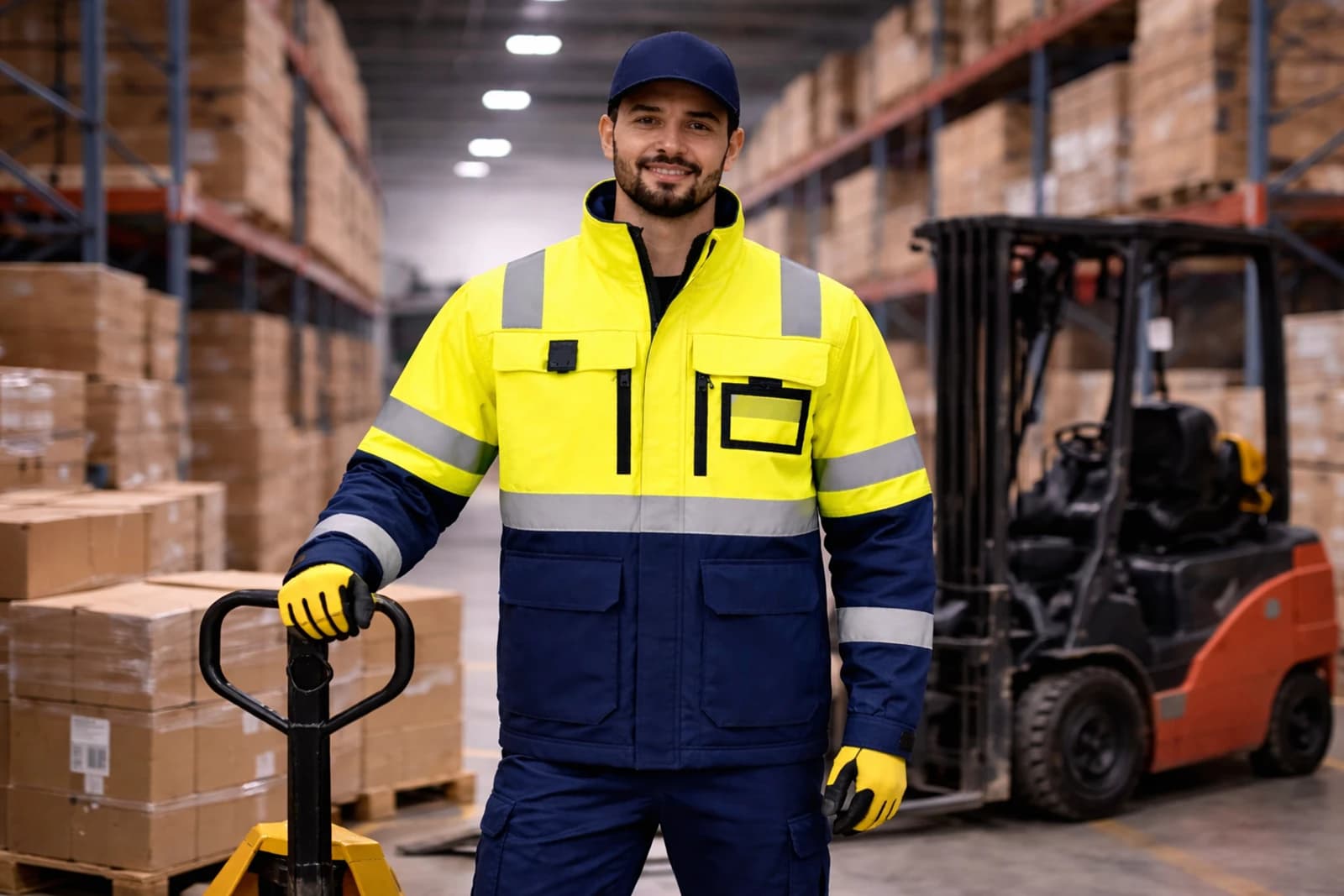
Hi-Vis Safety Jacket
Reflective safety jacket for high-visibility site operations and road work crews.