Logistics Polo Uniforms for Middle East B2B Buyers: Sourcing from a Chinese Workwear Manufacturer
From Dubai's DP World to Saudi Arabia's NEOM logistics hubs, the Middle East logistics and warehousing sector demands polo uniforms that combine professional corporate appearance with practical performance in extreme heat. For B2B buyers sourcing from a Chinese workwear manufacturer, this guide covers quick-dry moisture-wicking fabric specifications, colorfastness standards under intense UV exposure, embroidery vs. heat-transfer branding for corporate identity, and bulk procurement strategies for 5,000–50,000+ unit contracts.

Buyer context
What procurement teams run into
The Middle East logistics and warehousing sector is undergoing unprecedented expansion. DP World's portfolio spans 82 marine and inland terminals across 50 countries, with its flagship Jebel Ali Port in Dubai handling 19 million TEU annually—and expanding to 30 million TEU by 2030. Saudi Arabia's National Industrial Development and Logistics Program (NIDLP) targets $1 trillion in logistics sector investment by 2030, anchored by NEOM's Oxagon (the world's largest floating industrial complex), King Abdullah Economic City, and the Riyadh Integrated Logistics Zone. Qatar's Hamad Port expansion and the UAE's Khalifa Industrial Zone (KIZAD) combined will add 5 million square meters of warehousing space by 2028. Total GCC logistics workforce is projected to grow from 2.1 million to 3.5 million workers by 2030—each requiring branded corporate workwear. For Middle East B2B buyers sourcing logistics polo uniforms from a Chinese workwear manufacturer, the specific technical, branding, and logistics challenges are significant: **Moisture-wicking fabric performance in 55°C ambient conditions:** Standard 100% cotton polo shirts—the default specification from many Chinese suppliers—are dangerously unsuitable for GCC logistics work. Cotton absorbs sweat, becomes heavy and clingy at 75%+ saturation, takes hours to dry in 10-30% ambient humidity, and causes rapid heat stress and chafing in workers handling packages in non-air-conditioned warehouses and loading docks. The ambient temperature inside a non-insulated metal warehouse roof in Dubai or Dammam can reach 65°C in July, classifying it as an ISO 7243 WBGT (Wet Bulb Globe Temperature) extreme heat stress zone requiring a work-to-rest ratio of 15 minutes work / 45 minutes rest without appropriate moisture-management apparel. Buyers must specify polo uniforms constructed from: - 65% polyester / 35% cotton or 100% polyester interlock knit (180-220 gsm) with documented moisture-wicking properties - Minimum absorbency requirement: vertical wicking per AATCC TM197 ≥ 100mm in 30 minutes (warp direction) - Drying rate per AATCC TM199: ≥ 0.15 mL/hour evaporation rate - Fabric air permeability per ASTM D737: minimum 100 cfm at 0.5 inches water pressure—critical for heat dissipation - Advanced specifications: some large GCC logistics operators (such as Aramex, Agility, and Al-Futtaim Logistics) now require fabric with UPF 50+ rating (AS/NZS 4399) for workers with prolonged outdoor exposure, and silver-ion antimicrobial treatment per ISO 20743 to prevent odor buildup in high-humidity sweat zones (underarms and back) Many Chinese workwear factories can deliver high-quality polyester-cotton pique knit or interlock fabrics at $2.80-$4.50/yard FOB, but buyers must verify that moisture-wicking claims are backed by third-party lab reports from SGS, Intertek or Bureau Veritas—not the factory's own spec sheet. A common problem: factories claim "moisture-wicking" for standard polyester-cotton fabric that has no hydrophilic finish applied, resulting in only 20-40mm wicking (vs. the required 100mm+). **Colorfastness under aggressive GCC UV and washing conditions:** The GCC has UV Index 9-11 during 8 months of the year (extreme category per WHO classification). Chinese-manufactured polo uniforms dyed with reactive or direct dyes (the most common and cheapest dye category) typically show visible fading within 50-100 hours of UV exposure—equivalent to about 2-4 weeks of outdoor logistics work in Jeddah or Doha. Additionally, GCC industrial laundries use: - Wash temperatures of 70-85°C (higher than European standard 60°C) - Hard water with 200-500 ppm TDS (total dissolved solids) - Sodium hypochlorite (bleach) for sanitation in some facilities - Aggressive industrial detergents with pH 10-12 Buyers must require China suppliers to use vat dyes or fiber-reactive dyes with: - Lightfastness per ISO 105-B02: minimum Grade 5 (8-class scale) for 20-hour Xenon-arc exposure—not the Grade 6 (5-class scale) that many factories quote, which is a different scale - Wash fastness per ISO 105-C06: minimum Grade 4-5 at 60°C wash with perborate bleach - Perspiration fastness per ISO 105-E04: minimum Grade 4 (acidic and alkaline) - Rubbing fastness per ISO 105-X12: minimum Grade 4 (dry) and Grade 3-4 (wet)—critical for collar and cuff areas that contact vehicle seatbelts, delivery truck steering wheels, and cardboard boxes A practical tip for B2B buyers: request 50-hour accelerated UV testing (ISO 105-B02) on pre-production samples and compare against your approved color standard (Pantone or RAL). Many Chinese factories that achieve Grade 4-5 on their first submission will try to downgrade to Grade 3-4 "standard production quality" on bulk orders—insist on maintaining the pre-production grade in the quality agreement. **Corporate branding: embroidery vs. heat-transfer vs. woven labels:** Middle East logistics companies—from major players like Agility (Kuwait), Tristar (Dubai), and Al-Futtaim Logistics (Dubai)—place extreme importance on crisp, professional corporate branding on polo uniforms. The brand appears on chest logo, sleeve logo, and often collar back. Each method has specific requirements: - Embroidery (the gold standard for GCC corporate workwear): Requires 40,000-60,000 stitches minimum for full-color logos (corporate identities in the GCC increasingly use multi-color gradients and fine detail). Key specification: maximum stitch density of 6 stitches/mm² to prevent fabric puckering on knit polo materials. Embroidery thread must be: polyester (not rayon, which fades in UV), with minimum UV resistance of 200 hours (AATCC 16.3). For large logistics fleets (500+ polo shirts per order), buyers should request lockstitch backing—not fusible (cut-away) backing—because fusible backing breaks down under GCC laundry conditions within 10-15 washes and leaves adhesive residue on the inside of the collar. Additionally, embroidery positioning must be specified with ±3mm tolerance (a common issue: Chinese factories often embroider chest logos 15-25mm lower than Western/GCC expectations because of different body proportion patterns). - Heat-transfer vinyl (HTV) or silicone transfers: Suitable for smaller logos (under 50mm diameter) or where logo complexity exceeds embroidery capability (e.g., photorealistic gradients). Important: most Chinese factories use standard PVC heat transfers that yellow and crack after 20-30 industrial washes. Buyers must require premium polyurethane (PU) or silicone-based transfers with documented: minimum 50-wash durability (ISO 6330, Reference Washing Machine Type A, 60°C, tumble dry), minimum peeling resistance of 15 N/inch (ASTM D903), and temperature resistance from -20°C to +80°C (critical for delivery workers who move between 55°C yard temperatures and 4°C cold storage zones). - Woven labels (for collar interior sizing): Must have sealed edges to prevent fraying; minimum 200 dpi weave resolution for small text. Common issue: Chinese factories use woven labels with raw-cut edges that unravel within 5-10 washes. Specify laser-cut or heat-sealed edge finishing. **Sizing challenges across the Middle East workforce:** The GCC logistics workforce is among the most ethnically diverse in the world: South Asian workers from India, Pakistan, Bangladesh, Nepal, Sri Lanka; Filipino workers; Egyptian, Yemeni, Jordanian, and Syrian Arab workers; GCC nationals; and African workers from East and West Africa. Most Chinese factories default to Asian sizing (Small through 5XL) which runs significantly different from GCC composite sizing profiles. Buyers must provide detailed size specifications to the factory, ideally based on measurement of 200 representative workers from their target workforce. Key considerations: - Collar-to-cuff sleeve length: For GCC logistics workers, order sleeve lengths 3-5cm longer than Asian standard (workers spend 50%+ of work time with arms extended forward—handling packages, driving forklifts, operating pallet jacks) - Chest and waist differential: South Asian body types typically have a 15-18cm chest-to-waist difference; Arab body types 18-22cm; African body types 12-15cm. Standard Chinese polo patterns have a flat-chested, 12cm differential—resulting in tight-shoulder, loose-waist fit. - Neck circumference: Important for polo collars that must accommodate radio lanyards and ID card straps - Sample size protocol: Request 3 graded samples across the size range (small, medium large; or M, XL, 3XL) for wearer trials before bulk production **Bulk procurement, MOQs, and lead times for GCC logistics companies:** Chinese workwear factories typically have minimum order quantities (MOQs) of: 500-1,000 pieces per color per style (ex-factory), with 1,500-3,000 pieces per color as a more comfortable operational MOQ. For large GCC logistics operators ordering annual programs across multiple divisions (warehouse staff, drivers, supervisors, corporate staff—each with different color specifications), a consolidated order of 10,000-50,000 polo shirts across 3-5 colors represents a typical annual program. Key procurement considerations: - Fabric lead time: For standard polyester-cotton pique knit (in-stock greige fabric that is dyed to order): 20-30 days for dyeing + finishing - Garment production lead time: 25-40 days for first order (includes pattern digitization, grading, sample approval, 3-5 rounds of sample revision) - Quality inspection: Recommend in-line inspection at 30% completion and final AQL 2.5 inspection per ISO 2859-1 - Testing protocol: Third-party SGS/Intertek physical testing of pre-shipment samples (moisture wicking, UV colorfastness, wash durability) - Packaging for GCC: Individual polybag with dehumidifying silica gel packs (ship container humidity + temperature variation on a 25-day sea freight to Jebel Ali or Dammam causes mold on organic cotton blends if not properly packaged) - Shipping: FOB Shanghai/Ningbo, 6-8 weeks sea freight to Jebel Ali, Dammam, Hamad, or Shuwaikh ports
Sourcing approach
How a factory partner can respond
For Middle East B2B buyers ready to source logistics polo uniforms from a Chinese workwear manufacturer, here is a practical procurement framework: **1. Fabric specification checklist** Specify 65/35 polyester-cotton pique knit or 100% polyester interlock at 180-220 gsm with documented moisture-wicking (AATCC TM197 ≥ 100mm), drying rate (≥ 0.15 mL/hr), and air permeability (≥ 100 cfm). Include UPF 50+ and antimicrobial treatment for premium specifications. Always verify with third-party SGS/Intertek test reports—accept factory data only when accompanied by external lab certificates. **2. Color and UV fastness requirements** Specify vat dyes with lightfastness ISO 105-B02 minimum Grade 5 (8-class scale), wash fastness ISO 105-C06 minimum Grade 4-5, and rubbing fastness ISO 105-X12 minimum Grade 4/3-4. Pre-production 50-hour accelerated UV testing is non-negotiable—match against Pantone/RAL standards. **3. Professional branding** For embroidery: 40,000-60,000 stitches, polyester thread, lockstitch (cut-away) backing, ±3mm positioning tolerance. For heat transfers: PU/silicone, 50-wash durability, 15 N/inch peel resistance. Require sealed-edge woven labels for collar interior. **4. Sizing for diverse workforce** Provide factory with measured specifications from your target workforce, not Asian sizing defaults. Request 3 graded samples for wearer trials. Specify longer sleeve lengths and adjusted chest-to-waist differentials for South Asian, Arab, and African body types. **5. Lead time and MOQ planning** Allow 50-75 days total for first order (fabric dyeing 20-30 days + production 25-40 days + QC + shipping). Consolidate annual needs into 10,000-50,000 piece orders across 3-5 colors. Plan ordering 60-90 days before seasonal demand peaks (Ramadan/September-December e-commerce peak, summer peak for pilgrimage logistics).
Recommended Products
Products that fit this use case

Logistics Uniform
Logistics Polo Uniform
Breathable uniform polo for warehouse, delivery, and last-mile teams.
Safety Uniform
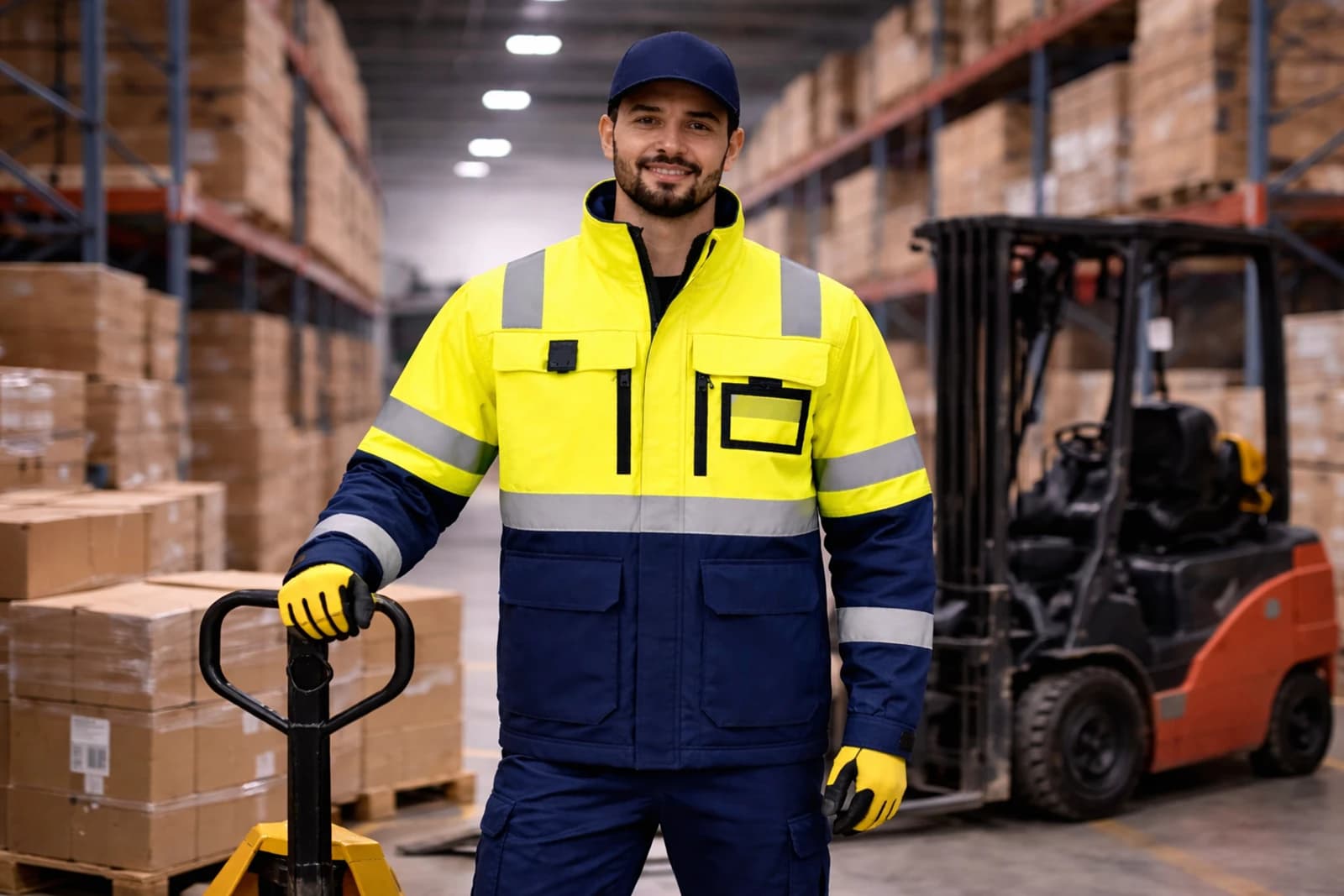
Hi-Vis Safety Jacket
Reflective safety jacket for high-visibility site operations and road work crews.