Logistics Polo Uniforms for Middle East E-Commerce & Courier Fleets: A B2B Sourcing Guide
From Noon.com and Talabat to Aramex and Saudi Post, logistics polo uniforms are the face of Middle East e-commerce. This guide helps B2B buyers source high-quality, heat-friendly polo uniforms from a Chinese manufacturer — covering moisture-wicking fabrics for Gulf summers, branding durability for fleet identity, bulk sizing for multinational workforces, and cost-effective procurement for operations with thousands of driver and warehouse staff.

Buyer context
What procurement teams run into
The Middle East e-commerce market is projected to exceed $50 billion by 2027, with Saudi Arabia's digital retail sector growing at 17% CAGR and the UAE's e-commerce market already surpassing $8 billion. This rapid expansion drives massive demand for logistics uniforms — polo shirts being the most ubiquitous choice for delivery drivers, warehouse pickers, and last-mile couriers.\n\nFor B2B buyers sourcing logistics polo uniforms from a Chinese workwear manufacturer, several recurring challenges must be addressed:\n\n**Heat management in 50°C Gulf summers:** The standard 180–200 gsm pure cotton polo shirt commonly used in European logistics fleets becomes a soaking, heat-stroke-inducing garment within 15 minutes of delivery work in a Riyadh or Dubai summer. A delivery driver making 40–60 stops per shift in 48°C ambient heat with 90% solar radiation needs fabric that actively manages moisture. Chinese manufacturers now offer dual-fabric polos: a 65% polyester / 35% cotton pique knit with moisture-wicking hydrophilic finish (160–180 gsm) that pulls sweat to the fabric surface where it evaporates, reducing skin wetness by 40–60% compared to pure cotton. For extreme heat zones (July–August in the Eastern Province or Abu Dhabi's inland areas), 100% micro-polyester polos with Coolmax-style channeled fibres perform best — they dry 3–4× faster than cotton and weigh just 130–150 gsm. However, these pure-polyester polos require careful specification of anti-static treatment (EN 1149-5 compliant) where drivers enter ATEX-classified warehouse zones, and they lack the "natural cotton hand feel" that some GCC corporate brands prefer for customer-facing roles.\n\n**Anti-static requirements in warehouse and fuel station environments:** Many Middle East logistics hubs — including DP World's Jebel Ali Free Zone, Saudi Arabia's Dammam logistics park, and UAE's KIZAD — have zones classified as ATEX 137 or IECEx hazardous areas where flammable vapours or dusts may be present. Standard polyester polo shirts (especially 100% synthetic) can generate static charges of 2–4 kV in dry warehouse conditions, sufficient to ignite solvent vapours near fuel delivery or chemical handling. The common solution: logistics polo uniforms incorporating carbon-filament conductive fibres (typically 1–3% by weight, woven as a grid or stripe pattern on the reverse side), certified to EN 1149-5 with surface resistance below 2.5 × 10⁹ Ω. Buyers should verify that their Chinese manufacturer offers separate anti-static (ATEX-compliant) and standard (non-ATEX) polo variants, or a single hybrid design meeting both requirements — and confirm the certification applies to the complete garment, not just the fabric roll.\n\n**Logo and brand identity durability under UV and repeated washing:** A courier fleet's polo uniform is its primary mobile branding asset. Disappearing logos — whether via UV-faded embroidery, cracked heat-transfer vinyl, or peeling screen prints — undermine brand perception at every doorstep delivery. In GCC conditions (UV Index 11+ for half the year), standard screen-printed logos on polyester-blend polos can show visible fading within 3–4 months. Industrial laundering (60–75°C, high-alkaline detergents) accelerates the degradation of heat-pressed transfers. The most durable solution is direct embroidery of company logos on the left chest, back yoke, or sleeve — 7,500–12,000 stitch count, using polyester thread with UV stabilizers. For multi-colour logos with gradients (common for tech-focused logistics startups), silicone-based screen printing offers superior UV and wash fastness compared to plastisol (PVC-based) inks, maintaining colour integrity through 50+ industrial washes. Chinese manufacturers with dedicated embroidery departments can offer quick turnarounds: 7–10 business days for initial sample approval, then bulk production with logo placement templates verified by the buyer before mass manufacturing begins.\n\n**Sizing for multinational logistics workforces:** A Saudi or UAE logistics company may employ drivers from India, Pakistan, Bangladesh, Egypt, the Philippines, Nepal, and Sri Lanka — plus supervisors and management from Europe, the Levant, and local GCC nationals. A single-size-range polo that fits a 65 kg Bangladeshi picker well will be too short, tight, or restrictive on an 85 kg Filipino driver with broader shoulders — and completely unsuitable for a 110 kg Egyptian supervisor. The practical solution: Chinese manufacturers offering two distinct size matrices (Asian cut: chest 90–120 cm, body length 66–78 cm, across sizes S–4XL; and International/Western cut: chest 96–132 cm, body length 70–84 cm, across sizes S–5XL) with detailed measurement charts that buyers can share with their HR/operations teams to pre-map workforce demographics. Some large Middle East fleets with 3,000+ staff maintain a 70:30 Asian-to-Western cut ratio for their driver workforce, plus a separate size range for management. Sharing a workforce height/weight distribution analysis with the manufacturer before production begins significantly reduces first-batch sizing errors.\n\n**Moisture-wicking vs. odour control in high-humidity coastal zones:** The Arabian Gulf coast — Dubai, Doha, Manama, Kuwait City — has 70–90% relative humidity for 8 months of the year. A delivery driver's polyester polo worn for 8–10 hours in these conditions becomes a bacterial breeding ground: studies show 100% polyester fabric can harbour 3–5× more odour-causing bacteria (Staphylococcus epidermidis, Micrococcus) than cotton after one shift. Anti-odour treatments like silver-ion (Ag⁺) or zinc pyrithione-based antimicrobial finishes, bonded to the fabric during the dyeing process (exhaust method rather than pad-dry-cure, for longer wash durability), reduce bacterial growth by 99% after 50 industrial washes. Buyers sourcing for fleets operating in Doha or Dubai's coastal logistics zones should specifically request polos with antimicrobial treatment certified to ISO 20743 (antibacterial activity) and tested after 50 wash cycles. The treatment adds approximately $0.50–0.80 per garment but reduces uniform replacement frequency by 30–50% since staff don't discard polos due to persistent odour.\n\n**Colour fastness — maintaining fleet colours under intense solar exposure:** Logistics companies often use corporate colours — the vivid red of Aramex, the green of Noon, the yellow of Talabat — that must remain consistent across years of procurement batches. Standard reactive-dyed cotton polo colours fade visibly within 3–4 months of Gulf outdoor exposure. Vat-dyed or fibre-dyed synthetic blends (polyester/cotton 65/35 with vat dyes on the cotton component and disperse dyes on the polyester) maintain colour stability 2–3× longer under equivalent UV exposure. Buyers should request ISO 105-B02 Xenon arc fading test data (at 200 and 400 hours) for their specific corporate colour, and retain dyed shade cards from the first production batch for colour-matching in subsequent orders. Many Chinese manufacturers offer a "colour lock" archive service — keeping 1 metre of dyed fabric from each production batch for 12 months to guarantee colour matching on reorders.\n\n**Collar integrity — the unsung durability challenge:** A polo shirt's collar is its most vulnerable point: folded, buttoned, pressed against a seatbelt, caught in vehicle doors, repeatedly washed at high temperature. Wing-tip collars on standard polos start curling irreversibly after 15–20 industrial washes. Solutions include: knitted collar bands (rather than cut-and-sew collars) that retain their shape through 50+ washes; internal fusible interlining (using hot-melt adhesive with polyamide dots, 23 gsm, rather than polyethylene, which delaminates after 30 washes); and smaller collar button pitch (8 cm vs. the standard 10 cm) that allows the collar to lie flatter and reduces stress on the single button point. Some Chinese manufacturers offer a reinforced collar variant with a hidden internal stay (similar to dress shirt collars) for high-end logistics brands that want their drivers presenting a crisp, professional appearance even after months of field use."
Sourcing approach
How a factory partner can respond
When sourcing logistics polo uniforms from a Chinese manufacturer for a Middle East e-commerce or courier fleet, the best approach combines technical fabric specification with workforce-specific sizing and branding durability. Here's how to get it right:\n\n**1. Choose the right fabric weight and composition for your climate zone**\n\nGulf logistics fleets operate across distinctly different climate zones. For the Arabian Gulf coast (Dubai, Doha, Manama) with high humidity: a 65/35 polyester-cotton pique knit at 160–180 gsm with moisture-wicking finish works best — breathable enough for humid heat while maintaining a professional corporate appearance. For inland arid zones (Riyadh, Dammam, Abu Dhabi inland): 100% micro-polyester at 130–150 gsm with Coolmax-style channel fibres offers maximum sweat evaporation — though anti-static treatment (EN 1149-5) is essential if drivers enter ATEX-classified warehouse or fuel zones. For mixed-use fleets that operate both in warehouses and on delivery routes: the polyester-cotton blend with antimicrobial finish is the safest all-rounder.\n\n**2. Specify anti-static treatment based on operational zones**\n\nDon't assume all logistics polo uniforms need EN 1149-5 certification — it adds 15-25% cost per garment. Instead:\n\n- **ATEX-classified zones** (fuel depots, chemical warehouses, grain dust storage): Require EN 1149-5 certification with surface resistance below 2.5 × 10⁹ Ω. Use the carbon-filament grid variant.\n\n- **Standard warehouse / pick-pack zones**: No anti-static requirement needed. Use the standard polyester-cotton blend to save cost.\n\n- **Mixed operations** (drivers delivering both to homes and to fuel station convenience stores): Choose the anti-static variant for safety compliance across all environments.\n\nMost major Chinese logistics uniform manufacturers offer both variants from the same base fabric — simply request the carbon-filament conductive fibre version for ATEX zones.\n\n**3. Invest in quality branding — embroidery wins in GCC conditions**\n\nIn the Gulf environment, direct embroidery is the only branding method guaranteed to survive 25+ industrial washes without visible degradation. For multi-colour or gradient logos: silicone screen printing (not plastisol) is the next best option. Budget considerations:\n\n- Embroidery (7,500–12,000 stitches, left chest): $1.50–3.00 additional per garment\n- Silicone screen print (4-colour max): $0.80–1.50 additional per garment\n- Heat-transfer vinyl (HTV): $0.40–0.80 but lasts only 10–15 washes in Gulf conditions\n\nFor fleet branding visibility: left chest logo (standard), back yoke logo (high-visibility for delivery interactions), and upper sleeve logo (optional) combine for comprehensive fleet identity.\n\n**4. Implement dual-size-matrix ordering**\n\nWorkforce sizing is a critical sourcing consideration. Partner with Chinese manufacturers who offer:\n\n- **Asian cut** (S–5XL): Shorter torso length (-4 cm vs international), narrower shoulders (-2-3 cm across), shorter sleeves (-2 cm) — fits 65–90% of South Asian driver personnel\n- **International / Western cut** (S–5XL): Standard torso length, broader shoulders, longer sleeves — for European, Arab, African and larger-built staff\n\nRequest a pre-production size run (2–3 samples per size in each cut) for your operations team to fit-test on 20–50 representative drivers before bulk production begins.\n\n**5. Require accelerated UV aging and wash-test data**\n\nDon't accept fresh-fabric colour or reflectivity numbers alone. Require your Chinese manufacturer to provide:\n\n- ISO 105-B02 Xenon arc fading test at 200 and 400 hours for the specific fabric/colour combination you're ordering\n- ISO 20743 antibacterial activity test after 50 industrial washes (for antimicrobial-treated polos)\n- ISO 15797 industrial laundering test results (25 cycles at 75°C) showing dimensional stability (shrinkage ≤3%) and colour change (grey scale rating ≥4)\n\nIf the manufacturer can't provide these — or won't — it's a warning sign that their fabric quality may not meet GCC durability requirements.\n\n**6. Request pre-production fabric swatches for shade approval**\n\nColour consistency across procurement batches is essential for fleet branding. Before any bulk production:\n\n- Request 30×30 cm fabric swatches in your corporate colour(s) from the actual fabric roll to be used\n- Measure and record CIELab colour space coordinates (L*, a*, b*) and CMC tolerance (set ΔE ≤ 1.5 for critical corporate colours, ≤ 2.5 for less critical colours)\n- Retain swatches for future batch matching\n\n**7. Plan for order minimums and lead times**\n\nFor logistics polo uniforms from Chinese manufacturers, typical MOQs and lead times:\n\n- Standard order (no anti-static, no antimicrobial): 500–1,000 pcs per colour per size — MOQ 3,000 pcs total — lead time 25–35 days from fabric approval\n- Anti-static variant (EN 1149-5): 1,000 pcs per variant — MOQ 5,000 pcs total — lead time 30–40 days\n- Full customized (custom-collar style, specific embroidery placement, special packaging): 2,000 pcs per variant — lead time 35–50 days\n\nPlan initial orders for 6–12 months of fleet requirement, with reorder triggers at 2-month stock remaining, to account for longer customs clearance times at GCC ports.\n\n**8. Look for value-added packaging for regional distribution**\n\nMiddle East logistics fleets often need polo uniforms pre-packaged by size and destination (Qatar depot vs. UAE warehouse vs. Saudi regional hub). Chinese manufacturers experienced with Gulf clients routinely offer:\n\n- Individual polybagging with size and destination labels\n- Barcode tags for automated warehouse receipt\n- Mixed-pallet loads with per-destination packing lists\n- GCC-compliant care labels in Arabic and English\n\nThis packaging adds 5–8% to garment cost but saves 15–20% in handling costs at the destination logistics hub."
Recommended Products
Products that fit this use case

Logistics Uniform
Logistics Polo Uniform
Breathable uniform polo for warehouse, delivery, and last-mile teams.
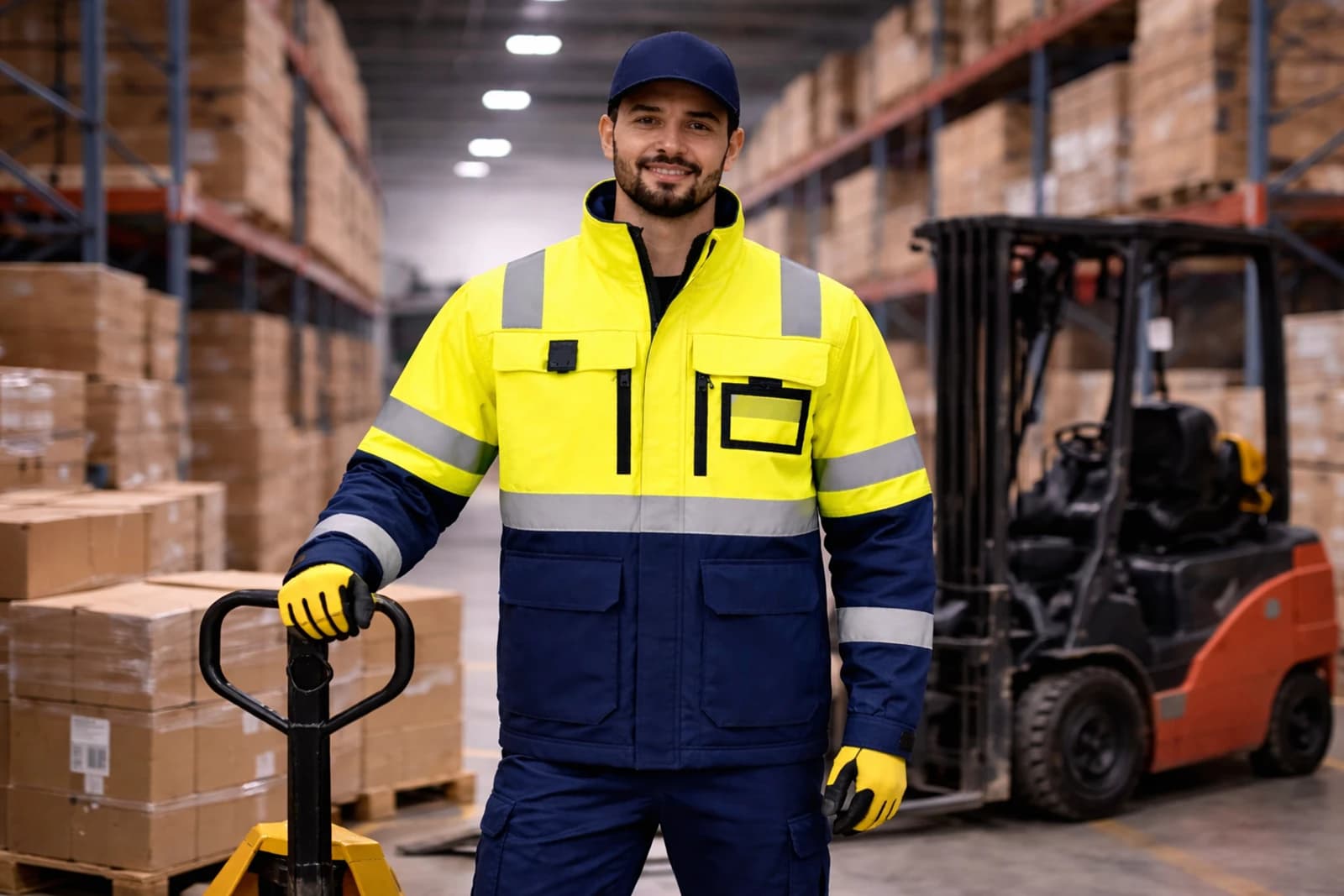
Safety Uniform
Hi-Vis Safety Jacket
Reflective safety jacket for high-visibility site operations and road work crews.