Logistics Polo Uniform Sourcing for Middle East: A Chinese Manufacturer's Guide for B2B Buyers
Middle East logistics and warehousing is booming—Saudi Arabia's $8 billion Logistics Cities project, UAE's Dubai Logistics Corridor, and Qatar's Abu Samra cargo complex are driving massive demand for professional polo uniforms. For Middle East B2B buyers sourcing from Chinese workwear manufacturers, this guide covers fabric selection for extreme heat (up to 55°C), moisture-wicking vs. pique knit choices, anti-static requirements for warehouse zones, embroidery and branding considerations for corporate identity, bulk procurement strategies for fleet-scale orders (500–50,000 units), and navigating import regulations across GCC countries.

Buyer context
What procurement teams run into
The Middle East logistics sector is undergoing unprecedented transformation. Saudi Arabia's National Transport and Logistics Strategy aims to position the Kingdom as a global logistics hub connecting three continents, with $8 billion invested in integrated logistics cities in Riyadh, Jeddah, and Dammam. The UAE's Dubai Logistics Corridor—including Dubai World Central, Jebel Ali Port expansion, and the new Al Maktoum International Airport cargo facilities—will handle over 12 million tonnes of air cargo annually by 2030. Qatar's Hamad Port and Abu Samra land cargo complex are expanding to support post-World Cup economic diversification. The UAE alone is investing $100 billion in logistics infrastructure over the next decade. These mega-projects translate into massive demand for logistics personnel—warehouse operators, forklift drivers, cargo handlers, last-mile delivery drivers, customs clearance agents, and warehouse supervisors. A single major logistics operator in the region may employ 5,000–15,000 uniformed staff across warehouses and delivery fleets. For Middle East B2B buyers sourcing uniforms for these workforces from Chinese workwear manufacturers, several critical challenges arise: **Fabric selection for 55°C ambient conditions:** Standard cotton polo shirts (180–220 gsm) commonly supplied by Chinese factories are unsuitable for Middle East warehouse environments where indoor temperatures can reach 40–45°C in non-air-conditioned storage zones, and outdoor delivery staff work in direct sun at 50°C+. The typical Chinese factory offers either 100% cotton pique knit or polyester-cotton (65/35) blends—neither is optimal. Cotton absorbs sweat and becomes heavy, creating heat stress and skin irritation; polyester-cotton blends trap heat and lack breathability. Buyers must specify performance fabric systems: - Moisture-wicking double-knit polyester (100% polyester with hydrophilic finish, 160–180 gsm) that transports sweat away from skin and dries rapidly. Leading Chinese fabric mills like Fujian Jinjiang Huafeng or Zhejiang Xinhe produce these for sportswear export but rarely market them for workwear. - Cotton-modal blends (50% cotton / 50% modal, 170–190 gsm) offering superior breathability with a professional appearance—modal fiber absorbs 50% more moisture than cotton while remaining lightweight. - Cooling fabric technologies with phase-change material (PCM) microcapsules embedded in polyester fibers, which absorb excess body heat and release it during cooler periods—particularly valuable for workers moving between air-conditioned cabs (delivery drivers) and outdoor loading docks. - UV protection (UPF 50+) is non-negotiable for outdoor logistics staff in GCC countries, as the UV index reaches 11+ on summer afternoons. **Anti-static requirements for warehouse and cargo zones:** Many Middle East logistics facilities handling e-commerce goods (including electronics) or operating in bonded warehouse zones near petrochemical storage require anti-static uniforms per EN 1149-5. This is often overlooked by Chinese workwear factories that categorize polo shirts purely as "corporate wear" rather than PPE. Buyers should specify carbon-fiber filament incorporation (1–2% conductive fibers) in the fabric, with surface resistivity tested below 10⁸ ohms per square. Importantly, anti-static properties must withstand 50 industrial wash cycles at 60°C—GCC warehouses often use high-temperature industrial laundry services to meet local hygiene standards. **Embroidery and branding considerations:** Middle East logistics companies place enormous emphasis on corporate branding visibility. Franchise operators (DHL, Aramex, FedEx) have strict global uniform standards, while local giants (Saudi's SAL, UAE's Emirates Post, Qatar's Wisa Logistics, Kuwait's KGL) incorporate region-specific design elements. Critical details for B2B buyers sourcing embroidered polos from China: - Thread count and stitch density: Standard Chinese embroidery machines run at 650–750 stitches per minute. For Middle East logistics, logos require minimum 12,000 stitches per logo (vs. 7,000–9,000 for standard corporate wear) to ensure crisp detail on large chest logos (up to 12 cm width in many fleet uniforms). - Thread color matching to Pantone TPX (Textile Paper eXtended) standards—Middle East brands are highly color-conscious (deep navy, royal blue, maroon, and forest green are dominant across logistics branding), and color deviation of even 2–3 Pantone shades is considered unacceptable. - Embroidery backing removal: Most Chinese factories use tear-away backing that leaves adhesive residue on the garment interior—irritating in 45°C conditions. Buyers must specify cut-away backing (adhesive-free) with anti-itch backing layer (napped polyester or soft cotton tricot). - Logo placement consistency: Across production batches of 10,000+ units, logo positioning tolerance should be ±3 mm horizontally and ±5 mm vertically. Buyers should request a first-article approval (PPAP—Production Part Approval Process) photo report showing logo placement measurements on S, M, L, XL, 2XL, and 3XL (Middle East sizing requires 3XL as standard in many regions). **Sizing across diverse workforces:** The Middle East logistics workforce is uniquely diverse—comprising local nationals, South Asian expatriates (India, Pakistan, Bangladesh, Sri Lanka, Nepal), Southeast Asian workers (Philippines, Indonesia), and African laborers (Egypt, Sudan). Body proportions vary significantly: South Asian workers typically need shorter torso lengths and narrower shoulders relative to chest circumference, while African workers often require longer sleeves and broader shoulders. Chinese factories predominantly pattern garments on East Asian body dimensions (shorter torso, narrower shoulder-to-height ratio). Buyers must: - Provide detailed size specification sheets with garment measurements (chest, waist, hip, sleeve length, center back length, shoulder width) for each size, based on their actual workforce body scanning data or existing uniform measurements—not Chinese national standard sizing tables. - Request graded patterns in 2 cm chest increments (vs. 4 cm typical in China) for better fit across body types. - Specify extended sizing (4XL–6XL) as GCC populations have higher obesity rates than Chinese standards. **Heat-seal labels vs. sewn labels:** Traditional sewn care labels cause neck irritation in hot, sweaty conditions. Leading Middle East logistics operators require heat-transfer care labels with washing instructions and RFID (for PPE asset tracking in warehouses over 50,000 sqm). Chinese factories typically use woven satin labels as standard—buyers should specify silicone heat-transfer labels (smooth, no edge fray, peel-resistant through 50 washes at 60°C). **Bulk procurement pricing and minimum order quantities:** Chinese polo shirt pricing (fabric + cut-make-trim) ranges significantly based on specification: | Specification Level | Typical Price Range (FOB Shanghai, per piece) | MOQ | |---|---|---| | Basic cotton pique, sewn label, standard embroidery | $3.50–$5.00 | 1,000 pcs per color | | Moisture-wicking polyester, heat-transfer label, anti-static, UV50+ | $6.00–$9.00 | 3,000 pcs per color | | Premium cooling fabric + PCM, RFID tag, cargo pockets, reflective trim | $10.00–$14.00 | 5,000 pcs per color | **Delivery lead times:** Chinese manufacturers typically quote 30–45 days for polo production (fabric sourcing: 10–15 days, cut-make-trim: 15–20 days, embroidery: 5–7 days, packing and inspection: 3–5 days). Middle East buyers should factor an additional 15–20 days for sea freight (Shanghai or Ningbo to Jebel Ali [UAE] = 14–16 days, to Dammam [Saudi] = 17–19 days, to Hamad Port [Qatar] = 18–20 days), plus 5–7 days for customs clearance and local delivery. Total landed timeline: 50–70 days from order confirmation. Express air freight is possible at 4–5× cost (3–5 days transit) for urgent first batches. **Regulatory compliance and import documentation:** UAE and Saudi Arabia have tightened textile import regulations: - UAE ESMA certification (Emirates Conformity Assessment Scheme) requires that all textile products meet UAE.S 2002:2022 (general textile safety standard) covering formaldehyde content limits (<75 mg/kg for garments), azo dye restrictions (banned amines), and nickel release limits for metal accessories. - Saudi SASO (Saudi Standards, Metrology and Quality Organization) requires textile products to be registered on the SABER electronic platform with an assigned Product Certificate (PC) and each shipment must obtain a Shipment Certificate (SC) before customs clearance. Non-compliance results in shipment hold at Dammam or Jeddah ports with demurrage charges of $50–$80 per container per day. - Qatar Ministry of Commerce and Industry requires QS (Qatar Standards) compliance, including fiber composition testing in accredited laboratories. - All GCC countries now require conformity assessment certificates from ISO 17025-accredited test labs (such as SGS, Intertek, Bureau Veritas) with test reports dated within 12 months of shipment date. **Recommended product selection:** For Middle East logistics companies establishing or refreshing their uniform programs, a two-tier approach works best: 1. **Logistics Polo Uniform** — The core uniform piece, specified with moisture-wicking double-knit fabric at 170–190 gsm, UPF 50+, anti-static carbon fiber grid, heat-transfer labels, and extended sizing (S–5XL). Corporate branding through 12,000+ stitch embroidery with cut-away backing. Available in navy, royal blue, maroon, forest green, and grey. FOB range: $6.00–$9.00 per piece depending on customization complexity. Ideal for warehouse staff, office-warehouse crossover roles, and delivery fleet drivers. 2. **Hi-Vis Safety Jacket** — Essential supplement for loading dock and roadside logistics workers. Class 3 or Class 2 hi-vis per EN ISO 20471 woven fabric with reflective tape placement optimized for GCC climate (mesh-lined body for airflow, detachable sleeves option). Compatible with polo uniform for layered approach—warehouse workers wear polo alone, outdoor cargo handlers and delivery drivers add hi-vis jacket. FOB range: $8.00–$13.00 per piece for standard hi-vis workwear jacket with reflective taping. These two product categories together cover the full logistics uniform system—indoor/office uniform (polo) and outdoor/loading zone PPE layer (hi-vis jacket)—across the complete range of Middle East logistics roles.
Sourcing approach
How a factory partner can respond
For Middle East B2B buyers sourcing logistics polo uniforms from Chinese workwear manufacturers, the optimal approach combines performance fabric specification, accurate sizing for diverse workforces, precise corporate branding execution, and complete regulatory documentation. **Step 1: Fabric specification** — Move beyond standard cotton pique to specify moisture-wicking double-knit polyester (170–190 gsm) or cotton-modal blends with UPF 50+ and anti-static carbon fiber grid. Ensure fabric mills provide mill test certificates showing moisture management (AATCC 195 vertical wicking rate ≥ 120 mm/hour), UV protection (AS/NZS 4399 UPF 50+), and surface resistivity (≤ 10⁸ ohms per square after 50 washes). **Step 2: Sizing development** — Provide Chinese factories with detailed workforce measurement data rather than accepting standard Asian sizing. Specify 2 cm grade increments, extended sizes (4XL–6XL), and request PPAP (first-article approval) for all sizes before production. **Step 3: Branding precision** — Specify minimum 12,000 stitches per logo, cut-away backing (no adhesive), Pantone TPX thread color matching, and ±3 mm placement tolerance across all sizes. Request photo measurement verification on all size variants before bulk embroidery production. **Step 4: Compliance documentation** — Engage an ISO 17025 accredited testing lab (SGS, Intertek, Bureau Veritas) for pre-shipment testing to ESMA (UAE), SASO/SABER (Saudi), and QS (Qatar) standards. Obtain Product Certificates (PC) through Saudi SABER system before shipment, and retain full documentation for customs clearance. **Step 5: Logistics planning** — Factor 50–70 days total lead time from order to delivered goods (including sea freight). Consider phased delivery: air-freight first batch (500–1,000 pcs, 10–15 days) to match uniform rollout with warehouse/staff ramp-up, followed by sea-freight bulk (remaining quantity). The recommended product pairing is: - **Logistics Polo Uniform** as the foundation garment — moisture-wicking, anti-static, professional branded appearance for 90% of day-to-day logistics operations - **Hi-Vis Safety Jacket** as the layered PPE addition — EN ISO 20471 Class 2/3 certified for loading dock, delivery, and cargo handling zones This two-product system meets the full operational needs of Middle East logistics enterprises while keeping per-worker uniform cost in the $14–$22 range (polo + jacket combined FOB prices) — cost-effective for fleet-scale procurement.
Recommended Products
Products that fit this use case

Logistics Uniform
Logistics Polo Uniform
Breathable uniform polo for warehouse, delivery, and last-mile teams.
Safety Uniform
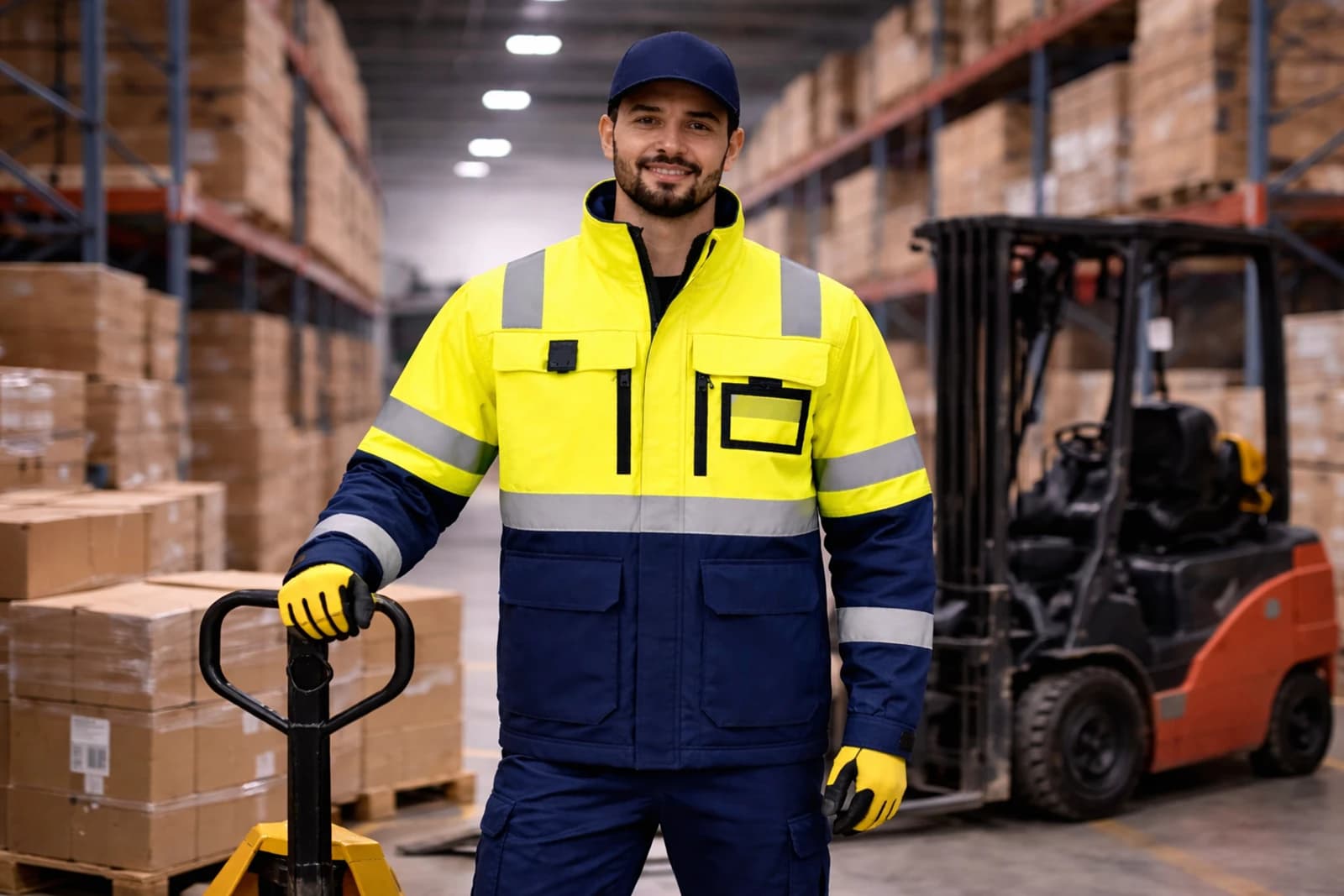
Hi-Vis Safety Jacket
Reflective safety jacket for high-visibility site operations and road work crews.