Logistics Polo Uniforms for Middle East Warehousing: Sourcing Smart Uniforms for Temperature-Controlled & Ambient Supply Chains
Middle East logistics is booming — from Dubai's Jebel Ali and Abu Dhabi's KIZAD to Saudi Arabia's new King Salman Logistics Zone. Warehousing and supply chain operators need polo uniforms that handle temperature swings from -20°C cold-chain environments to 50°C ambient yards. This guide covers what B2B procurement managers should evaluate when sourcing logistics polo uniforms from a Chinese workwear manufacturer.

Buyer context
What procurement teams run into
Middle East logistics and warehousing is one of the fastest-growing industrial sectors in the region. Dubai's Jebel Ali Free Zone alone handles over 15 million TEUs annually. Saudi Arabia's King Salman Logistics Zone and the new Special Integrated Logistics Zone at King Khalid International Airport are creating massive warehousing demand. Across the Gulf, temperature-controlled food logistics, pharmaceutical cold-chain distribution, e-commerce fulfilment centres, and ambient goods warehousing all need a single uniform solution that works across vastly different thermal environments. For B2B buyers sourcing polo uniforms from a Chinese workwear manufacturer, the challenge is balancing professional branding, worker comfort across extreme temperature differentials, and durability for 5–7-day warehouse shifts. A logistics polo is not a desk-job polo — warehouse associates, forklift operators, inventory controllers, and dispatch staff wear these uniforms 10–12 hours a day in environments ranging from -20°C cold storage to 50°C loading bays. Getting the specification right means reducing heat stress claims, extending uniform replacement cycles, and presenting a clean professional image when international clients tour the warehouse. **1. Fabric selection for thermal layering and moisture management.** The core requirement for a Middle East logistics polo is that it must work as both a standalone garment in ambient warehousing and as a base layer under added cold-chain coats in freezer environments. A 180–200 gsm pique-knit fabric in 100% polyester or a polyester-cotton blend (65/35 or 50/50) is the industry standard. The fabric must meet minimum moisture-wicking performance: a wicking rate of at least 10 cm per 30 minutes per AATCC 197 (Moisture Management Test Method) and a drying rate of under 4 hours at room temperature. For cold-chain workers who sweat heavily inside freezer coats and then remove them in the ambient break room, fast moisture transport prevents chills and reduces sick leave. Anti-static properties (EN 1149-3) are increasingly mandatory in logistics facilities with high-value electronics, battery storage zones, and automated picking systems. The fabric should also have UPF 40+ rating — maintenance workers in open loading yards and dispatch zones experience full-day UV exposure in Gulf summers. When sourcing from a Chinese manufacturer, ask for verified test reports covering wicking, anti-static, and UV protection; do not rely on fabric declarations alone. **2. Cut and fit for movement and layering.** A logistics polo must fit closely enough to look professional under customer-facing conditions but generously enough to allow full range of motion for lifting, bending, and reaching on warehouse shelving at heights of 6–12 metres. Key dimensions: sleeve length should extend to mid-bicep with a relaxed armhole that does not bind at the shoulder when reaching overhead; the body length should be 3–5 cm longer than a standard retail polo so it stays tucked in during repeated squatting and bending; and the collar should sit structurally (not flop) against the neck. A two-button placket with reinforced buttonholes (at least 12–14 stitches per cm, bar-tacked at both ends) is recommended over three-button or four-button styles, as warehouse polo necks get pulled on and off multiple times daily. The side seams should be twin-needle-stitched (chainstitch for stretch recovery) to prevent seam popping under the torsional stress of twisting to reach pallet locations. For cold-chain workers, consider a 2–3 cm longer body and reinforced shoulder seams to prevent tear-out when worn under freezer coats. **3. Cold-chain considerations for frozen and chilled environments.** The uniform requirement in a -20°C to -25°C frozen food warehouse is different from ambient warehousing. The polo in this context is a mid-layer between thermal underwear and a freezer coat. The fabric must have a minimum thermal resistance (clo value) of approximately 0.3–0.4 clo for the polo alone — just enough to provide a barrier without overheating during the brief periods workers spend in the ambient break room or while loading docks at 10–20°C transition zones. Antistatic properties become mission-critical in cold-chain: the low humidity in freezer environments (often below 20% RH) creates severe electrostatic discharge risks, especially in automated cold stores where static-sensitive electronics control the ASRS (Automated Storage and Retrieval Systems). Request EN 1149-3 compliance from the manufacturer and verify that antistatic properties survive at least 50 industrial launderings. Additionally, fastenings must be non-metallic or covered — metal buttons in -20°C become painful to touch (even through gloves) and can cause freezer burns or ice-bridging. Plastic or resin buttons, or a hidden zipper under the placket, are the cold-chain standard. **4. Branding and corporate identity application.** Logistics operators across the Middle East — from Aramex and Agility in the UAE to Bahri Logistics in Saudi Arabia and GAC in Dubai — treat their uniform programmes as a mobile branding investment. A fleet of 200–500 warehouse staff wearing branded polos creates consistent brand exposure for every customer visiting the facility. The polo must support multiple branding methods: embroidered chest logos (at least 10,000 stitches for fine detail on logos with Arabic calligraphy), heat-pressed transfer patches for back-of-neck branding, and screen-printed or silicone heat-seal logos on the upper sleeve. The key requirement for B2B buyers is durability of branding through repeated industrial laundering — specify minimum 50 launderings with ≤ 10% colour fade for printed logos and ≤ 5% thread breakage for embroidered logos per ISO 105 C06 at 60°C. Many Chinese workwear manufacturers offer integrated embroidery or contract with local embroidery shops in the Middle East for speed — but the durable outcome depends on the substrate fabric being stable (pique knit must have a tight enough stitch density to hold embroidery detail without puckering). A 180 gsm pique knit with 12–14 courses per cm provides the best embroidery substrate. **5. Sizing for the Middle East workforce demographic.** The Middle East logistics workforce is diverse — South Asian warehouse workers (Indian, Pakistani, Bangladeshi, Sri Lankan), Arab forklift operators, Filipino and Nepali inventory controllers, and a growing number of local nationals in supervisory and safety roles. A single-size-range uniform programme will produce a high rate of rejections and refits. Chinese manufacturers exporting to the Middle East should offer extended sizing: a 2XS–4XL range with waist-to-height ratio variations. Specifically, the regional sizing consideration is that many South Asian workers require a shorter body length (68–72 cm for M) but a wider chest (115–120 cm for M) compared to the standard Caucasian athletic fit. Manufacturers offering a "Middle East fit" pattern — with a slightly fuller chest and a shortened torso — reduce refit rates dramatically. Request a size chart breakdown by body measurements (not just ready-made garment sizes) and ask for a pilot sizing run for a sample of 20–30 workers from each demographic group before placing the bulk order. A 5% sizing error rate on a 10,000-unit order means 500 unusable uniforms — avoidable with proper demographic testing. **6. Durability and industrial laundering performance.** A logistics polo in a busy Middle East warehouse typically needs to survive 100–150 wash cycles at 60–75°C (the standard industrial laundry temperature across the Gulf, where many facilities use combined wash-dry cycles). Key durability metrics to specify: colourfastness to washing (ISO 105 C06) at 60°C with a minimum rating of 4 (on a 1–5 grey scale) for both colour change and staining; dimensional stability (ISO 5077) with maximum shrinkage of 3% in length and 4% in width after 5 washes; and minimum tensile strength of 400 N in both warp and weft directions (ISO 13934-1) to withstand the mechanical agitation of industrial tumble dryers. Many budget polos sourced from low-cost Chinese producers use recycled polyester with lower tensile strength and will start fraying at seams and collar edges after 40–50 washes. Specify virgin polyester or a virgin-cotton blend for the logistics programme to guarantee 100+ wash durability. **7. Compliance with Middle East labour law uniform requirements.** Qatar's Law No. 14 of 2004 mandating adequate heat-protective workwear for outdoor workers, UAE's Ministerial Resolution No. 44 of 2022 on occupational safety and health for summer work, and Saudi Arabia's Labour Law Article 114 on protective equipment — all require employers in warehousing and logistics to provide uniforms that protect against the hazards of the work environment. For ambient warehousing, this means the polo must be certified as sun-protective (UPF 40+ per AS/NZS 4399 or EN 13758-1) and manufactured from fabrics that do not generate excessive heat stress. For cold-chain, the Ministry of Labour authorities in the UAE and Saudi Arabia now expect documented thermal risk assessments for freezer workers, which means the uniform supplier must provide thermal insulation values (clo) for the entire garment system. B2B buyers should request a compliance dossier from the manufacturer covering these standards and keep it on file for any labour inspection. **8. Sustainability and corporate ESG reporting.** Middle East logistics operators — particularly those with European or North American parent companies or serving multinational retailers (Carrefour, Lulu, Spinneys) — are increasingly required to report their Scope 3 supply chain emissions, including textile procurement. Recycled polyester polos (rPET from post-consumer bottles) at 160–180 gsm are now available from Chinese manufacturers at a 15–25% premium over virgin polyester. For a fleet of 500 warehouse staff requiring 2 polos each annually, a switch to rPET fabric saves approximately 3,000 kg of CO2 equivalent compared to virgin polyester. Additionally, GOTS (Global Organic Textile Standard) organic cotton options and OEKO-TEX Standard 100 certified fabrics (guaranteeing no harmful substances) are increasingly requested in tender documents from major Middle East logistics operators. While these certifications add 10–20% to the unit cost, they are often mandatory for logistics contracts with sustainability-linked KPIs.
Sourcing approach
How a factory partner can respond
A high-quality logistics polo uniform designed for Middle East warehousing and supply chain operators should include: **Fabric:** 180–200 gsm pique-knit in 100% polyester or 65/35 polyester-cotton blend, with moisture-wicking (AATCC 197 wicking ≥10 cm/30 min), antistatic (EN 1149-3), and UPF 40+ sun protection properties. **Cut & Design:** Relaxed fit with mid-bicep sleeves, extended body length (3–5 cm longer than retail), reinforced twin-needle side seams, and two-button placket with bar-tacked buttonholes. Optional: 2–3 cm longer body for cold-chain layering. **Cold-Chain Features:** Plastic or covered buttons, antistatic compliance verified through 50+ industrial launderings, non-metallic fastenings, 0.3–0.4 clo thermal value for mid-layer performance. **Branding:** Supports embroidery (10,000+ stitches), heat-transfer patches, and silicone heat-seal logos. Minimum 50-wash durability for printed logos (≤10% fade) per ISO 105 C06 at 60°C. **Sizing:** 2XS–4XL range with Middle East fit (fuller chest, shorter torso). Pilot sizing run recommended across demographic groups. **Durability:** 100+ industrial wash cycles at 60–75°C; colourfastness rating ≥4; shrinkage ≤3% length / ≤4% width (ISO 5077); tensile strength ≥400 N. **Compliance:** EN 1149-3 antistatic certification, UPF 40+ (AS/NZS 4399), OEKO-TEX Standard 100, and full compliance documentation for UAE Ministerial Resolution No. 44, Saudi Labour Law Article 114, and Qatar Law No. 14. **Sustainability:** rPET recycled polyester option available at 15–25% premium, GOTS organic cotton, and OEKO-TEX certified materials. ESG reporting data provided on request. **Supplier Qualification:** Request third-party test reports from accredited labs (SGS, Intertek, Bureau Veritas) for fabric, branding, and laundering durability claims. Verify past logistics sector experience with Gulf-based warehouse operators.
Recommended Products
Products that fit this use case

Logistics Uniform
Logistics Polo Uniform
Breathable uniform polo for warehouse, delivery, and last-mile teams.
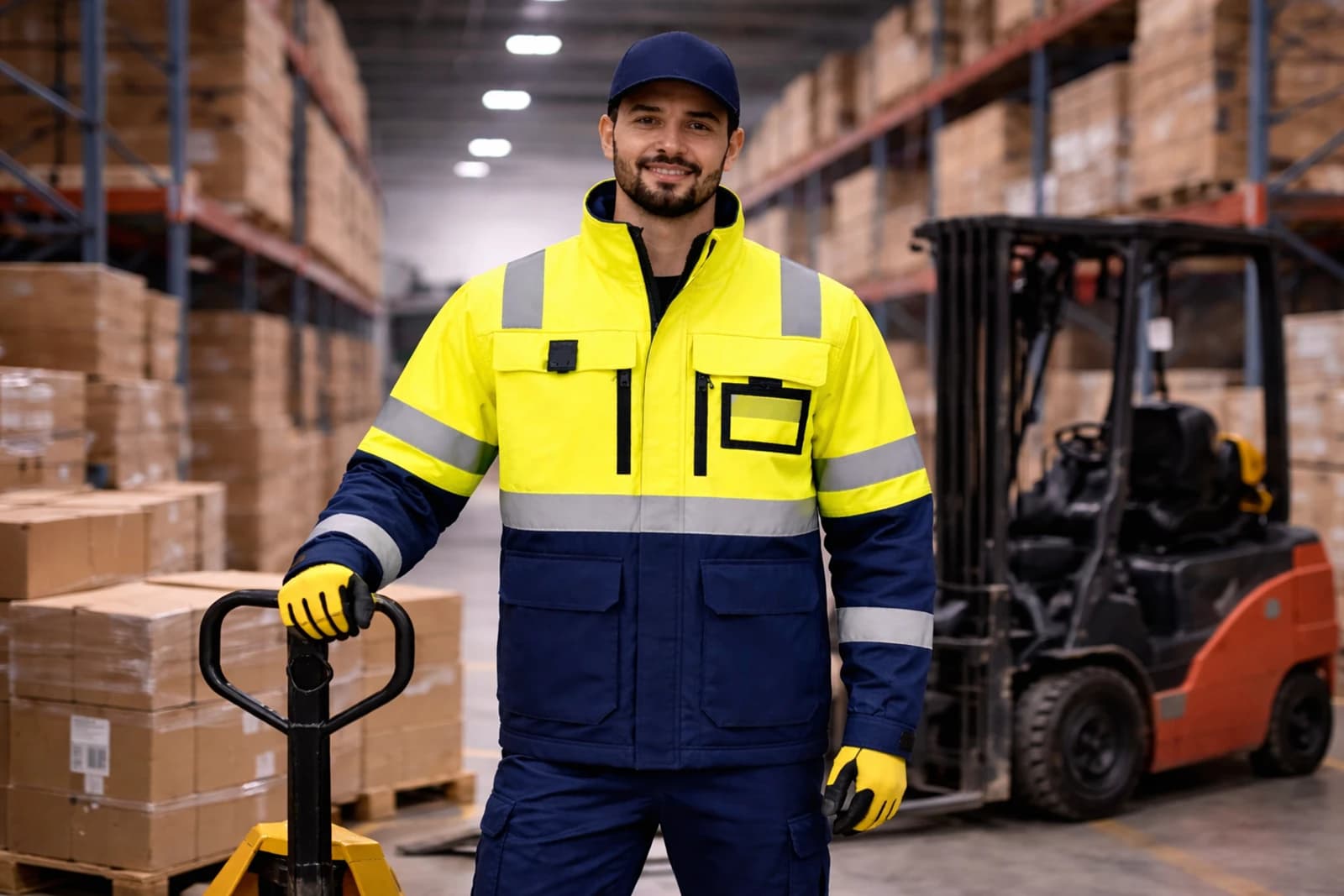
Safety Uniform
Hi-Vis Safety Jacket
Reflective safety jacket for high-visibility site operations and road work crews.