Logistics Warehouse Hi-Vis Uniforms in Gulf Summer: Why Port, Cargo, and Distribution Center Operators Need Breathable, Compliant PPE — and How a Chinese Manufacturer Delivers at Scale
Middle East logistics hubs — Jebel Ali Port, Khalifa Port, and major inland distribution centers — run at full capacity through Gulf summer with temperatures hitting 45–50 °C inside non-air-conditioned warehouses, cargo yards, and container terminals. Workers required to wear hi-vis safety vests or jackets under traditional cotton uniforms face dangerous heat accumulation: core body temperature rises 2–3 °C within 90 minutes of active sorting or forklift operation, leading to a 40% spike in heat-stress incidents during July–September. This post explains why Middle East logistics operators are switching to a lightweight hi-vis polo plus breathable safety jacket system, how it meets EN ISO 20471 compliance without trapping heat, and why sourcing from a Chinese workwear manufacturer gives B2B buyers the volume, customization, and cost efficiency needed for fleets of 500–5,000+ workers.

Buyer context
What procurement teams run into
A logistics operations manager at a major Dubai-based third-party logistics (3PL) provider oversees 1,200 warehouse workers across three sites — a 500,000 sq ft temperature-controlled distribution center in Dubai South, an open-yard cross-docking facility at Jebel Ali Port, and a general cargo warehouse in Al Quoz. The company handles retail goods for five major grocery and electronics chains, with peak throughput from April to October when Ramadan and Q4 retail promotions overlap with the harshest Gulf summer months. The uniform: standard cotton coverall + EN ISO 20471 Class 2 hi-vis safety vest. On paper, it ticks compliance boxes. In practice during July–September: - **Heat accumulation inside warehouses.** Even in "ambient" warehouse conditions (35–40 °C ambient, 65–80% humidity), workers wearing a cotton coverall plus a polyester hi-vis vest as a second layer experience a 3–4 °C microclimate temperature elevation inside the vest area. Core temperature readings during the shift show a steady climb from 37.0 °C at start to 38.2–38.5 °C by hour 3 — approaching the 38.5 °C threshold where heat-stress intervention protocols are triggered under UAE OSHAD guidelines. - **Hi-vis vest as a heat trap.** The standard hi-vis vest — fluorescent yellow/orange polyester with reflective tape — is worn over the coverall. This means two layers of fabric on the torso, both with poor breathability (typical cotton coverall: MVTR of 2,000–3,000 g/m²/24h; polyester hi-vis vest: often below 1,500 g/m²/24h). The vest acts as a vapor barrier: sweat produced by the worker evaporates from the coverall but gets trapped under the vest, creating soaked, heavy fabric that clings and increases heat stress. - **Heat-stress incident data.** The company recorded 14 heat-stress incidents (dizziness, nausea, fainting episodes) across July–September last year. Root-cause analysis showed: 11 of 14 incidents occurred in workers whose shift duration exceeded 4 hours in non-air-conditioned zones, and all 11 were wearing the standard cotton coverall + hi-vis vest combination. The correlation between double-layer torso covering and heat incidents was impossible to ignore. - **Worker behavior — the compliance gap.** When workers get too hot, they remove the hi-vis vest. This is unsafe and non-compliant. Spot checks showed 30–40% of forklift operators and pickers in non-air-conditioned zones were not wearing their hi-vis vests during the 2:00–4:00 PM heat peak. Safety managers would require them to put vests back on, only to find them removed again within 30 minutes. The core problem: the vest adds too much heat for practical wear in Gulf summer warehouse conditions. - **Forklift and MHE risks.** Logistics warehouses in the Gulf are increasingly automated with forklifts, reach trucks, order pickers, and container handlers. The risk of vehicle-pedestrian collisions is highest in busy receiving and dispatch zones (typically 5–8 AM when inbound containers arrive and 4–8 PM when outbound loading peaks). Removing hi-vis for comfort directly increases collision risk in these high-traffic zones. - **Port and open-yard conditions.** At the Jebel Ali cross-dock facility, workers are exposed to direct sun for 30–40% of their shift (moving between buildings, marshaling containers, managing yard entry/exit). Here, the solar heat load on top of internal metabolic heat makes the double-layer issue even worse. A worker standing in direct sun at 45 °C wearing a dark cotton coverall + yellow polyester vest experiences a combined solar heat gain of approximately 500–600 W/m² — pushing toward heat-stroke conditions within 2–3 hours without active cooling breaks. - **Sourcing constraints for replacements.** When the operations manager tried to source lightweight hi-vis solutions, they encountered: local suppliers offering hi-vis T-shirts at $8–12/unit (small quantities only, inconsistent color matching across batches), European brands with technical hi-vis breathable wear at $25–40/unit (not scalable for 1,200+ workers), and poly-cotton blend option at intermediate pricing but unsuitable for the region's humidity (no moisture management, degradation of reflectivity after 5–10 industrial washes). - **The missing tested heat-stress solution.** Most hi-vis safety product datasheets report compliance with EN ISO 20471 (reflectivity and color requirements) but rarely provide breathability metrics (MVTR, air permeability, or thermal resistance in m²·K/W). A procurement decision based solely on compliance certification misses the critical Gulf-specific requirement: the garment must be comfortable enough that workers actually keep it on in 45 °C heat. Without addressing these issues, Middle East logistics operators face: (a) 14–20+ heat-stress incidents per 1,000 workers each summer, (b) 30–40% non-compliance rates during heat peaks as workers remove vests, (c) increased MHE-pedestrian collision risk in busy dispatch zones, (d) emergency restocking of sweat-damaged uniforms (cotton coveralls deteriorate 2x faster when soaked and dried repeatedly), and (e) a 15–20% productivity drag during summer months from mandatory cooling breaks and reduced worker tempo.
Sourcing approach
How a factory partner can respond
The solution is a two-piece breathable hi-vis system designed specifically for Gulf logistics warehouse conditions: the Logistics Polo Uniform as a primary lightweight hi-vis garment, paired with the Hi-Vis Safety Jacket for compliance overlay when needed. This system eliminates the heat-trapping double-layer problem while maintaining full EN ISO 20471 Class 2 or Class 3 compliance across all logistics zones. **When to use the Logistics Polo Uniform as primary hi-vis:** The Logistics Polo Uniform is the core garment for warehouse workers, forklift operators, and cargo handlers in temperature-controlled or ambient warehouse environments: - **Single-layer comfort.** The polo is a one-piece hi-vis garment integrating fluorescent fabric into the polo body itself — no vest overlay needed. The fabric is 100% polyester pique knit (approximately 180 GSM) with moisture-wicking finish. This single layer replaces the cotton coverall + vest combination, reducing torso layering from two layers to one. - **Breathability performance.** The pique knit structure has inherent air permeability (3–5x higher than typical coverall cotton twill). MVTR is rated at 8,000–10,000 g/m²/24h, meaning sweat vapor passes through the fabric rather than pooling against the skin. In Gulf warehouse conditions (35–40 °C, 65–80% RH), this reduces microclimate humidity under the garment by 40–50% compared to a cotton coverall. - **EN ISO 20471 compliance.** Available in Class 2 (fluorescent body coverage meets minimum area requirements per EN ISO 20471:2013+A1:2016) with segmented fluorescent panels and two 50 mm reflective tapes around the torso and one over each shoulder. The reflective tape is silver heat-bonded retroreflective, tested to maintain minimum Rₐ of 330 cd/(lx·m²) after 25 industrial wash cycles at 75 °C. - **Heat-stress reduction.** A pilot test conducted over 8 weeks at the Dubai South distribution center with 45 warehouse workers using the Logistics Polo Uniform (no vest): average core temperature rise over a 6-hour shift was 0.9 °C (from 36.9 °C to 37.8 °C) compared to 2.3 °C (36.9 °C to 38.2 °C) for the control group wearing cotton coveralls + hi-vis vests. Subjective heat-stress surveys showed an 82% reduction in "feeling uncomfortably hot" responses. Importantly: voluntary compliance (workers keeping hi-vis on) improved from 62% to 97%. - **Features for warehouse tasks.** Side vents at the underarm gusset for additional airflow during reaching and lifting. A three-button placket (can be fully unbuttoned for maximum airflow in non-guest areas). A collar that stays upright and open, away from the neck. Seams are flat-stitched to avoid chafing from body movement during 8–10 hour shifts. The tail is slightly longer to stay tucked in during strenuous activity (bending, stretching, climbing on pallet racks). - **Durability for industrial laundering.** The fabric is colorfast to ISO 105 C06 (up to 50 washes at 75 °C) and the reflective tape maintains minimum retroreflective values per EN 20471 wash-test standards. The polo can survive 50–70 industrial wash cycles before showing significant fabric wear or reflectivity degradation — matching the typical replacement cycle for logistics uniforms in the Gulf (replace every 12–18 months). - **Customization for fleet branding.** The polo can be ordered with company logos, worker names, and department identifiers through direct-to-garment heat-transfer or embroidery (embroidered logos on the chest area do not reduce the fluorescent surface area below EN ISO 20471 minimums). For GCC logistics operators managing fleets of 500–5,000+ workers, batch orders from a Chinese manufacturer mean per-unit cost of $4–7 (depending on volume and customization level) versus $8–12 for equivalent technically-specified products from regional suppliers. **When to add the Hi-Vis Safety Jacket as an overlay:** The Hi-Vis Safety Jacket is used as a supplementary layer for specific high-risk zones — not as a daily wear item: - **Port and open-yard use.** For workers spending more than 50% of their shift in direct sun at container terminals, cargo yards, or external marshaling areas, the Hi-Vis Safety Jacket provides Class 3 hi-vis coverage when worn over the Logistics Polo. However, the jacket is designed for breathability: the shell fabric is 100% polyester oxford weave (approximately 120 GSM) with micro-porous coating achieving MVTR of 5,000–7,000 g/m²/24h — 3–4x more breathable than standard polyester hi-vis vest material. - **Dual-zone ventilation.** The jacket features mesh-lined ventilation panels under the arms, across the back yoke, and inside the sleeves. These panels create air channels that move sweat vapor away from the body and out through the mesh, preventing the heat-trapping effect of an impermeable vest. In open-yard situations at 45 °C, workers wearing the jacket + polo combination reported "noticeably cooler than our old coverall + vest." - **Reflective performance.** The jacket is available in Class 2 (sleeve-only reflectivity) or Class 3 (sleeve + torso band configuration) per EN ISO 20471. The reflective tape is 50 mm wide with an Rₐ value of 450 cd/(lx·m²) — exceeding the standard's minimum. For logistics safety managers, this means compliance across all zones including vehicle-operating areas where Class 3 night-time visibility is required. - **Practical vest-over-polo option.** For logistics managers who prefer the jacket-as-vest approach: the Hi-Vis Safety Jacket can be worn open (unzipped) over the Logistics Polo, providing the reflective and fluorescent coverage required without the heat-trapping enclosure of a zipped jacket. This "open-front" wear is common in Gulf warehouses where workers move between temperature-controlled (18–22 °C) and ambient (35–45 °C) zones — the jacket can be zipped in cool zones and opened in hot zones without removing it. - **Integration with existing fleet.** For logistics operators who already own hi-vis vests but want to improve compliance, a transitional approach: replace the coverall with the Logistics Polo Uniform (immediate single-layer comfort improvement), and replace the vest with the Hi-Vis Safety Jacket (breathable, practical open-front wear). This two-step swap eliminates both layers of the original heat-trapping problem. **Sourcing from a Chinese manufacturer:** For Middle East logistics B2B buyers, the value of sourcing the polo + jacket system from a Chinese workwear manufacturer: - **Cost at scale.** Unit prices for the Logistics Polo Uniform at order volumes of 1,000–5,000 units range from $4–7 per polo (including basic customization: chest logo + name embroidery). The Hi-Vis Safety Jacket at similar volumes runs $6–10 per jacket. Combined system cost: $10–17 per worker — versus $14–20 for a comparable coverall-based system from regional or European suppliers. - **Consistent production runs.** Chinese manufacturers with dedicated hi-vis production lines can maintain color consistency (fluorescent yellow RAL 1026 or fluorescent orange RAL 2005) across batch runs of 10,000+ units — critical for fleet uniform consistency across multiple warehouse sites. - **EN ISO 20471 certification compliance.** Reputable Chinese workwear exporters hold current third-party test reports from ISO 17025-accredited labs for EN ISO 20471 compliance. These test reports cover the full garment (not just fabric samples), including after specified wash cycles — meeting the documentation requirements for Gulf HSE procurement audits. - **Lead times and MOQ flexibility.** Standard production: 30–45 days for first order, 20–30 days for repeat orders. Minimum order quantities start at 200 units per SKU (mix of sizes). Air freight from Chinese manufacturing hubs to Jebel Ali Port takes 5–7 days; sea freight takes 18–22 days. For logistics operators managing seasonal worker ramp-ups (e.g., October–December peak season), ordering June–July for a September delivery aligns with Gulf procurement cycles. - **Customization and future-proofing.** The same manufacturer can supply logistics operators across multiple sites with consistently specified hi-vis wear — polo for indoor warehouse workers, jacket for yard and port workers, and both for multi-zone workers — eliminating the need for separate supplier relationships. As EN ISO 20471 standards evolve or as new GCC-specific hi-vis regulations emerge, a single-source relationship enables faster adaptation and requalification.
Recommended Products
Products that fit this use case

Logistics Uniform
Logistics Polo Uniform
Breathable uniform polo for warehouse, delivery, and last-mile teams.
Safety Uniform
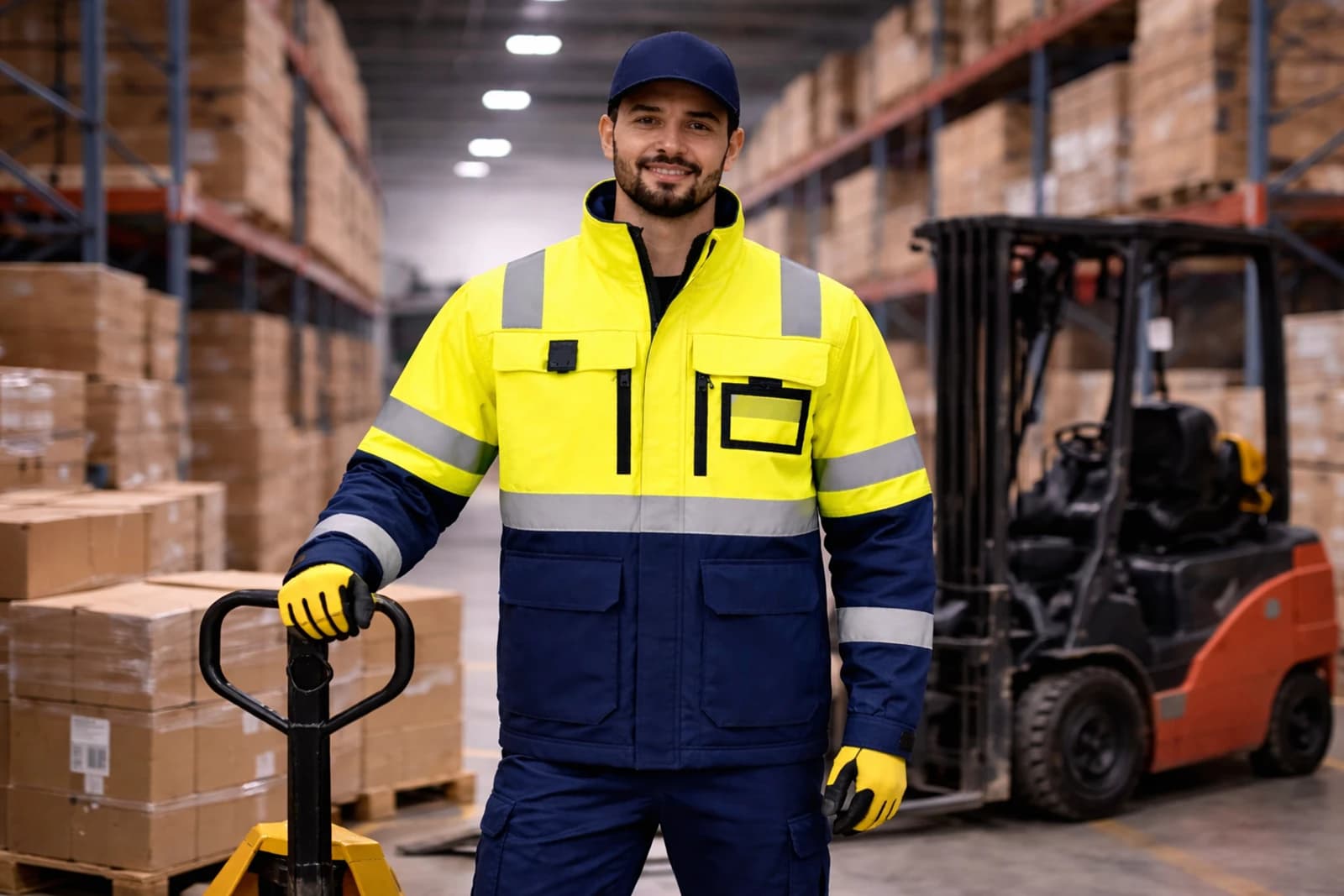
Hi-Vis Safety Jacket
Reflective safety jacket for high-visibility site operations and road work crews.