OEM Custom Workwear from China: A Step-by-Step Sourcing Process for Middle East B2B Buyers
Middle East importers and contractors often struggle with the OEM workwear process — from logo placement to sample approval. This guide breaks down the practical steps for customising coveralls, hi-vis jackets, and polo uniforms with a Chinese manufacturer, covering MOQ, embroidery vs. heat transfer, and how to get samples right the first time.

Buyer context
What procurement teams run into
<p>Middle East B2B buyers who source workwear from China often discover that ordering a standard stock product and ordering a custom OEM product are two very different processes. Logo placement rules, minimum order quantities, colour matching across fabric types, and sample approval timelines create friction that many first-time OEM buyers do not anticipate.</p> <p>A common scenario: a Saudi contractor who needs 500 hi-vis jackets with a company logo assumes the factory will simply add embroidery to an existing jacket. But the fabric weight, reflective tape positioning, and pocket layout may need to change to accommodate the logo without compromising EN 20471 certification. The sample arrives looking nothing like the reference image — colours are off, the logo is too small, or the embroidery distorts the fabric around it. Two more rounds of samples eat up six weeks, and the bulk delivery deadline has already passed.</p> <p>Another frequent issue: MOQ mismatches. A Dubai distributor wants 200 custom polo uniforms with a specific collar colour and pocket design, but the factory’s MOQ for custom fabric dyeing is 1,000 metres — enough for 2,500 polos. The buyer either over-orders or is told the request cannot be fulfilled at that quantity, losing the opportunity to build a branded uniform program.</p> <p>These problems are not signs of a bad manufacturer. They are signs of a process the buyer did not understand upfront. Sourcing custom workwear from Chinese OEM factories is straightforward when you know the right questions to ask at each step.</p>
Sourcing approach
How a factory partner can respond
<p>Here is the step-by-step OEM workwear process for Middle East B2B buyers sourcing from China, from initial inquiry to bulk delivery.</p> <h2>1. Understand MOQ Structures</h2> <p>Chinese workwear manufacturers typically operate with tiered MOQs. A stock colour garment in standard sizing might have an MOQ of 100–300 pieces. A custom colour (dyed specifically for your order) usually requires 500–1,000 pieces per colour, because the mill needs a minimum fabric roll. Custom patterns, pocket layouts, or added tape (for hi-vis) may increase MOQ moderately. Ask clearly: what is the MOQ for stock fabric, for custom-dyed fabric, and for custom patterns? This lets you decide whether to choose stock colours (lower commitment) or go fully custom (higher volume commitment).</p> <h2>2. Logo Methods & Placement</h2> <p>Three common logo methods each have tradeoffs. Embroidery is durable and looks premium on polo uniforms and coverall chest areas, but can compromise the fabric membrane on softshell jackets and may reduce reflective tape effectiveness if placed too close. Silicone heat transfer is ideal for hi-vis jackets and construction sets — it does not puncture the fabric and handles curved chest areas well. Screen printing works for T-shirts and simple polos but wears off faster on high-contact areas like elbows and cuffs. Discuss placement at the inquiry stage so the factory can plan seam and tape layout around the logo zone.</p> <h2>3. Sample Approval: What to Expect</h2> <p>A reliable OEM process includes a pre-production sample (PPS) before bulk manufacturing. The PPS confirms fabric colour, logo size and position, seam construction, and overall fit. Allow 10–14 days for PPS production and 3–5 days for shipping to the Middle East (DHL or FedEx express). Review the sample under natural daylight and with the actual uniform set — colour matching across different garment types (e.g., jacket vs. trousers) is a common miss. Approve the PPS in writing before the factory cuts bulk fabric, not verbally over the phone.</p> <h2>4. Production & Quality Checkpoints</h2> <p>Once the PPS is approved, request two production-stage quality checks: a fabric inspection (after cutting, before sewing) to verify colour and weight consistency, and a final inspection (after packing, before container loading) to check stitching, logo alignment, and zipper functionality. Factories that offer third-party inspection (SGS, Bureau Veritas) at your cost are more transparent about quality assurance.</p> <h2>5. Lead Time & Delivery Planning</h2> <p>Typical OEM lead times from Chinese manufacturers: 35–50 days from PPS approval for fabric-dyed orders, 25–35 days for stock-fabric orders. Sea freight from Shanghai or Ningbo to Jebel Ali (Dubai) or Dammam takes 18–22 days. Add 5–7 days for customs clearance. Total end-to-end timeline: 8–10 weeks for custom colours, 6–8 weeks for stock colours. Plan your uniform launch date accordingly.</p>
Recommended Products
Products that fit this use case
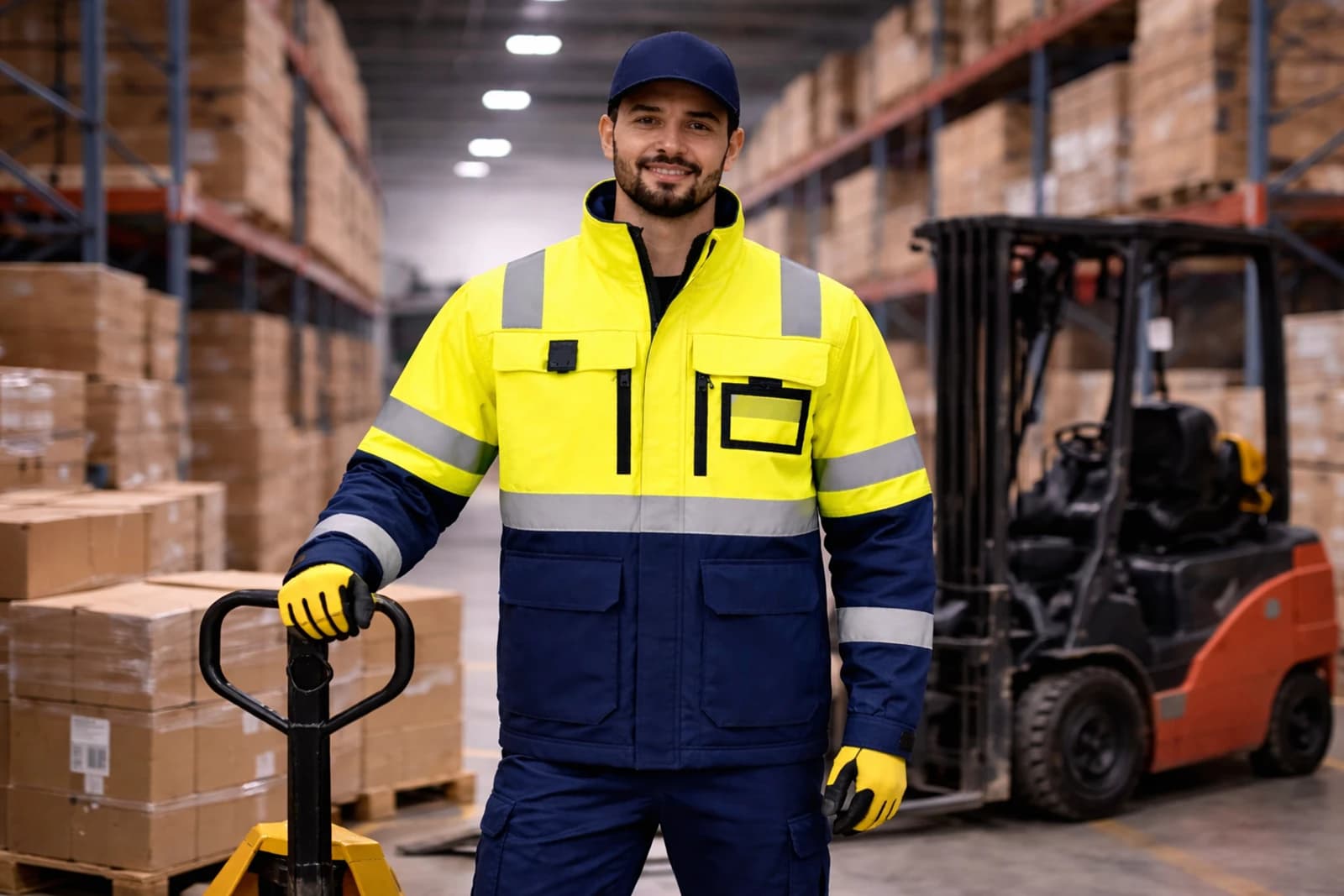
Safety Uniform
Hi-Vis Safety Jacket
Reflective safety jacket for high-visibility site operations and road work crews.

Industrial Workwear
Industrial Coverall Pro
Hard-wearing one-piece coverall for plant, maintenance, and heavy-duty operations.

Logistics Uniform
Logistics Polo Uniform
Breathable uniform polo for warehouse, delivery, and last-mile teams.