Industrial Coveralls for Middle East Oil & Gas: Why B2B Buyers Choose Chinese Manufacturing for Heavy-Duty Flame-Resistant PPE
Middle East oil and gas operators — from Saudi Aramco to ADNOC and QatarEnergy — require industrial coveralls that meet international flame-resistant (FR) standards while performing under extreme heat, humidity, and frequent industrial laundering. This guide covers how B2B procurement managers for NOCs, drilling contractors, and petrochemical EPC firms can source industrial coveralls from a Chinese workwear manufacturer that delivers EN ISO 11612-certified FR garments, custom corporate branding, extended sizing for multinational workforces, and bulk FOB pricing from Asian ports to Dammam, Jubail, Ruwais, and Ras Laffan.

Buyer context
What procurement teams run into
A procurement manager for a drilling services contractor in Saudi Arabia's Eastern Province needs flame-resistant (FR) industrial coveralls for 2,800 workers across five rig sites. The current supplier — a European FR workwear brand — delivers excellent quality but at $85–$120 per coverall, consuming 40% of the PPE budget while the contractor is under margin pressure from the operator. Smaller local Saudi uniform suppliers offer coveralls at $35–$50, but they use non-certified FR-treated cotton that fails third-party audits after 15–20 industrial washes, exposing the contractor to safety compliance penalties of SAR 50,000+ per incident under Saudi labor law.\n\nFor Middle East B2B procurement teams sourcing industrial coveralls from a Chinese workwear manufacturer, the specific challenges differ significantly from general workwear procurement:\n\n**Flame resistance certification complexity** — Middle East NOCs (national oil companies) typically require dual certification: EN ISO 11612 for heat and flame protection (or NFPA 2112 for US-influenced projects) plus IEC 61482-2 for arc flash protection (common in petrochemical plants with electrical risk zones). Many budget-priced coveralls carry only one certification or use self-declared compliance without third-party testing. A failed audit against, for example, Saudi Aramco's SAES-D-002 standard can result in contractor disqualification — a risk no procurement manager can afford. Chinese manufacturers who regularly export to Middle East NOCs must maintain SGS or TÜV-verified certification files and batch-specific test reports.\n\n**Heat stress vs. protection trade-off** — Gulf oil fields (Ghawar, Safaniyah, Al-Shaheen) and petrochemical plants (Jubail, Yanbu, Ruwais) operate at 45–55°C ambient temperatures for 6+ months of the year. Standard FR coveralls using 100% FR-treated cotton (270–320 GSM) create a thermal barrier that traps body heat. Workers in open-air rig sites frequently unzip coveralls to the waist, remove sleeves, or wear them open — defeating the purpose of FR protection. A coverall that cuts peak core temperature by even 2°C during a 12-hour shift measurably reduces heat-stroke incidents, which Gulf NOCs now track as a KPI under their HSE management systems.\n\n**Industrial laundering durability** — in Middle East oil and gas operations, FR coveralls are typically industrially laundered every 1–2 shifts at 75–85°C using alkaline detergents to remove hydrocarbon residues and drilling mud. Standard FR-treated cotton loses its flame-retardant chemical finish progressively: 15–20% loss after 25 washes, 40–50% after 50 washes. For a contractor supplying 2,800 workers with 3 sets each (8,400 coveralls total) at $85/unit imported from Europe, premature end-of-life after 35–40 washes (vs. 75–100 expected) means $210,000+ in unplanned replacement costs per year.\n\n**Sizing for multinational crews** — oil and gas rig crews in the Middle East are among the most diverse workforces globally: Arab engineers (tall, slim to medium build), South Asian technicians (shorter, broader shoulders), Filipino welders (medium build), and Western expatriate supervisors (taller, larger frames). Standard coverall sizing systems from Asian manufacturers (M–3XL based on Asian body proportions) often produce coveralls that are too short in the torso for Arab workers (safety risk — exposed midriff when bending) and too narrow at the hips for larger-frame workers (restricted mobility = fatigue and lower productivity).\n\n**Corporate branding at scale** — NOC contractors need logo embroidery or heat-transfer reflective branding on the chest and back of each coverall, typically in corporate colors with specific Pantone matches (e.g., Saudi Aramco Safety Green, ADNOC Safety Yellow). Unlike polo shirts where embroidery is straightforward, FR coveralls use thicker fabric (270–320 GSM) with FR-treated barrier layers, requiring industrial-grade embroidery machines with heavy-duty needles and Teflon-coated presser feet to avoid needle breakage and thread tension issues at scale.\n\nWithout a structured approach to FR coverall procurement, buyers face: (a) safety audit failures from non-certified FR treatment or premature degradation, (b) heat-stress-related productivity loss of 15–25% during Gulf summer months, (c) unplanned replacement costs of $25–$40 per coverall per year from accelerated laundering degradation, and (d) workforce compliance issues from workers rejecting ill-fitting or uncomfortably hot coveralls.
Sourcing approach
How a factory partner can respond
The solution is a purpose-designed Industrial Coverall Pro — an EN ISO 11612-certified flame-resistant coverall engineered for Middle East oil and gas conditions and manufactured by a Chinese workwear supplier with proven Gulf NOC procurement track records.\n\n**Industrial Coverall Pro — key specifications:**\n\n**Dual-certified FR fabric system** — the coverall uses a 88% cotton / 12% high-tenacity polyamide (HT PA) blend at 290 GSM, treated with an FR finish that meets EN ISO 11612 (A1+A2, B1+C1, E1+F1) and IEC 61482-2 Class 1 (4 kA arc rating). Unlike 100% cotton FR treatments that leach chemicals in alkaline wash environments, the polyamide component provides a structural FR backbone — even as the chemical FR finish gradually diminishes over 60+ washes, the polyamide retains flame-resistant properties, providing a safety margin beyond the chemical treatment's certified lifespan.\n\n**Gulf-optimized thermal comfort** — the fabric is woven with a ripstop structure (small reinforcing squares at 8×8 mm intervals) that improves air permeability by 25% vs. standard FR twill weave, allowing convective heat dissipation while maintaining tear resistance (50 N warp, 45 N weft per ISO 13937-2). The coverall design incorporates: mesh-lined underarm gussets for ventilation (hidden under sleeves, maintaining FR integrity), a pleated back panel that increases range of motion and reduces fabric-to-skin contact area, and side seam vents at hip level that can be opened for airflow without compromising front-facing FR protection. These design features collectively reduce core temperature rise by an estimated 1.5–2.5°C in 50°C ambient conditions compared to standard coverall designs.\n\n**Extended laundering durability** — the HT PA reinforcement extends the effective FR lifespan to 75+ industrial wash cycles (ISO 10528 method, 75°C, alkaline detergent) before the fabric's FR performance degrades below certifiable thresholds. This contrasts with typical 100% cotton FR-treated coveralls that fall below certification at 35–50 washes. For a contractor supplying 3 sets per worker: at 75 washes per coverall × 3 rotations, the system lasts 225 washes per worker — roughly 18 months vs. 8–12 months for cheaper alternatives. At a unit cost of $55–$65 FOB from the Chinese manufacturer (vs. $85–$120 from European suppliers), this represents a 35–45% total cost of ownership reduction.\n\n**Extended sizing for multinational Gulf workforces (S–5XL)** — sizes S (34–36\" chest), M (38–40\"), L (42–44\"), XL (46–48\"), 2XL (50–52\"), 3XL (54–56\"), 4XL (58–60\"), 5XL (62–64\"). The key innovation is the "Gulf Extended Torso" cut for 2XL+ sizes: the torso length is increased by 4 cm (from standard Asian pattern) and the crotch depth is increased by 2 cm, which accommodates taller Arab workers without gap exposure when bending or reaching overhead. Sleeve articulation uses a 2-piece sleeve construction with 15° forward rotation at the shoulder, matching natural arm posture for drilling and maintenance tasks.\n\n**Corporate branding integration** — the manufacturer uses industrial-grade embroidery machines (12-needle Tajima) with Teflon-coated presser feet and reinforced needles (DPx5, size 18–21) to embroider corporate logos through the FR fabric without needle breakage. For multi-contractor NOC sites requiring different branding on the same coverall platform (e.g., ADNOC Onshore vs. ADNOC Offshore), the manufacturer supports: (a) chest embroidery (up to 80,000 stitches, 8-color max), (b) back reflective heat-transfer branding using silver retro-reflective tape (EN 20471 Class 2, coexisting with FR certification), and (c) left-sleeve patch pocket with embroidered company name — all with Pantone matching within ΔE ≤ 2.0.\n\n**Why a Chinese manufacturer for Middle East NOC procurement:**\n- **FOB pricing of $55–$65** per coverall for minimum 1,000-unit orders, vs. $85–$120 from European brands and $35–$50 from local Gulf suppliers (who lack dual certification)\n- **Certification files** maintained per batch — third-party SGS or TÜV reports available for EN ISO 11612 and IEC 61482-2, satisfying NOC audit requirements under Saudi Aramco SAES-D-002 or ADNOC HSE-01 standards\n- **Production lead time** 30–45 days for 3,000–5,000 units, from order confirmation to FOB Shanghai/Ningbo — compatible with Gulf procurement cycles for annual framework agreements\n- **Sea freight to Dammam or Jebel Ali** — approximately 18–25 days transit, with door-to-door available via Chinese freight forwarders experienced in Saudi and UAE customs clearance for PPE\n\nThe Industrial Coverall Pro from a Chinese workwear manufacturer provides NOC contractors in Saudi Arabia, UAE, Qatar, Oman, and Kuwait with FR-certified protection that survives Gulf industrial laundering, workers that stay 2°C cooler in peak heat, and total cost of ownership that beats both European and local alternatives.
Recommended Products
Products that fit this use case
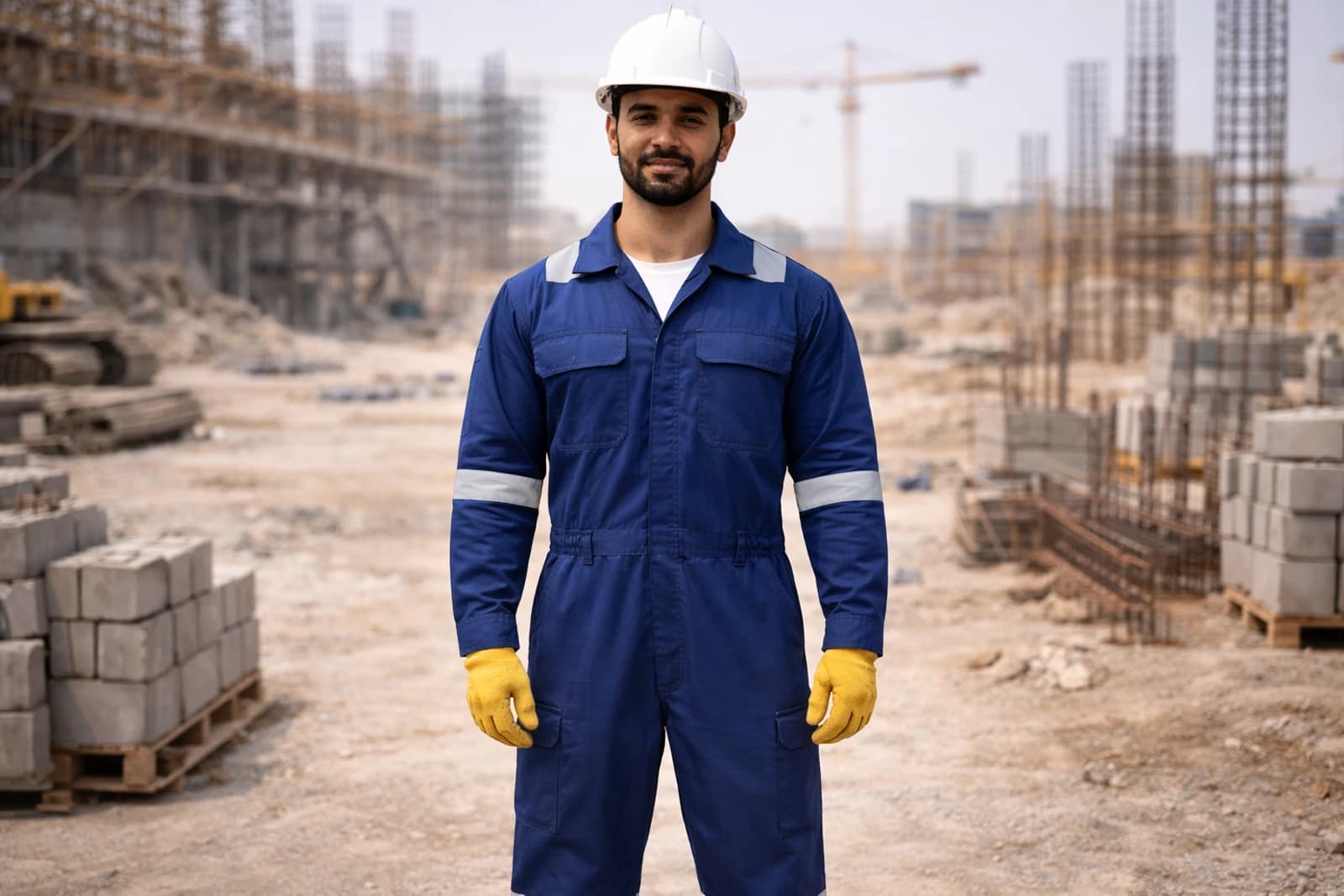
Industrial Workwear
Industrial Coverall Pro
Hard-wearing one-piece coverall for plant, maintenance, and heavy-duty operations.
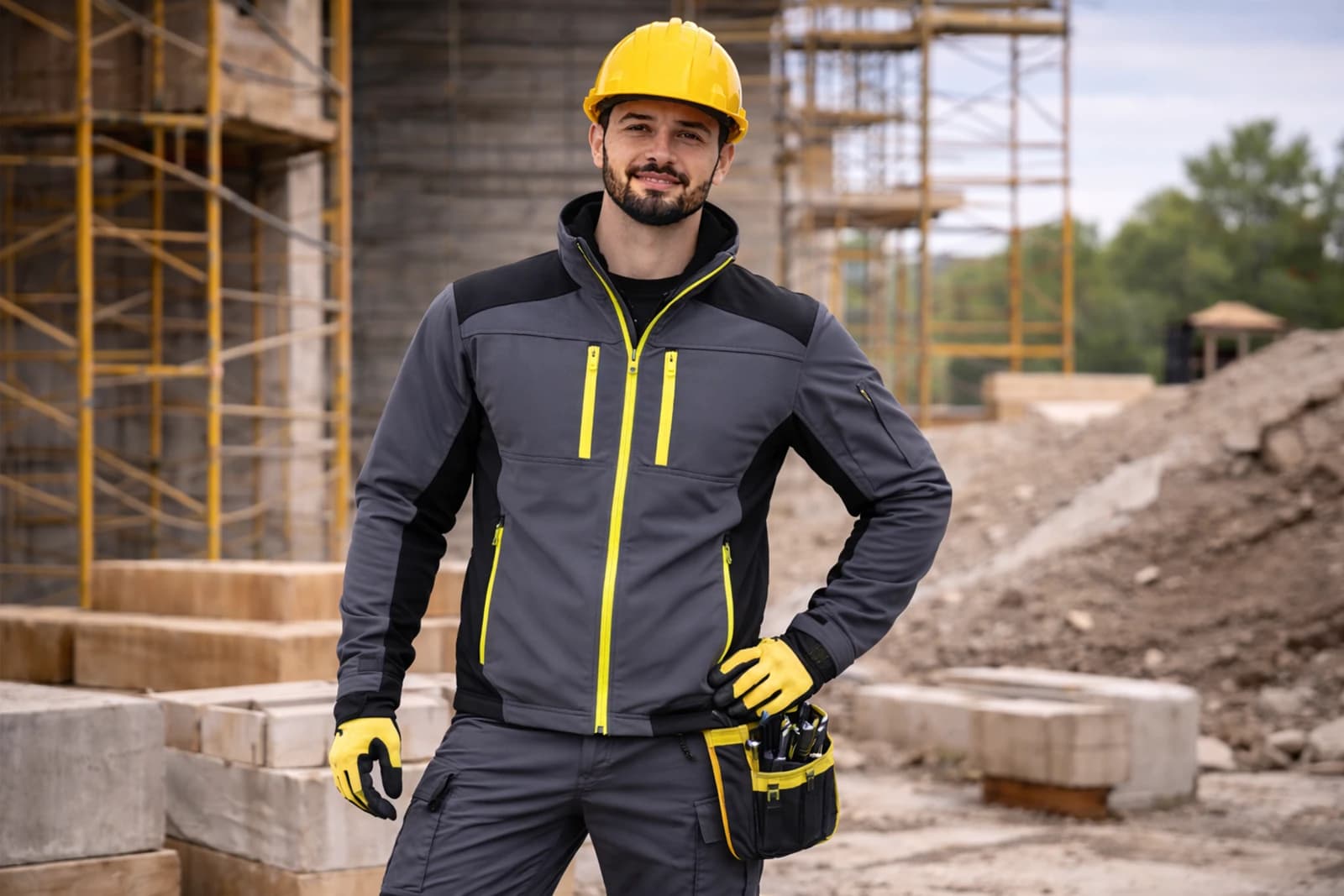
Construction Clothing
Construction Softshell Set
Flexible jacket and trouser set built for crews working across changing weather conditions.