Oil & Gas Workwear for Middle East Petrochemical Facilities: FR Coveralls and Hi-Vis Safety Jackets from a Chinese Manufacturer
Middle East oil & gas and petrochemical facilities — from Saudi Aramco refineries to ADNOC plants and QatarEnergy LNG terminals — require flame-resistant (FR) workwear that meets international safety standards while keeping workers comfortable in extreme Gulf heat. This guide covers when to specify FR industrial coveralls, how hi-vis safety jackets integrate into layered FR systems, and what B2B buyers in the GCC energy sector should look for when sourcing from a specialized Chinese workwear manufacturer.

Buyer context
What procurement teams run into
Middle East oil & gas and petrochemical facilities — from Saudi Aramco refineries in Jubail and Yanbu to ADNOC's onshore and offshore operations and QatarEnergy's LNG processing plants — operate in environments where the combination of flammable hydrocarbons, high-pressure processing equipment, and extreme ambient heat creates one of the world's most demanding workwear challenges. Procurement teams at these facilities must specify flame-resistant (FR) workwear that meets international standards such as NFPA 2112, EN ISO 11612, or IEC 61482-2 (arc flash) while remaining wearable in Gulf summer conditions where temperatures exceed 50°C and humidity can reach 85%+. The core tension in FR workwear for the Middle East is thermal burden. FR fabrics — inherently flame-resistant fibers like meta-aramid (Nomex, Kermel) or treated cotton (Proban, Indura) — are inherently heavier and less breathable than standard workwear fabrics. A typical FR coverall in the 250–300 gsm range that is comfortable for a North Sea platform in winter becomes a heat-stress hazard when worn for a 12-hour shift in a Saudi Arabian refinery during July. Workers respond by leaving coveralls unzipped, rolling up sleeves, or removing FR outer layers — behaviors that defeat the purpose of the garment and expose workers to burns from flash fires, arc flashes, and hot surface contact. A second problem is multi-layer compatibility. Many oil & gas roles require layered FR protection: an FR coverall as the primary garment, with an FR hi-vis jacket or vest added for roles requiring high visibility (night shift workers, vehicle marshals, scaffold taggers, and emergency response teams) or additional insulation (offshore platforms, winter months, or air-conditioned control rooms with sudden outdoor exposure). But Gulf buyers frequently discover that FR coveralls from one supplier and FR hi-vis jackets from another use fabrics with different shrinkage rates, colours that fade at different speeds, and dimensions that don't layer properly — creating safety gaps, inconsistent appearance, and garments that bind or restrict movement when worn together. Certification complexity is a third major challenge. Different Middle East oil & gas operators require different standards. Saudi Aramco's SATR (Supplier Acceptance and Technical Rejection) process demands specific fabric certifications and in-country testing. ADNOC's HSE standards reference international norms with local amendments. QatarEnergy follows yet another framework. International suppliers like Carhartt and Bulwark offer certified FR products but at Gulf pricing premiums of 2–3× and lead times of 12–20 weeks. Many Chinese FR manufacturers can produce compliant garments at competitive pricing but lack the documentation, testing, or client references that Gulf NOC procurement teams require. Colour standardization across a large energy workforce is another persistent issue. Most Middle East oil & gas operators use colour-coded uniforms: white for management and engineers, navy blue for operations, orange for maintenance, red for emergency response, green for HSE, and grey for contractors and visitors. Maintaining consistent FR fabric colour across multiple garment types (coveralls, jackets, boiler suits) and across repeat orders over 2–3 year contract cycles requires a manufacturer with strict dye-lot control and colour-fastness testing — capabilities that many generic workwear suppliers do not prioritize. Finally, there is the question of extended sizing. Gulf energy workforces include a wide range of nationalities and body types — Saudi nationals, expatriates from South Asia and Southeast Asia, Western technical specialists — all requiring different fit profiles. A one-size-fits-all approach to FR coveralls leads to garments that are too long for shorter workers (creating trip hazards and drag risks around rotating equipment) or too tight across the shoulders and chest for larger workers (restricting mobility and reducing the air gap that provides thermal insulation in a flash fire event).
Sourcing approach
How a factory partner can respond
The most effective workwear strategy for Middle East oil & gas and petrochemical facilities is an integrated FR garment system — with flame-resistant industrial coveralls as the primary layer and FR-rated hi-vis safety jackets as the secondary layer — sourced from a single manufacturer who offers certified FR materials, Gulf-optimized fabric weights, and consistent colour-matching across product types. **Primary layer: FR industrial coveralls (industrial-coverall-pro in FR configuration).** For workers in hydrocarbon processing areas — refinery operators, gas plant technicians, wellhead maintenance crews, and pipeline fitters — the FR coverall is the fundamental protection layer. Request the following specifications for Gulf conditions: a 220–260 gsm inherent FR fabric (meta-aramid or FR viscose blend rather than treated cotton, which loses FR properties after repeated industrial washing at 60–75°C and has higher thermal burden); a generous cut through the chest and upper arm for mobility and air circulation; a two-way front zipper that allows unzipping from the bottom for ventilation without full garment removal; underarm gussets and back pleats for unrestricted reaching and bending around pipe racks and vessel manways; and closure-free pocket designs (snap or concealed) to avoid ignition or snag hazards on equipment. Key certifications: NFPA 2112 (flash fire) or EN ISO 11612 (heat and flame), with documentation from an accredited third-party lab. For workers near energized electrical equipment (instrument technicians, electrical maintenance), add IEC 61482-2 arc flash rating to the same coverall platform. **Secondary layer: FR-rated hi-vis safety jackets (hi-vis-safety-jacket in FR configuration).** Workers who need high visibility and/or an additional thermal layer — night shift operators, vehicle marshals, scaffold inspectors, emergency response teams, and safety officers moving between indoor control rooms and outdoor process areas — should wear an FR-rated hi-vis safety jacket over their FR coveralls. Critical considerations for Gulf conditions: specify a 160–200 gsm FR hi-vis fabric in fluorescent yellow-orange or orange-red with FR reflective tape (EN ISO 20471 Class 2 or Class 3); the jacket must be designed with sufficient room to layer over the FR coverall without restricting arm lift, bending, or climbing; include underarm vent zippers and a mesh back panel for airflow in high-temperature outdoor work; and ensure the jacket's FR rating (EN ISO 11612 or NFPA 2112) matches the base layer so that both garments together provide equivalent protection. The jacket should also feature radio/phone pocket placement compatible with a two-way radio worn on the belt or chest — a common requirement for permit-to-work coordination and emergency communications on large sites. **Integrated FR system — why one manufacturer matters.** Sourcing both FR coveralls and FR hi-vis jackets from the same manufacturer delivers three critical benefits for Middle East oil & gas buyers. First, certified system layering: when both garments come from the same FR fabric and design platform, the thermal protection performance (TPP) rating of the combined system is known and documented, rather than an unknown composite of two independent garments. Second, colour consistency: FR fabrics are more difficult to colour-match than standard fabrics because the flame-resistant treatment affects dye uptake — a single manufacturer guarantees consistent navy blue or orange across both coveralls and jackets over multiple production runs. Third, proportional sizing across FR product types: a size 'L' FR coverall and a size 'L' FR hi-vis jacket from the same manufacturer are designed to layer together, with the jacket cut 1–2 sizes wider than the coverall for proper fit without excess bulk. **Fabric selection for Gulf heat.** For Middle East oil & gas applications, prioritize inherent FR fabrics (meta-aramid / para-aramid blends, FR modacrylic, FR viscose) over chemically treated cottons. Inherent FR fabrics maintain their flame-resistant properties for the life of the garment regardless of washing frequency or methodology, while treated cottons lose protection after 25–50 industrial wash cycles — a critical difference for Gulf facilities where uniforms are laundered industrially at high temperatures 2–3 times per week. Inherent FR fabrics also offer superior moisture management and 10–15% lower thermal burden than equivalently rated treated cotton, translating to measurably lower heat stress risk in Gulf summer conditions. **Colour coding for role identification.** Standardize on a colour-coded FR system: white for engineers and managers (inherent FR, clean-room compatible for control centers), navy blue for operations and process technicians, orange for maintenance and turnaround crews, red for emergency response and fire teams, green for HSE and safety inspectors, grey or khaki for contractor personnel. Require the manufacturer to batch-test colour consistency across all FR products within a Delta E ≤ 1.0 tolerance — the threshold below which the human eye cannot distinguish colour differences under typical processing area lighting. **Sizing for a multinational workforce.** Request an extended size range covering 3XS through 5XL, with proportional grading that accounts for differences in height-to-torso ratio across ethnicities. Special-order shorter-length FR coveralls (option 'S' in sleeve and inseam) for workers under 165 cm to prevent fabric dragging near rotating equipment. Request a full sizing fit trial with 10–20 workers covering the range of body types on site before committing to bulk production. **Sourcing from a Chinese manufacturer with oil & gas capability.** The right Chinese FR workwear partner for Middle East energy sector buyers should offer: inherent FR fabric options (not just treated cotton) with certified testing to NFPA 2112, EN ISO 11612, and IEC 61482-2; a platform that integrates FR coveralls and FR hi-vis jackets from the same FR fabric family for certified layering; colour consistency (Delta E ≤ 1.0) across FR products and production runs; Gulf-adapted fabric weights (220–260 gsm for coveralls, 160–200 gsm for hi-vis jackets) with documented moisture management and thermal burden data; sizing across a multinational range with short/tall options; and experience supplying national oil companies or international energy contractors with SATR or equivalent qualification processes. Request pre-production samples in every colour and garment type, specifying which NOC or contractor qualification standards the samples must meet. Include wash-test documentation showing FR property retention, colour fastness, and reflective tape adhesion after 50+ industrial wash cycles at 75°C. A Chinese manufacturer who understands the thermal burden problem in Gulf energy workwear — and who can show you their inherent FR fabric options, certified layering system, and extended sizing program — is the right partner for a multi-year Middle East oil & gas workwear contract.
Recommended Products
Products that fit this use case
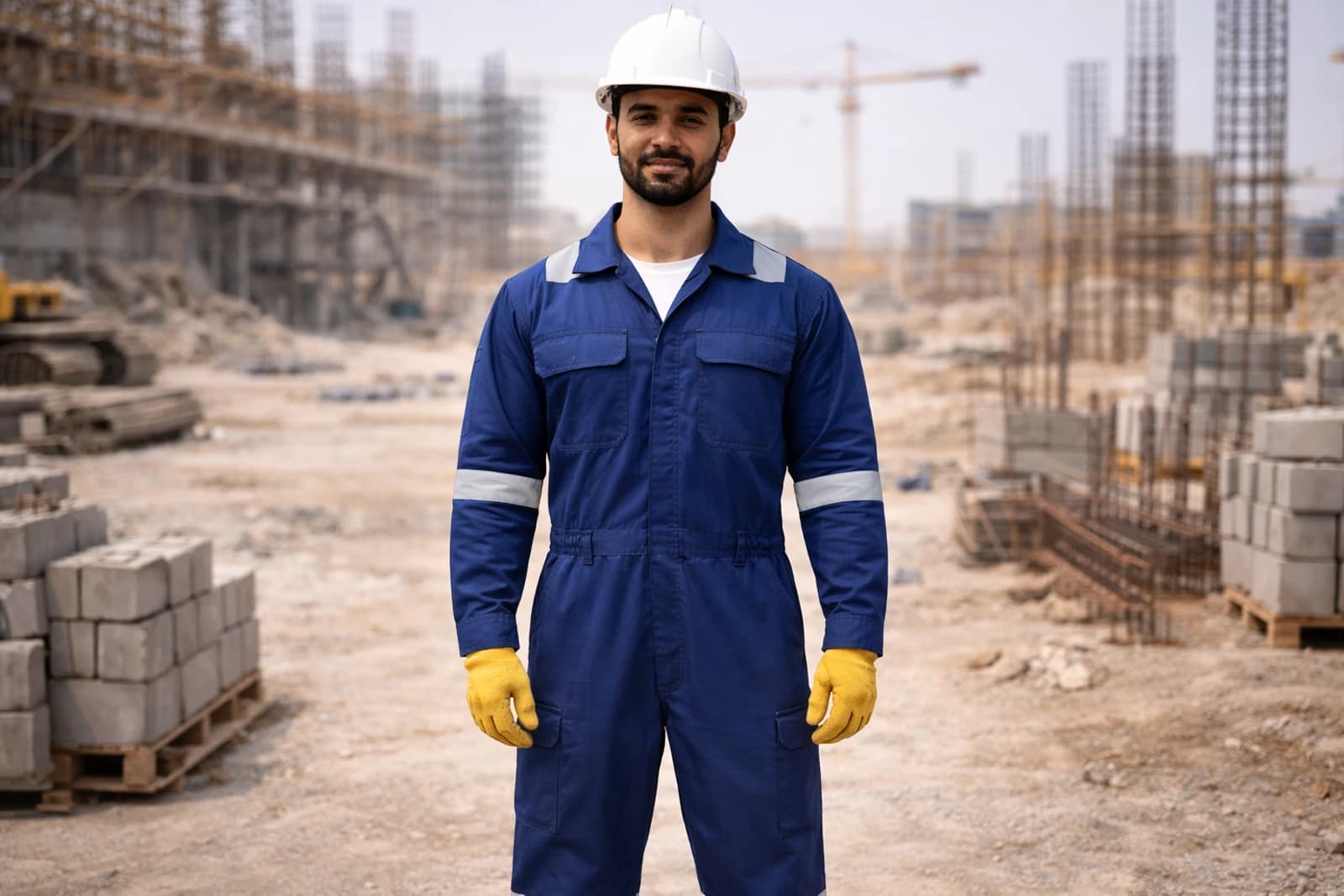
Industrial Workwear
Industrial Coverall Pro
Hard-wearing one-piece coverall for plant, maintenance, and heavy-duty operations.
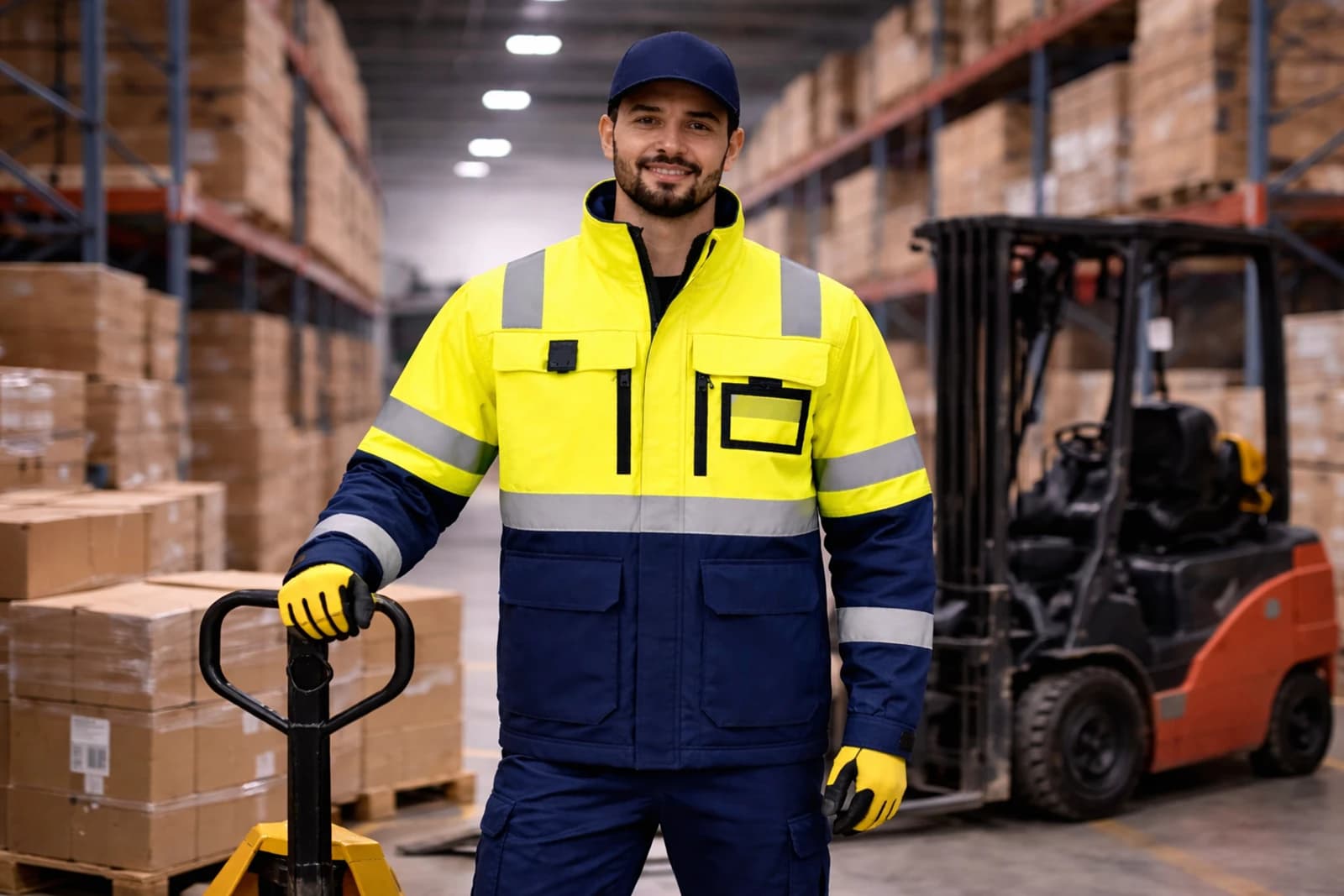
Safety Uniform
Hi-Vis Safety Jacket
Reflective safety jacket for high-visibility site operations and road work crews.