Pre-Production Sample Approval Does Not Prevent Bulk Fabric Lot Variation
Workwear buyers approve a pre-production sample — checking fit, style, stitching, and fabric hand-feel — and assume bulk production will match. But the sample is made from a single fabric roll, while bulk production uses multiple rolls from different dye lots. Fabric properties (GSM, shrinkage, colour, hand-feel) vary roll-to-roll within the manufacturer's tolerance. Without bulk-level controls, the buyer receives garments that differ from the approved sample in weight, dimensions after wash, and colour — even though the sample was approved correctly. This article covers the gap between sample approval and bulk fabric consistency, and the procurement controls that close it.

Buyer context
What procurement teams run into
Workwear buyers approve a pre-production sample — checking fit, style, stitching, and fabric hand-feel — and assume bulk production will match. But the sample is made from a single fabric roll, while bulk production uses multiple rolls from different dye lots. Fabric properties (GSM, shrinkage, colour, hand-feel) vary roll-to-roll within the manufacturer's tolerance. Without bulk-level controls, the buyer receives garments that differ from the approved sample in weight, dimensions after wash, and colour — even though the sample was approved correctly. The procurement process has a control gap: sample approval controls the garment style, but does not control the bulk fabric lot. **1. The pre-production sample is made from a single fabric roll — bulk production uses multiple rolls** A pre-production sample is typically made from 2–3 metres of fabric taken from a single roll. The sample is checked for fit (pattern and grading), style (construction, stitching, trims, pockets, closures), and fabric quality (hand-feel, weight, colour). If the sample passes, the buyer approves it and bulk production proceeds. But bulk production of 500–5,000 garments requires 2,000–20,000 metres of fabric — sourced from 10–50 rolls. These rolls come from different dye lots (batches of fabric dyed at different times). Even within the same fabric specification (same fibre composition, same GSM target, same colour standard), roll-to-roll variation exists: - **GSM variation:** A fabric specified at 220 GSM may vary ±5–8% roll-to-roll (i.e., 209–231 GSM for a ±5% tolerance). The sample was made from a roll at 220 GSM; bulk rolls may range from 210 to 230 GSM. The garment weight differs from the sample. - **Shrinkage variation:** Fabric shrinkage after washing varies by dye lot. A fabric with a target shrinkage of ±3% may actually shrink 2% in one roll and 4% in another. The sample garment was made from a roll that shrank 2%; bulk garments from a roll that shrinks 4% will be smaller after the first wash — even though the pre-wash dimensions matched the sample. - **Colour variation:** Dye lots vary in colour even when matched to the same standard. The sample was made from a roll that matched the approved lab dip; bulk rolls from a different dye lot may be slightly lighter or darker. The colour difference is not visible when comparing a single bulk garment to the sample — but when 500 garments from different dye lots are issued together, the colour inconsistency is visible. - **Hand-feel variation:** Fabric hand-feel (softness, stiffness, drape) varies with yarn batch, weaving tension, and finishing chemistry. The sample had a specific hand-feel that the buyer approved; bulk fabric from a different yarn batch or finishing run may feel slightly different. **2. Sample approval checks the garment, not the fabric lot** The pre-production sample approval process typically checks: - **Fit:** Garment dimensions match the size spec (chest, waist, inseam, sleeve length, etc.) - **Style:** Construction matches the tech pack (stitching type, seam allowance, pocket placement, closure type, trim colour, label placement) - **Fabric:** Fabric hand-feel, weight, and colour are acceptable The sample approval does not typically check: - **Fabric GSM tolerance:** The sample's fabric weight is measured once and accepted. There is no requirement to measure GSM across multiple rolls in bulk production. - **Fabric shrinkage consistency:** The sample is washed once (or not washed) and dimensions are measured. There is no requirement to measure shrinkage across multiple fabric rolls. - **Colour consistency across dye lots:** The sample's colour is compared to the approved lab dip. There is no requirement to check colour consistency across all fabric rolls used in bulk production. - **Garment dimensions after wash across fabric lots:** The sample garment is measured after wash (if wash testing is done at all). There is no requirement to measure garment dimensions after wash for garments made from different fabric rolls. The result: the sample is approved correctly — it meets all the checked criteria. But the bulk fabric lots are not controlled to the same standard, and the bulk garments differ from the sample in ways that the sample approval process did not check. **3. The variation is within the fabric manufacturer's tolerance — but creates garment-level problems** Fabric manufacturers specify tolerances for their products: - GSM tolerance: typically ±5% (some manufacturers specify ±3% for premium fabrics) - Shrinkage tolerance: typically ±3% (some manufacturers specify ±2%) - Colour tolerance: typically ΔE ≤ 1.0 (some buyers specify ΔE ≤ 0.5) These tolerances are acceptable for the fabric manufacturer — the fabric is within specification. But when the tolerances accumulate across multiple rolls, the garment-level variation becomes visible: - A ±5% GSM tolerance on a 220 GSM fabric means bulk garments range from 209 to 231 GSM — a 10% range. Workers receiving garments from different GSM rolls notice the weight difference. - A ±3% shrinkage tolerance means garments from different rolls shrink differently after the first wash. Two garments of the same size, washed in the same conditions, end up with different dimensions. One fits; the other is too small or too large. - A ΔE ≤ 1.0 colour tolerance means bulk garments from different dye lots are within the tolerance — but when 50 garments from 5 different dye lots are issued to a team, the colour variation across the team is visible. The fabric is within the manufacturer's tolerance. The garments are not within the buyer's expectation. The gap is caused by the lack of bulk-level controls. **4. The top-of-production (TOP) sample closes the gap between pre-production sample and bulk fabric** The top-of-production (TOP) sample is a garment made from actual bulk production fabric — taken from the first rolls cut in bulk production. The TOP sample is sent to the buyer for approval before bulk cutting proceeds. The TOP sample checks: - **Fabric from actual bulk rolls:** The TOP sample's fabric is from the same rolls used in bulk production — not from a separate sample roll. If the bulk fabric differs from the pre-production sample fabric, the TOP sample reveals the difference. - **Garment dimensions from bulk fabric:** The TOP sample is measured pre-wash and after wash, using the actual bulk fabric's shrinkage behaviour. If the bulk fabric shrinks differently from the sample fabric, the TOP sample reveals the dimension difference. - **Colour from actual bulk dye lots:** The TOP sample's colour is from the actual bulk dye lots. If the bulk colour differs from the approved lab dip, the TOP sample reveals the colour difference. The TOP sample is the buyer's last opportunity to reject bulk fabric before cutting proceeds. If the TOP sample does not match the approved pre-production sample (in fabric weight, dimensions after wash, or colour), the buyer can reject the bulk fabric lot and require the manufacturer to source fabric that matches the approved sample. Without a TOP sample, the buyer discovers the fabric variation only when the finished garments arrive — at which point the cost of rejection (return shipping, re-production, delivery delay) is much higher than the cost of rejecting fabric before cutting. **5. Bulk fabric test reports provide documented evidence of fabric consistency** The procurement specification should require the fabric manufacturer to provide test reports for each fabric roll (or each dye lot) used in bulk production: - **GSM test report:** Measured GSM for each roll, confirming it is within the specified tolerance (e.g., 220 GSM ±5%). - **Shrinkage test report:** Measured shrinkage after 3 wash cycles at 60°C for each dye lot, confirming it is within the specified tolerance (e.g., ±3% in both warp and weft). - **Colour test report:** Measured colour (spectrophotometer reading, ΔE value) for each dye lot, compared to the approved lab dip, confirming it is within the specified tolerance (e.g., ΔE ≤ 1.0). These test reports are provided by the fabric manufacturer before the fabric is released for cutting. The garment manufacturer reviews the test reports and confirms that all fabric rolls are within tolerance before proceeding. If any roll is outside tolerance, it is rejected and replaced. Without bulk fabric test reports, the buyer has no documented evidence that the bulk fabric matches the approved sample. The garment manufacturer may proceed with fabric that is technically within the fabric manufacturer's tolerance — but that produces garments that differ from the approved sample. **6. The procurement specification gap: sample approval without bulk controls** Most workwear procurement specifications include a sample approval step but do not include bulk-level controls: - **Pre-production sample:** Required and approved. ✓ - **Top-of-production (TOP) sample:** Not required. ✗ - **Bulk fabric test reports (GSM, shrinkage, colour per roll/dye lot):** Not required. ✗ - **Garment dimension tolerance after wash (measured on bulk production garments):** Not specified. ✗ - **Colour consistency requirement across dye lots (ΔE per dye lot, maximum ΔE across all dye lots):** Not specified. ✗ The procurement specification controls the garment style (through the approved sample) but does not control the bulk fabric lot. The result is a consistent pattern: the sample is approved correctly, but the bulk garments differ from the sample in fabric weight, dimensions after wash, and colour — creating worker complaints, issuance problems, and re-procurement cost.
Sourcing approach
How a factory partner can respond
The solution is to add bulk-level fabric controls to the procurement specification — closing the gap between sample approval and bulk fabric consistency. **Step 1: Require a top-of-production (TOP) sample from actual bulk fabric** Before bulk cutting proceeds, the garment manufacturer must submit a TOP sample made from actual bulk production fabric (taken from the first rolls cut in bulk production). The TOP sample must be checked for: - Fabric weight (GSM): measured and compared to the approved pre-production sample. Acceptable tolerance: ±3% from the sample's measured GSM. - Garment dimensions pre-wash and after 3 wash cycles at 60°C: compared to the approved pre-production sample's dimensions. Acceptable tolerance: ±2% in all critical dimensions (chest, waist, inseam, sleeve length). - Colour: compared to the approved lab dip using a spectrophotometer. Acceptable tolerance: ΔE ≤ 1.0. The buyer must approve the TOP sample before bulk cutting proceeds. If the TOP sample does not match the approved pre-production sample, the buyer can reject the bulk fabric lot and require the manufacturer to source fabric that matches the approved sample. **Step 2: Require bulk fabric test reports for each dye lot** The procurement specification must require the fabric manufacturer to provide test reports for each dye lot used in bulk production: - GSM test report: measured GSM for each roll, confirming it is within ±5% of the target GSM (or ±3% if specified). - Shrinkage test report: measured shrinkage after 3 wash cycles at 60°C for each dye lot, confirming it is within ±3% in both warp and weft. - Colour test report: spectrophotometer reading (ΔE value) for each dye lot, compared to the approved lab dip, confirming it is within ΔE ≤ 1.0. These test reports must be provided before the fabric is released for cutting. The garment manufacturer reviews the test reports and confirms all fabric rolls are within tolerance. If any roll is outside tolerance, it is rejected and replaced before cutting. **Step 3: Specify garment dimension tolerance after wash for bulk production** The procurement specification must specify garment dimension tolerance after wash — not just pre-wash dimensions: - Pre-wash dimensions: must match the approved sample within ±1.5% in all critical dimensions. - After-wash dimensions (after 3 wash cycles at 60°C): must match the approved sample's after-wash dimensions within ±2% in all critical dimensions. - Shrinkage: must be within ±3% in both warp and weft (measured on fabric from each dye lot). The after-wash dimension tolerance ensures that garments from different fabric dye lots end up with the same dimensions after the first wash — even if the pre-wash dimensions vary slightly to compensate for different shrinkage rates. **Step 4: Specify colour consistency requirements across dye lots** The procurement specification must specify colour consistency requirements: - Each dye lot: ΔE ≤ 1.0 compared to the approved lab dip (measured by spectrophotometer). - Maximum colour difference across all dye lots used in a single order: ΔE ≤ 1.5 between the lightest and darkest dye lot. The maximum across-lot tolerance ensures that garments from different dye lots — when issued together to a team — do not show visible colour variation. A ΔE ≤ 1.5 across all dye lots means the colour difference is not visible to the naked eye in normal lighting conditions. **Step 5: Implement inline inspection during cutting and sewing** The garment manufacturer must implement inline inspection during cutting and sewing to catch fabric variation before it becomes a finished garment: - **Cutting stage:** Measure fabric GSM from each roll before cutting. Reject rolls outside tolerance. Mark rolls by dye lot to ensure garments from the same dye lot are grouped together (reducing colour variation within a single garment size). - **Sewing stage:** Inspect garments at the end of the sewing line for fabric defects, colour variation, and construction quality. Remove garments with visible fabric defects or colour variation. - **Final inspection:** Measure garment dimensions (pre-wash) for a statistical sample of finished garments (e.g., 10% of each size). Confirm dimensions are within tolerance. Wash a sub-sample (e.g., 5 garments per size) and measure after-wash dimensions to confirm shrinkage is within tolerance. **Step 6: Pilot the bulk control process before full commitment** Before requiring bulk fabric controls for all orders, pilot the process with one order: - Require TOP sample approval before bulk cutting. - Require bulk fabric test reports for each dye lot. - Specify garment dimension tolerance after wash. - Specify colour consistency requirements across dye lots. - Implement inline inspection during cutting and sewing. Measure the outcome: - Did the TOP sample reveal fabric variation that would have been missed without the TOP sample check? - Were any fabric rolls rejected based on bulk fabric test reports? - Did bulk garments match the approved sample in fabric weight, dimensions after wash, and colour? - What was the cost of the bulk control process (TOP sample preparation, test reports, inline inspection) compared to the cost of re-procurement if bulk garments had not matched the sample? Use pilot data to confirm the value of bulk fabric controls before requiring them for all orders. **Recommended garments for procurement with bulk fabric controls:** - **Industrial coverall-pro** — specify with bulk fabric controls: TOP sample from actual bulk fabric, bulk fabric test reports (GSM, shrinkage, colour per dye lot), garment dimension tolerance after wash (±2% in all critical dimensions after 3 wash cycles at 60°C), and colour consistency across dye lots (ΔE ≤ 1.0 per dye lot, ΔE ≤ 1.5 across all dye lots). The coverall's fit and comfort depend on consistent fabric shrinkage — bulk fabric controls ensure that all coveralls, regardless of dye lot, fit the same after the first wash. - **Construction softshell set** — specify with bulk fabric controls: TOP sample from actual bulk fabric, bulk fabric test reports for the shell fabric and lining fabric (separate test reports for each), garment dimension tolerance after wash, and colour consistency across dye lots. The softshell set's layered construction (shell + lining) requires consistent shrinkage in both fabrics — if the shell and lining shrink at different rates, the garment distorts after washing.
Recommended Products
Products that fit this use case

Industrial Workwear
Industrial Coverall Pro
Hard-wearing one-piece coverall for plant, maintenance, and heavy-duty operations.
Construction Clothing
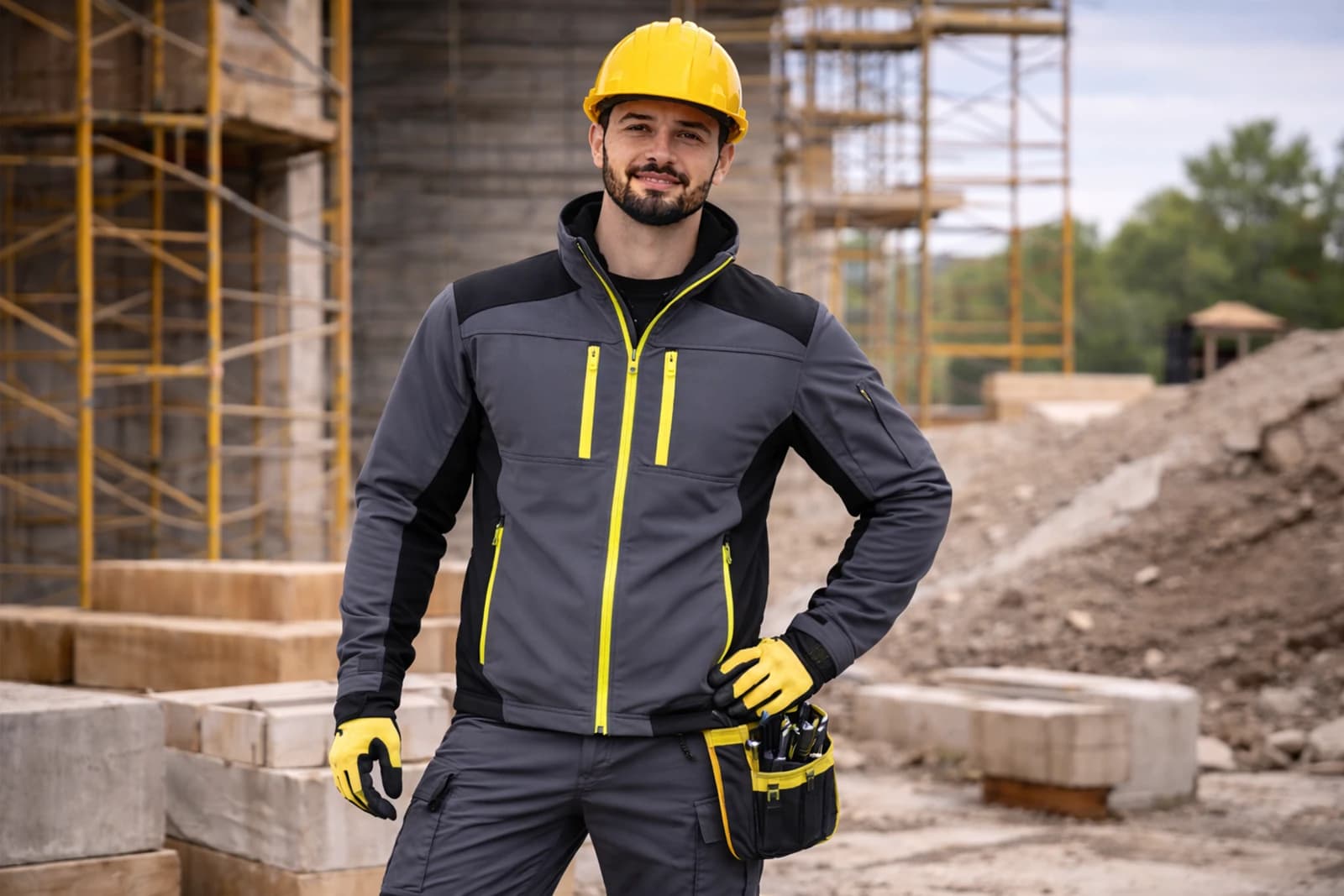
Construction Softshell Set
Flexible jacket and trouser set built for crews working across changing weather conditions.