Recycling Workwear Must Survive Biological Contamination and Mechanical Abrasion
Recycling facilities expose workers to biological hazards (bacteria, mold, decomposing organic matter, sharp contaminated objects) and mechanical hazards (abrasion from sharp objects, puncture from metal and glass, tearing from heavy loads). Most specifications treat these as separate problems — selecting biological-resistant fabric OR mechanical-resistant fabric — but recycling workwear must handle both simultaneously. This article covers the fabric selection criteria that resist both biological degradation and mechanical abrasion, the construction features that prevent contamination trapping and mechanical failure, and the laundering validation that proves garments can be effectively decontaminated without degrading fabric properties.
Buyer context
What procurement teams run into
Recycling facilities — sorting municipal solid waste, construction and demolition debris, electronic waste, plastics, metals, and paper — expose workers to simultaneous biological and mechanical hazards that degrade standard workwear fabrics rapidly. Workers handle contaminated materials (decomposing organic matter, food waste, medical waste, diapers, animal carcasses), sharp objects (broken glass, metal fragments, nails, wire), and abrasive materials (concrete, brick, rough wood, contaminated plastics) throughout every shift. The biological and mechanical hazards act together: biological contamination weakens fabric fibers, and mechanical abrasion removes fabric surface that resists biological penetration. The result: standard workwear fabrics degrade rapidly in recycling environments, failing both biologically (harboring bacteria, retaining odors, resisting decontamination) and mechanically (tearing, puncturing, abrading through) within weeks rather than months. The mechanism: **1. Biological contamination weakens fabric fibers and creates contamination reservoirs** Recycling workers contact biological contaminants throughout every shift: bacteria from decomposing organic matter, mold spores from wet paper and cardboard, viruses from contaminated medical waste, and endotoxins from bacterial cell walls. These biological contaminants penetrate fabric fibers and create contamination reservoirs that resist standard laundering. The root cause: standard workwear fabrics are not designed for biological resistance. Cotton and cotton-blend fabrics absorb biological contaminants into fiber structure, creating reservoirs that harbor bacteria and resist decontamination. Synthetic fabrics (polyester, nylon) resist absorption but create smooth surfaces where biological contaminants adhere and resist removal through laundering. **2. Mechanical abrasion removes fabric surface that resists biological penetration** Recycling workers handle sharp, abrasive materials throughout every shift: broken glass, metal fragments, concrete, brick, rough wood, and contaminated plastics. These materials abrade fabric surfaces, removing the tight-weave structure that prevents biological contaminants from penetrating fabric. The root cause: mechanical abrasion and biological resistance are linked. A fabric that resists biological penetration at receipt (tight weave, smooth surface) loses that resistance as abrasion loosens the weave and creates surface roughness. The abraded fabric allows biological contaminants to penetrate more easily, creating contamination pathways that didn't exist at receipt. **3. Puncture and tear failures create direct contamination pathways** Sharp objects (nails, wire, glass shards, metal fragments) puncture and tear workwear fabric, creating direct pathways for biological contaminants to contact skin. A puncture or tear bypasses the fabric's biological resistance entirely — the contaminant contacts skin directly through the hole. The root cause: standard workwear fabrics are not designed for puncture and tear resistance in recycling environments. Lightweight fabrics (below 250 gsm) and loose-weave fabrics puncture and tear easily when workers handle sharp objects. The puncture or tear creates an immediate contamination pathway that biological resistance cannot address. **4. Garment construction features trap biological contaminants and create mechanical failure points** Standard workwear construction includes features that trap biological contaminants and create mechanical failure points: - **External pockets with flaps:** biological contaminants (decomposing matter, wet organic material) fall into pockets and become trapped between the pocket flap and pocket body. The trapped material decomposes, creating odor and bacterial colonization that resists laundering. Sharp objects in pockets abrade pocket fabric from inside, creating mechanical failure. - **Cuffs and wrist closures:** biological contaminants enter through open cuffs and become trapped between cuff and wrist. Elastic cuffs stretch out from repeated contact with sharp objects, losing closure integrity and creating contamination pathways. - **Seams and stitching:** raised seams and exposed stitching create ridges where biological contaminants accumulate. Seams are mechanical failure points — sharp objects catch on raised seams and pull stitching loose, creating seam failure. - **Waistbands and belt lines:** biological contaminants fall into waistband gaps and become trapped between waistband and skin. Loose waistbands create contamination pathways and mechanical failure points where sharp objects catch. The root cause: standard workwear construction is optimized for utility and ease of dressing — not for biological contamination management and mechanical resistance in recycling environments. Garment features that create pockets, gaps, and ridges become biological contamination traps and mechanical failure points. **5. Laundering degrades fabric properties not validated for recycling conditions** Recycling workwear requires frequent industrial laundering to remove biological contaminants, soil, and odor. Industrial laundering degrades fabric properties: - **Wash durability:** repeated washing loosens fabric weave, degrades fabric surface, and reduces biological resistance. Garments that resist biological penetration at receipt may not resist penetration after 25-50 wash cycles. - **Drying degradation:** high-temperature drying degrades fabric fibers, reducing tensile strength and tear resistance. Garments that resist mechanical failure at receipt may not resist failure after repeated high-temperature drying. - **Chemical degradation:** industrial detergents and sanitizers degrade fabric fibers, reducing biological resistance and mechanical strength. Garments exposed to harsh chemicals degrade faster than garments laundered with mild detergents. The root cause: without wash durability validation for recycling conditions, buyers cannot prove that garments maintain biological resistance and mechanical strength throughout service life. A garment that performs well at receipt may fail biologically and mechanically after repeated industrial laundering. **6. The cost of getting it wrong** The buyer who specifies standard workwear for recycling facilities without addressing biological contamination and mechanical abrasion faces: - Biological contamination risk (bacteria, mold, viruses contacting skin through degraded fabric) - Mechanical injury risk (punctures, tears, abrasions from sharp objects penetrating degraded fabric) - Odor and hygiene complaints (garments retaining biological contaminants and odors after laundering) - Budget waste (replacing garments that degrade prematurely, under-replacing garments that lose biological and mechanical resistance after washing) The buyer who specifies recycling-appropriate workwear faces: - Biological contamination controlled (fabric resists biological penetration and can be effectively decontaminated) - Mechanical injury risk reduced (fabric resists puncture, tear, and abrasion from sharp objects) - Garment hygiene maintained (garments can be effectively decontaminated through industrial laundering) - Garment service life optimized (wash-durable fabric maintains biological and mechanical resistance through repeated laundering)
Sourcing approach
How a factory partner can respond
The solution is a recycling facility workwear specification that addresses biological contamination resistance, mechanical abrasion resistance, construction features that prevent contamination trapping and mechanical failure, and laundering validation that proves garments can be effectively decontaminated without degrading fabric properties. **Step 1: Specify tight-weave, heavyweight fabric that resists both biological penetration and mechanical abrasion** For recycling facility workwear, specify fabrics that prevent biological contaminants from penetrating fabric and resist mechanical abrasion from sharp objects: - **Tight-weave cotton or cotton-blend fabric:** specify fabric with a tight weave (minimum 280 gsm for sorting and handling areas) that prevents biological contaminants from penetrating between yarns. Tight-weave fabrics create a smooth surface that resists biological penetration and mechanical abrasion. Cotton fabric absorbs biological contaminants but can be effectively decontaminated through industrial laundering with appropriate detergents and sanitizers. - **Heavyweight fabric:** specify fabric weight of 280-320 gsm for high-exposure areas (sorting lines, manual handling, contaminated material processing). Heavier fabrics have tighter weave structures and more fiber mass to resist biological penetration and mechanical abrasion. Lightweight fabrics (below 250 gsm) allow biological penetration and mechanical failure even with tight weave. - **Wash durability:** require supplier testing data confirming that fabric maintains tight weave, biological resistance, and mechanical strength after 25, 50, and 75 wash cycles. The testing data proves that garments maintain biological and mechanical resistance throughout service life. The fabric specification ensures that garments prevent biological penetration and resist mechanical abrasion — the primary degradation mechanisms in recycling environments. **Step 2: Specify garment construction that eliminates contamination traps and mechanical failure points** Specify garment construction that eliminates features that trap biological contaminants and create mechanical failure points: - **No external pockets over high-exposure areas:** specify garments with no external pockets on the chest or upper body for workers in sorting and handling areas. External pockets create contamination traps where biological material accumulates and decomposes. If pockets are required, specify internal pockets accessed through a sealed opening, or specify pockets on the lower body (thigh) away from direct contamination exposure. - **Covered closures:** specify covered zippers with fabric flaps that cover the zipper teeth. Covered closures eliminate crevices where biological contaminants accumulate. Avoid exposed buttons — buttons create crevices where contaminants collect. - **Elastic or snap cuffs:** specify cuffs that close tightly around the wrist to prevent contamination entry. Elastic cuffs or snap-adjustable cuffs seal the wrist opening, preventing biological contaminants from entering and becoming trapped. Specify cuffs with reinforced elastic that maintains tension after repeated washing and contact with sharp objects. - **Closed collar:** specify garments with closed collar designs that seal the neck opening. Closed collars prevent biological contaminants from falling into the neck area. Avoid open collar designs that allow contamination entry. - **Enclosed seams:** specify flat-felled seams or bound seams that enclose raw fabric edges. Enclosed seams eliminate raised seams and stitching ridges where biological contaminants accumulate. Enclosed seams also reduce mechanical failure points — sharp objects catch less on flat seams than on raised seams. - **No loose components:** specify garments with no drawstrings, loose labels, or dangling components. Loose components create contamination traps and mechanical failure points where sharp objects catch. The construction specification ensures that garment features don't create contamination traps or mechanical failure points that accelerate degradation in recycling environments. **Step 3: Validate laundering effectiveness for biological decontamination** Recycling workwear requires frequent industrial laundering to remove biological contaminants. Validate that laundering effectively decontaminates garments: - **Laundering validation testing:** test garments after laundering for biological contamination (swab testing analyzed by laboratory), odor (sensory testing), and fabric integrity (tensile strength, tear resistance). If garments fail validation testing after laundering, adjust wash parameters (water temperature, detergent type, sanitizer concentration, rinse cycles, drying temperature) to improve decontamination effectiveness. - **Laundering process control:** monitor laundering processes (water temperature, detergent concentration, sanitizer concentration, wash duration, drying temperature) to ensure consistent decontamination. If laundering processes deviate from validated parameters, reprocess garments or remove them from service. - **Wash durability validation:** require supplier testing data confirming that fabric maintains biological resistance, mechanical strength, and dimensional stability after 25, 50, and 75 wash cycles. The testing data proves that garments can be effectively decontaminated without degrading fabric properties. The laundering validation ensures that garments are effectively decontaminated — reducing biological contamination risk and extending garment service life. **Step 4: Create a zone-based specification that matches garment coverage to each area** Recycling facilities have distinct zones with different biological and mechanical exposure levels. Specify different garments for each zone: - **High-exposure areas (sorting lines, manual handling, contaminated material processing):** specify full coverall in tight-weave, heavyweight fabric (280-320 gsm). The coverall provides full body coverage, preventing biological contamination and mechanical injury. Specify the coverall with enclosed seams, no external chest pockets, covered zippers, elastic cuffs, and closed collar. Specify the coverall with wash durability testing data confirming that fabric maintains biological and mechanical resistance after 50 wash cycles. - **Moderate-exposure areas (equipment operation, material transport, facility maintenance):** specify coverall or two-piece suit (shirt and trouser) in tight-weave fabric (250-280 gsm). These areas have lower exposure but still require biological and mechanical protection. Specify the garment with biological-resistant and mechanical-resistant construction features. - **Low-exposure areas (administrative offices, customer-facing areas, vehicle operation):** specify polo shirt and trouser in cotton or cotton-blend fabric. These areas should be free of biological and mechanical exposure — the polo provides professional appearance without the full coverage needed in high-exposure areas. Specify the polo in company-branded colors for professional appearance. The zone-based specification matches garment coverage and cost to each area's exposure level. The buyer doesn't over-specify workwear for low-exposure areas (paying for full coveralls not needed) and doesn't under-specify workwear for high-exposure areas (creating contamination and injury risk). **Step 5: Track garment condition and replace based on biological and mechanical degradation** Repeated washing and exposure degrade fabric biological resistance and mechanical strength. Track garment condition and replace garments before degradation increases contamination and injury risk: - **Wash cycle tracking:** record the number of wash cycles for each garment. Set a maximum wash cycle limit based on supplier wash durability testing (e.g., replace garments after 50 wash cycles if wash durability testing confirms fabric maintains biological and mechanical resistance through 50 cycles). - **Periodic fabric inspection:** inspect garments periodically (monthly or quarterly) for fabric degradation — weave loosening, biological staining that doesn't wash out, odor retention, seam degradation, closure damage, punctures, tears. Garments that show degradation are removed from service regardless of wash cycle count. - **Biological contamination testing:** test garments periodically for biological contamination (swab testing) after laundering. Garments that retain biological contamination above acceptance thresholds are removed from service. The tracking and replacement protocol ensures that garments are replaced before degradation increases contamination and injury risk — maintaining protection throughout garment service life. **Recommended garments for recycling facility workwear:** - **Industrial coverall-pro** — specify the coverall for sorting lines, manual handling, and contaminated material processing areas where biological and mechanical exposure is highest. The coverall's full-body coverage prevents biological contamination and mechanical injury. Specify the coverall in tight-weave, heavyweight fabric (280-320 gsm) with enclosed seams, no external chest pockets, covered zippers, elastic cuffs, and closed collar. Specify the coverall with wash durability testing data confirming that fabric maintains biological resistance and mechanical strength after 50 wash cycles. The coverall's full coverage, biological-resistant fabric, and mechanical-resistant construction make it suitable for recycling operations where biological contamination and mechanical hazards are critical. - **Hi-vis safety jacket** — specify the hi-vis jacket for yard workers, equipment operators, and vehicle traffic areas where high visibility is required for safety. The jacket's hi-vis colors and reflective tape make workers visible to vehicle and equipment operators in recycling facility yards and processing areas. Specify the jacket in tight-weave fabric (250-280 gsm) that resists biological penetration and mechanical abrasion. Specify the jacket with reflective tape that maintains visibility after repeated industrial washing and biological/ mechanical exposure. The jacket's high visibility, biological-resistant fabric, and mechanical-resistant construction make it suitable for recycling facility operations where vehicle and equipment hazards combine with biological and mechanical exposure.
Recommended Products
Products that fit this use case

Industrial Workwear
Industrial Coverall Pro
Hard-wearing one-piece coverall for plant, maintenance, and heavy-duty operations.
Safety Uniform
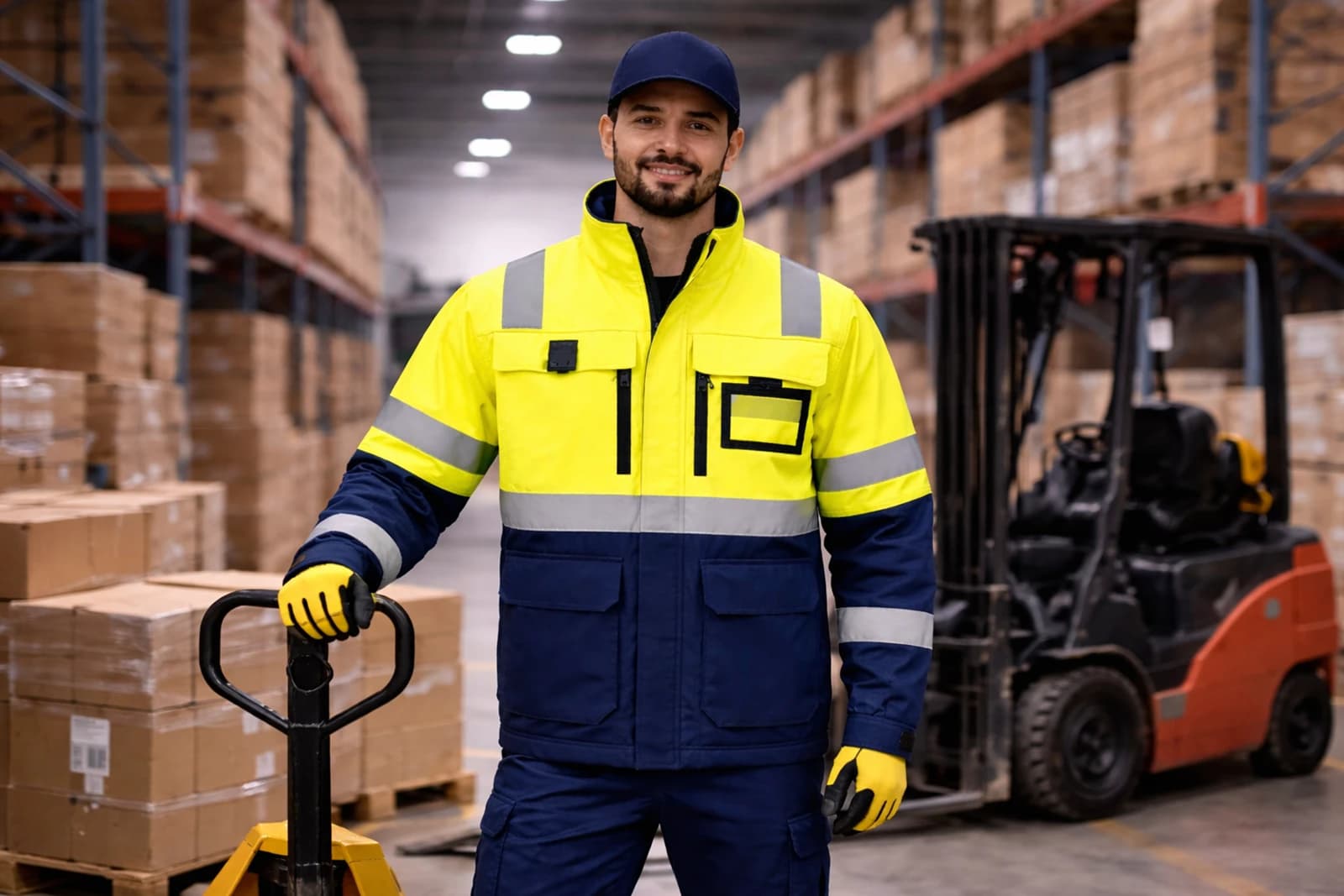
Hi-Vis Safety Jacket
Reflective safety jacket for high-visibility site operations and road work crews.