Road Construction & Highway Maintenance Workwear for Middle East Infrastructure Projects: Hi-Vis Jackets, Softshell Sets, and Polo Uniforms from a Chinese Manufacturer
Middle East governments are investing heavily in road and highway projects — from Saudi Arabia's mega infrastructure under Vision 2030 to expressway expansions across the UAE, Qatar, Oman, and Kuwait. Road construction and highway maintenance crews face a unique set of workwear demands: extreme daytime heat combined with the constant risk of moving traffic, heavy equipment, and night-shift operations. This guide covers when to spec hi-vis safety jackets vs construction softshell sets vs logistics polo uniforms for different road crew roles, what Class 3 / Class 2 hi-vis compliance looks like for Middle East road sites, and how B2B buyers can source road construction workwear from a Chinese manufacturer that understands Gulf safety requirements and site conditions.

Buyer context
What procurement teams run into
Middle East road construction and highway maintenance projects present a workwear challenge that is distinct from building construction or industrial plant work. Road crews operate in a dynamic environment where the primary hazard is not height or chemicals — it is traffic. Workers lay asphalt, install guardrails, place concrete barriers, paint lane markings, and maintain signage and lighting — all while heavy vehicles and public traffic pass within arm's length at high speed. The first and most critical requirement is high-visibility compliance. On Middle East road projects — whether it is the Riyadh Metro surface works, the Dubai-Al Ain Road widening, or the Qatar Expressway Programme — workers must be visible from all directions under both daytime glare and nighttime artificial lighting. EN ISO 20471 Class 3 hi-vis is the minimum standard for road construction workers exposed to traffic, requiring a minimum of 0.80 m² of fluorescent background material and 0.20 m² of retroreflective tape arranged in a full torso pattern (trouser stripes if wearing a full set). Many Middle East road authorities also follow the US MUTCD (Manual on Uniform Traffic Control Devices) guidance or local equivalents, requiring workers to be visible at a minimum distance of 300 metres in daytime and 500 metres at night. A simple hi-vis vest over a T-shirt is inadequate for road crews working in active traffic zones — yet many small contractors and subcontractors in the region still supply basic vests to flaggers and labourers, putting workers at unnecessary risk. Heat is the second major problem. Road construction in the Gulf happens year-round, including through the May-to-September summer when asphalt surface temperatures can reach 60–70°C and ambient temperatures exceed 48°C. Asphalt paving crews work directly on surfaces radiating this heat, and they work in close proximity to hot asphalt delivery trucks and paving machines. A standard hi-vis jacket designed for European or North American road works (typically 200–250 gsm polyester with a solid lining) is dangerously hot to wear in this environment. Workers who are given these heavy garments routinely remove them to cool down — often doing so exactly when they most need to be visible to approaching traffic. Hi-vis garments for Gulf road crews must be lightweight (130–180 gsm mesh or breathable fabric) with ventilation features (underarm mesh panels, open-weave reflective tape materials, back venting) to allow evaporative cooling. Night work is the third distinct challenge. Most major Middle East road projects — particularly highway maintenance, lane closures, and intersection upgrades — are carried out at night to avoid daytime traffic disruption. Night-shift road crews work in conditions that combine reduced visibility, artificial lighting glare, and driver fatigue. EN ISO 20471 specifies that hi-vis garments for night use must have retroreflective tape that meets a minimum coefficient of retroreflection (RA) of 330 cd/lx/m² at a 5° observation angle and 5° incidence angle. Not all hi-vis tape is created equal: cheaper imported tape can lose 30–50% of its retroreflective performance after a few industrial wash cycles. For road crews working night shifts in environments where the difference between being seen and being hit is measured in milliseconds, tape performance degradation is a life-safety issue. Fourth is the multi-role nature of road construction crews. A typical Middle East road project team includes asphalt paving crews, concrete barrier installers, steel reinforcement fixers, traffic management staff (flaggers, sign setters, lane closure supervisors), surveyors, quality inspectors, and project supervisors. Not every role needs a full hi-vis jacket. On a hot summer day, a traffic management staff member who stands in one location for eight hours directing traffic needs a hi-vis Class 3 mesh vest — not a heavy jacket — whereas a concrete barrier installer who works at ground level with heavy materials in an active lane closure zone may need both a hi-vis jacket for the approach to the work zone and a durable hi-vis polo or softshell for warmth during predawn winter shifts. Using the wrong garment for the wrong role causes discomfort, non-compliance, or both. Finally, logistics and colour coding. Road construction projects in the Middle East typically use colour-coded hi-vis to distinguish between roles at a distance: orange for most road workers and traffic control staff, yellow for supervisors and inspectors, and red for emergency response. A road construction contractor sourcing from multiple suppliers often ends up with inconsistent colour shades and tape configurations across different garment types (jackets, polos, vests), making role identification unreliable.
Sourcing approach
How a factory partner can respond
An effective road construction and highway maintenance workwear program for Middle East projects uses a role-based system of hi-vis garments adapted for the Gulf climate, with consistent colour coding and certification-grade reflective materials across all items. The goal is to keep workers visible, comfortable, and compliant across all site roles and shift conditions. **For asphalt paving crews, concrete barrier installers, and steel fixers working in active traffic zones: the hi-vis safety jacket.** The hi-vis-safety-jacket is the primary garment for road crews exposed to live traffic — the workers closest to the vehicle lane. For Middle East road projects, select a lightweight Class 3 hi-vis jacket in 130–150 gsm breathable polyester mesh with EN ISO 20471-compliant retroreflective tape. Critical features for Gulf road crews: underarm mesh ventilation panels to allow airflow while the jacket is zipped; a front zipper with a chin guard and a stand-up collar for sun protection on the back of the neck; multiple pockets sized for a two-way radio, mobile phone, and notepad (flaggers and supervisors need quick access to communication devices); and a hook-and-loop adjustable cuff to prevent the sleeves from catching on rebar, signposts, and vehicle mirrors. Specify retroreflective tape with documented RA performance of at least 330 cd/lx/m² at 5° observation after 25 industrial wash cycles — do not accept "meets standard" without test data. The jacket should be designed to be worn as a standalone outer layer, not as an overlay over a thick base garment, so sizing should be true-to-body with room for a lightweight base layer. For flaggers and traffic control staff who need maximum airflow, a Class 3 hi-vis mesh vest (sleeveless) can replace the jacket on extreme summer days, but the worker must also wear a hi-vis arm band or sleeve if arm movement obscures the torso tape pattern. **For night-shift road crews, winter-season workers, and highway maintenance patrol crews: the construction softshell set.** Road work continues year-round in the Middle East, and from December through February, night temperatures in desert-located road projects (Riyadh, Tabuk, NEOM area, interior Oman) can drop to 8–15°C. For night-shift highway maintenance crews who may be on site for 10–12 hours in cool windy conditions, the construction-softshell-set (jacket and trouser) provides wind resistance and thermal insulation at 280–320 gsm without the bulk of a traditional winter coat. The critical advantage for road crews: the softshell jacket carries full Class 3 hi-vis tape — torso front and back, and sleeve bands — so a worker who wears the softshell as their outer layer maintains full nighttime visibility without needing to layer a second hi-vis garment. Choose a softshell with bonded reflective tape that stays flat and does not peel when the jacket flexes during bending, kneeling, and reaching — all common movements in barrier installation and road marking preparation. The softshell trousers should have knee-pad pockets and reinforced seat panels for workers who spend time kneeling on asphalt and concrete surfaces. A water-repellent DWR finish is recommended for overnight shifts, dew, and light rain during the Gulf winter short wet season. **For surveyors, quality inspectors, and project supervisors: the logistics polo uniform with a hi-vis overlay.** Not every person on a road construction site needs a full hi-vis jacket or softshell. Surveyors and inspectors who work primarily in designated safety zones — behind concrete barriers, inside the safe zone of a lane closure, or in surveyed areas well away from live traffic — are better served by the logistics-polo-uniform as a comfortable base garment, combined with a lightweight Class 2 hi-vis mesh vest or detachable hi-vis overlay for the moments they step into active traffic zones. The polo uniform — short-sleeve, moisture-wicking poly-cotton pique in the 170–190 gsm range — keeps these staff comfortable during the long Gulf summer day when ambient temperatures exceed 45°C. For supervisors who need to be visible from a distance but do not work directly in traffic, a short-sleeve Class 3 hi-vis polo shirt is an alternative option that provides continuous visibility without the ventilation loss of a jacket. **Colour-coded role identification across all garment types.** Colour consistency across hi-vis garments is essential for Middle East road construction sites where quick role identification can save lives. The standard colour scheme for Gulf road projects: hi-vis orange for all direct-zone road workers and traffic management staff; hi-vis yellow for supervisors, inspectors, and surveyors; hi-vis red for emergency response and designated first-aid personnel; and hi-vis green or blue where site-specific teams (e.g., concrete testing, quality control) require separate identification. Work with a manufacturer who can match fluorescent dye formulations across jacket, vest, softshell, and polo platforms so that all orange-garment workers appear as the same colour group under both sun and artificial lighting. Factory-original fluorescent colours outperform post-production dyeing — ensure the garments are constructed from factory-laminated hi-vis fabric rather than fabric that is dyed or coated after weaving. **Sourcing from a Chinese manufacturer with road construction expertise.** The right Chinese workwear manufacturer for Middle East road projects should provide: verified EN ISO 20471 Class 3 certification documentation with independent lab test reports for both garment design and reflective tape; hi-vis garment weights starting at 130–150 gsm for breathable poly-mesh jacket options specifically for hot-climate road use; multi-garment platform availability (hi-vis jacket, softshell set, polo uniform, and hi-vis vest) with consistent fluorescent colour matching; documented tape performance retention after 25+ wash cycles; proportional sizing for multinational workforces including taller and broader proportions common in expatriate road construction crews; and custom logo attachment without compromising reflective material area or tape layout. Before committing to a bulk order, request pre-production samples in all required fluorescent colours and evaluate them under both daytime sun and nighttime artificial yellow sodium lighting to confirm visibility. A manufacturer who cannot supply test reports for retroreflective tape degradation, or who offers only standard-weight hi-vis jackets with no lightweight option for Gulf conditions, is not prepared for Middle East road construction supply.
Recommended Products
Products that fit this use case
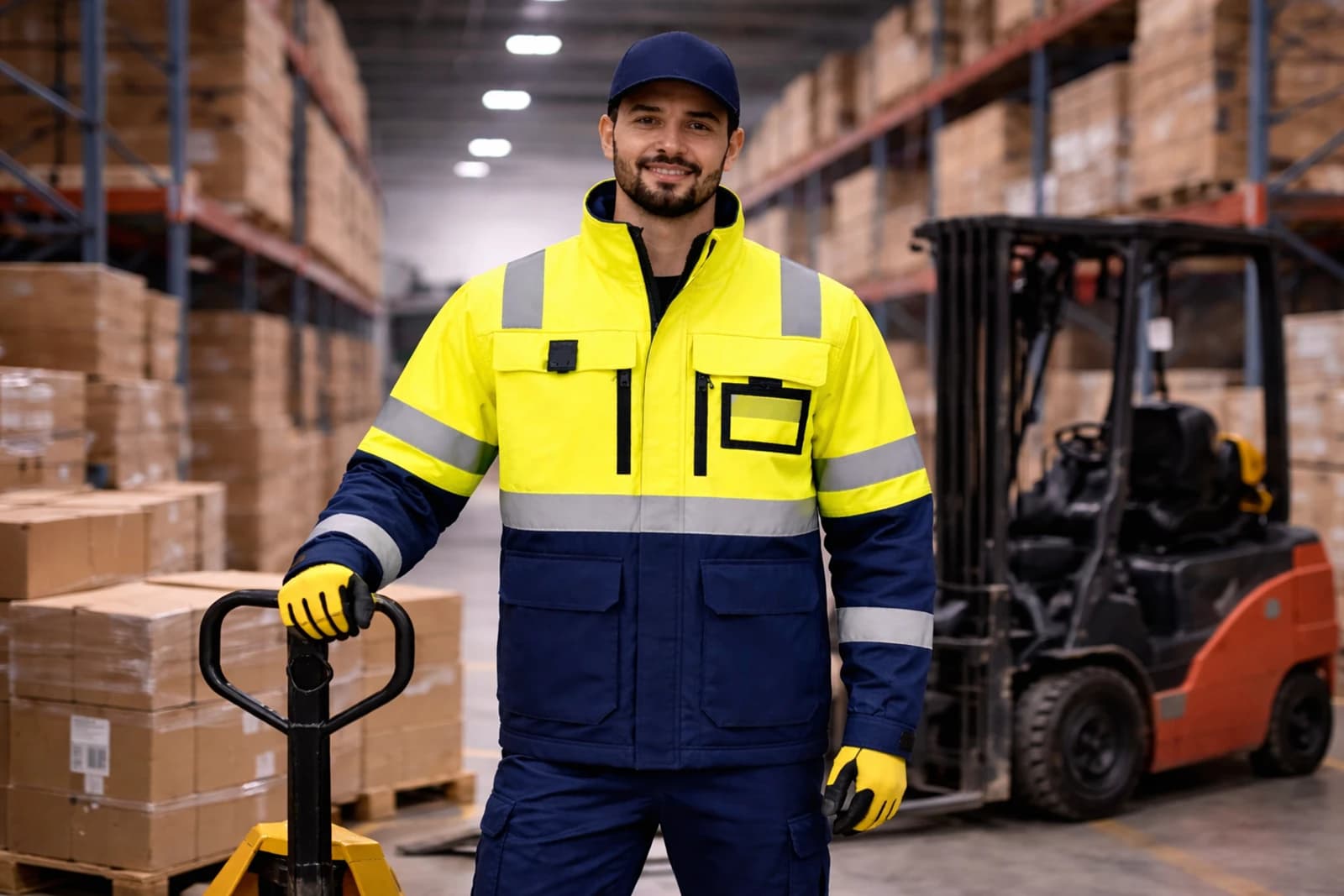
Safety Uniform
Hi-Vis Safety Jacket
Reflective safety jacket for high-visibility site operations and road work crews.
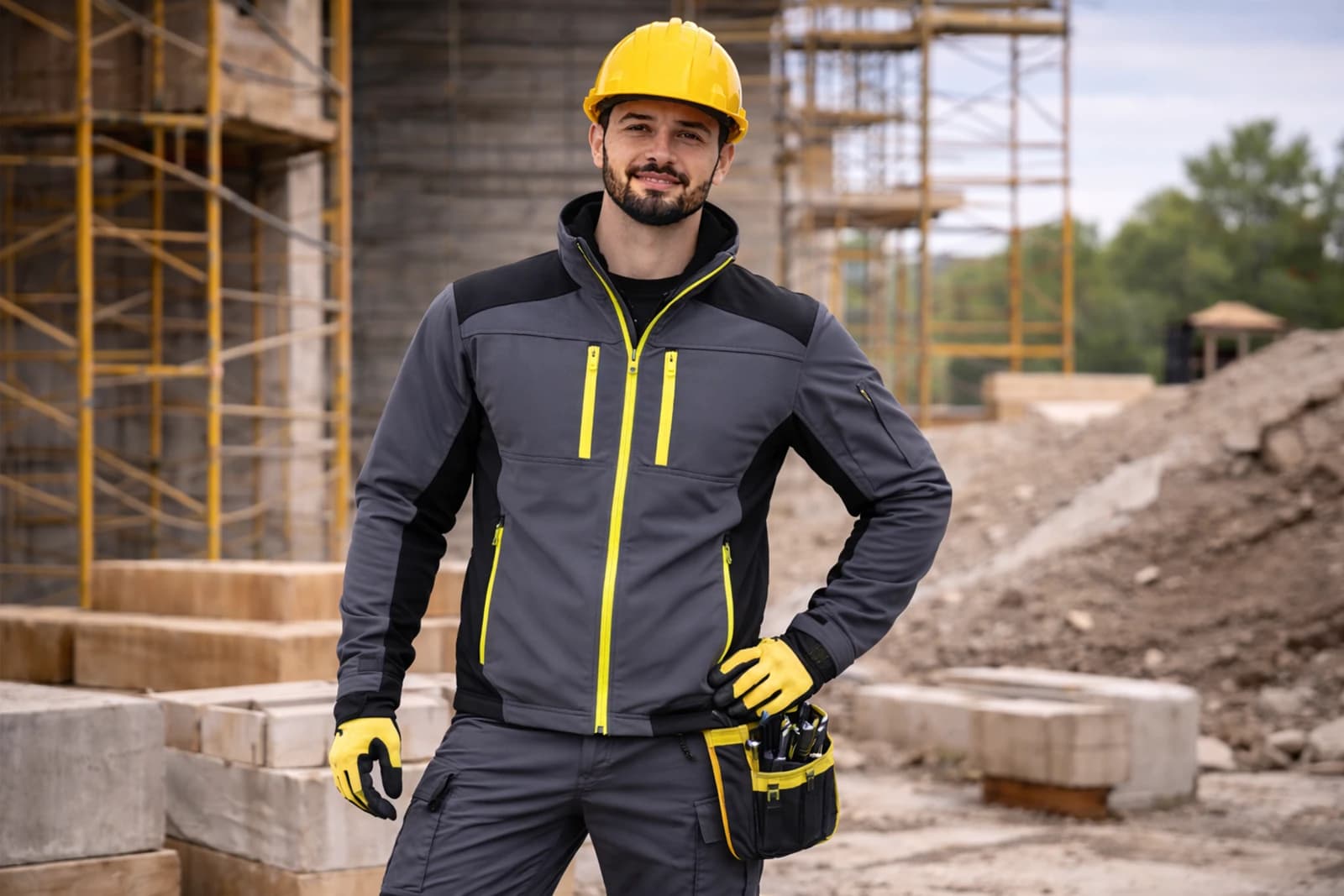
Construction Clothing
Construction Softshell Set
Flexible jacket and trouser set built for crews working across changing weather conditions.

Logistics Uniform
Logistics Polo Uniform
Breathable uniform polo for warehouse, delivery, and last-mile teams.