Value vs. Price: A Practical Workwear Sourcing Guide for Middle East B2B Buyers Evaluating Chinese Manufacturers
Middle East B2B buyers sourcing workwear from China often face a difficult choice: the lowest unit price or the best long-term value? This guide breaks down total cost of ownership (TCO) for industrial coveralls, hi-vis jackets, and other workwear categories — covering wash durability, compliance costs, fabric grades, and practical tips for negotiating with Chinese manufacturers without sacrificing quality.

Buyer context
What procurement teams run into
Middle East B2B procurement teams sourcing workwear from Chinese manufacturers often default to the lowest unit price as the primary decision criterion. This approach creates hidden costs: garments that shrink or fade after 10 washes, reflective tape that delaminates before the first compliance inspection, stitching that fails at the seams under actual working conditions, and fabrics that trap heat in 50°C ambient temperatures. The true cost of a cheap coverall or hi-vis jacket — replacement frequency, compliance failures, worker complaints, lost productivity — far exceeds the upfront unit price. Yet most buyers lack a framework for comparing workwear quality across different manufacturers, especially when sourcing remotely from China without visiting factories in person.
Sourcing approach
How a factory partner can respond
<p>Stop buying workwear by price per unit. Start buying by cost per wear. Here is a practical framework for Middle East B2B buyers to evaluate true value when sourcing from Chinese workwear manufacturers.</p> <h2>1. Cost Per Wear: The Metric That Matters</h2> <p>A standard industrial coverall priced at $12 that lasts 25 washes before the zipper fails, seams fray, or colour fades has a cost of $0.48 per wear. A higher-grade coverall at $18 that lasts 80+ washes without failure has a cost of $0.23 per wear — less than half. The same logic applies to hi-vis safety jackets, polo uniforms, and construction softshell sets.</p> <p>Ask every potential manufacturer for their <strong>wash test data</strong>: How many industrial wash cycles does the fabric retain its original tensile strength? When does the reflective tape begin to peel (EN 20471 requires tape to remain intact for a minimum number of washes)? When does colour fade beyond 4 on the greyscale? A manufacturer that refuses to share wash test data is signalling that their product will not compete favourably on these metrics.</p> <p>For Middle East conditions specifically, request wash tests run at 75°C with industrial detergent — this matches the typical laundry protocol for heavily soiled industrial garments in GCC facilities. Standard 60°C tests used in Europe underestimate real-world laundry wear in the Gulf region.</p> <h2>2. Fabric Grade: The Biggest Differentiator</h2> <p>Not all 300 gsm polyester-cotton blends are equal. The key differences:</p> <ul> <li><strong>Yarn quality:</strong> Higher-grade combed yarns (50s to 60s count) produce fabric with fewer broken fibres, reducing pilling and fraying. Lower-grade carded yarns (20s to 30s count) pill visibly after 5–10 washes. Ask your manufacturer for the yarn count specification — premium fabric suppliers in China (e.g., Sunshine Group, Luthai) use combed yarns as standard.</li> <li><strong>Thread count:</strong> Higher thread count fabric (120×60 or above for poly-cotton twill) provides better tear strength and a smoother finish. Lower thread count fabric (90×50 or below) is prone to seam slippage — the fabric pulls apart at the stitch line under stress. This is a common failure point on cheap coveralls worn by workers who bend and stretch frequently.</li> <li><strong>Dye quality:</strong> Reactive dyes (used by premium mills) bond chemically with cotton fibres and resist fading through 40+ industrial washes. Direct dyes (used by budget mills) sit on the fibre surface and fade significantly after 10–15 washes. The simplest diagnostic: rub the fabric firmly with a white cloth. If colour transfers, the garment uses direct dyes and will not hold colour in wash.</li> <li><strong>Finishing:</strong> Anti-pilling treatment, anti-static finish, and DWR (for hi-vis jackets) are applied at the finishing stage. Not all Chinese mills apply these — many budget products skip anti-pilling entirely. Ask for the specific finishing processes used and request a fabric sample for your own pilling test (Martindale or ICI pilling box, EN ISO 12945).</li> </ul> <h2>3. Compliance Cost Avoidance</h2> <p>Non-compliant workwear is the most expensive workwear. A single compliance failure on a client site — whether it is a hi-vis jacket that fails EN 20471 reflective tape testing or a coverall that lacks proper flame resistance certification — can cost more than an entire uniform order in penalties, contract clauses, and reputational damage.</p> <p>When evaluating a Chinese manufacturer's compliance claims:</p> <ul> <li>Request <strong>third-party test reports</strong> (SGS, Intertek, Bureau Veritas), not factory self-declarations. Reports should be dated within the last 12 months.</li> <li>Verify that the test report covers the <strong>specific fabric batch</strong> used for your order, not a generic submission from three years ago. Compliant factories in China maintain batch-specific traceability — the thread, fabric, and trim used in your coveralls should match a production record tied to a test report.</li> <li>For hi-vis garments, confirm <strong>tape-backing compatibility with the fabric</strong>. Some Chinese manufacturers use generic reflective tape that works fine on standard poly-cotton but delaminates when applied to treated or coated fabrics (e.g., FR-treated coveralls, water-repellent hi-vis jackets). This mismatch is a frequent root cause of tape failure in Middle East conditions.</li> <li>Understand <strong>GCC-specific certification pathways</strong>: EN standards are accepted in most GCC states (Saudi through SASO, UAE through ESMA), but some projects or clients may require additional local certification. Ask your manufacturer whether they have experience with SASO or ESMA certification processes — if they don't, you may need to handle local approval separately, adding timeline and cost.</li> </ul> <h2>4. Construction Details That Predict Durability</h2> <p>Read a workwear sample the way a tailor reads a suit. These details separate $12 coveralls from $18 coveralls:</p> <ul> <li><strong>Stitch density:</strong> Premium workwear uses 8–10 stitches per inch (SPI). Budget workwear uses 4–6 SPI. Lower SPI means each individual stitch bears more stress under load — seams pop faster. Count the stitches yourself on a 2.5 cm section of a main seam. If it is below 7, expect failures.</li> <li><strong>Seam type:</strong> Flat-felled or lapped seams (where fabric edges are folded inside the seam for reinforcement) are standard on premium workwear. Plain open seams (edges visible and unfinished) are standard on budget workwear and fail 3–4× faster under tensile stress. Turn a coverall sleeve inside out — open seams will be immediately visible at the armhole.</li> <li><strong>Bar tacks at stress points:</strong> Every critical stress point (crotch, pocket corners, belt loops, zipper ends) should have a bar tack — a tight zigzag stitch about 1 cm long that reinforces the area. Budget workwear often skips bar tacks at the crotch and pocket corners, which is where tears first appear.</li> <li><strong>Zipper grade:</strong> YKK or SBS (Chinese brand with international quality) zippers with metal teeth (for coveralls) or auto-lock sliders (for jackets) are the minimum. No-name plastic zippers fail on industrial coveralls within weeks. The zipper is the most common single point of failure on workwear — do not compromise on this component.</li> <li><strong>Button and rivet attachment:</strong> Buttons on budget coveralls are often attached with a single thread loop and a small plastic backing that cracks after a few washes. Premium workwear uses riveted metal buttons or heavy-duty thread attachments with fabric reinforcement behind the button area.</li> </ul> <h2>5. A Sourcing Triage Checklist for Workwear Categories</h2> <p><strong>Industrial coveralls (oil & gas, manufacturing):</strong> Priority specs — FR certification with batch-specific SGS/Intertek report, 8+ SPI stitch density, YKK metal zippers, bar tacks at crotch and pocket corners, 245+ gsm fabric weight for standard, 300+ gsm for heavy-duty. Avoid coveralls with open seams, carded yarn fabric, or untested reflective tape on FR fabric.</p> <p><strong>Hi-vis safety jackets (infrastructure, utility, road work):</strong> Priority specs — EN 20471 certification with current test report, DWR treatment for dew/mist protection (C6 or better), reflective tape bonded to the same fabric type as the order, breathable lining for Middle East heat. Avoid jackets with low-melt thermoplastic fabric components near reflective tape (tape adhesion failure at high temperatures), non-breathable backings, or sub-200 gsm shells that tear on first snag.</p> <p><strong>Construction softshell sets (evening and cold weather):</strong> Priority specs — bonded three-layer fabric with 5,000+ g/m²/24h breathability, four-way mechanical stretch, harness-compatible chest pocket layout, abrasion-resistant zones at elbows and forearms. Avoid non-DWR shells, embroidery (compromises membrane layer — use silicone heat-transfer instead), and fabrics without stretch.</p> <p><strong>Logistics polo uniforms (drivers, warehouse, delivery):</strong> Priority specs — 65/35 poly-cotton pique knit for breathability and shape retention, wrinkle resistance for professional appearance, moisture-wicking finish for 45°C work conditions, reinforced collar to prevent curling after washing. Avoid 100% cotton (shrinks, wrinkles, dries slowly) and thin single-knit fabric (loses shape after 5–10 washes).</p> <h2>6. Practical Tips for Working with Chinese Manufacturers</h2> <ul> <li><strong>Order a size run first, not a bulk order.</strong> A size run (5–10 garments across your size range) typically costs $150–$400 including shipping. It reveals fabric hand-feel, construction quality, fit accuracy, and true colour — none of which digital communication can convey. Manufacturers who push you straight to bulk without a sample are usually price-driven, not quality-driven.</li> <li><strong>Negotiate on payment terms, not unit price.</strong> A manufacturer who offers 30% deposit / 70% before shipment is more confident in their product than one demanding 50% deposit / 50% before shipment. The payment term structure reveals how much risk the manufacturer is willing to share.</li> <li><strong>Ask about overrun policy.</strong> Reputable factories accept 2–3% overrun or shortage as standard and charge only for delivered quantities. Some factories deliver 5–10% over the ordered quantity and expect payment — clarify this upfront.</li> <li><strong>Request photos of actual production, not marketing renders.</strong> A scheduled video call during production (cutting stage and final assembly stage) reveals more about a factory's real capabilities than any brochure. Factories with clean, organised, well-lit production floors consistently deliver higher quality.</li> <li><strong>Volume consolidation reduces cost without sacrificing quality.</strong> If you need 500 coveralls and 300 hi-vis jackets, combining both into one order reduces per-unit logistics costs (consolidated sea freight), allows shared trim procurement (same zipper supplier, same thread colour), and may qualify for a tiered volume discount — even though the two products use different fabrics.</li> </ul> <h2>Summary</h2> <p>The cheapest workwear is almost never the most economical when measured over a 12-month uniform program. A $6 price difference on a coverall that lasts 80 washes instead of 25 means the more expensive garment saves more than 50% on a per-wear basis — before accounting for compliance risk, worker satisfaction, and uniform program management overhead. For Middle East B2B buyers sourcing from China, the most valuable negotiating lever is not price — it is specification clarity. The clearer your spec sheet (fabric grade, construction details, compliance requirements, test reports), the harder it is for any manufacturer to deliver a low-price product that fails on quality.</p> <p>Start with a detailed RFQ. Order samples. Test the fabric. Count the stitches. Then negotiate on terms, not price.</p>
Recommended Products
Products that fit this use case

Industrial Workwear
Industrial Coverall Pro
Hard-wearing one-piece coverall for plant, maintenance, and heavy-duty operations.
Safety Uniform
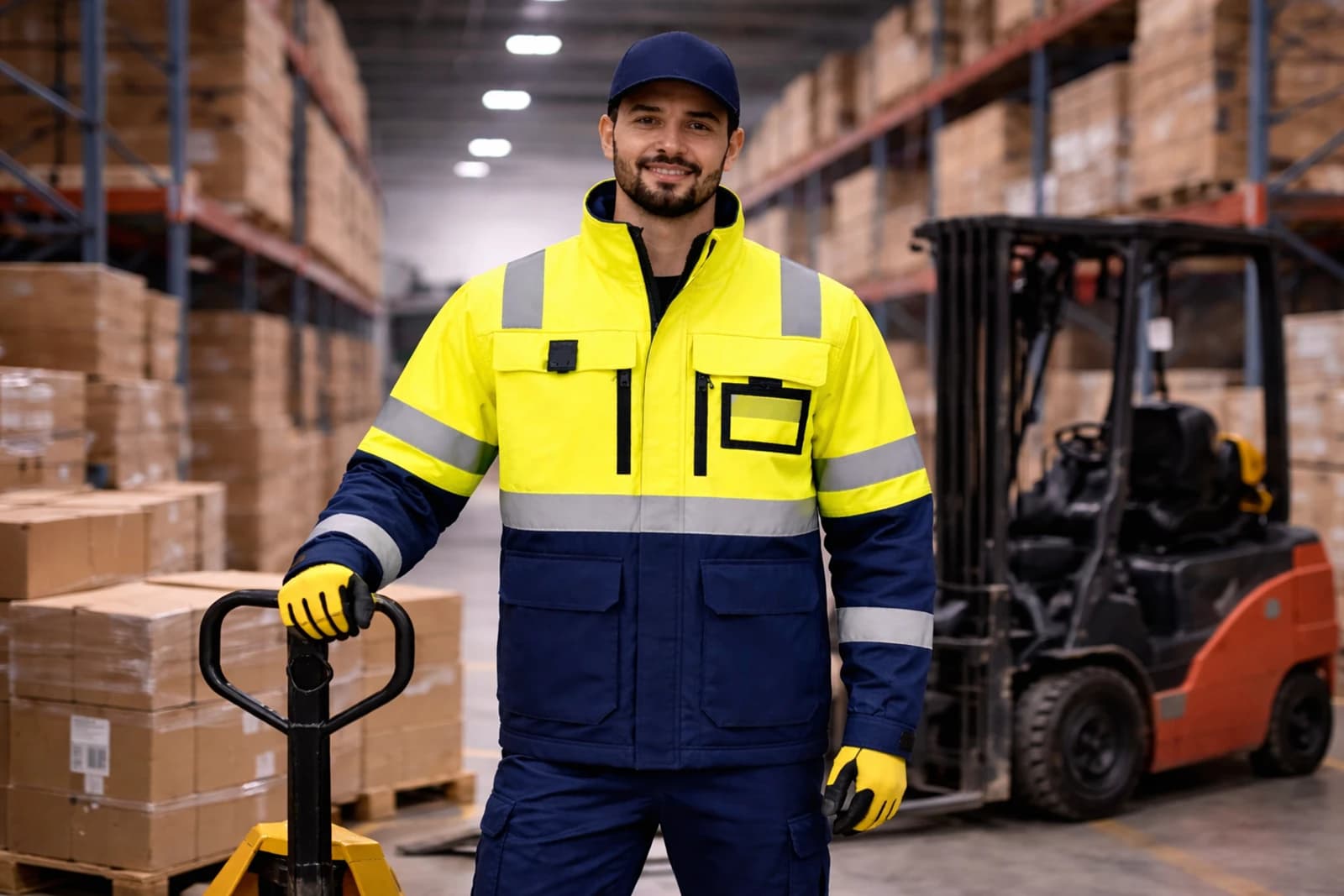
Hi-Vis Safety Jacket
Reflective safety jacket for high-visibility site operations and road work crews.