Warehouse & Logistics Workwear for Middle East Distribution Hubs: How a Chinese Manufacturer Supports High-Volume B2B Procurement
Middle East logistics hubs in Dubai, Jebel Ali, Dammam, and Riyadh are expanding rapidly, driving demand for professional warehouse uniforms that balance durability, heat comfort, and brand consistency. This guide covers how B2B buyers can source logistics polo uniforms and hi-vis safety jackets from a Chinese workwear manufacturer at competitive FOB prices, with custom branding, moisture-wicking fabrics for 40°C+ environments, and bulk shipping to Gulf ports.

Buyer context
What procurement teams run into
A procurement director for a third-party logistics (3PL) operator in Dubai is sourcing warehouse uniforms for 3,500 employees across four distribution centers serving e-commerce, cold-chain, and general cargo clients. The current supplier — a local uniform supplier in Al Quoz — delivers basic cotton polo shirts at AED 45 per unit with inconsistent sizing and colors that fade after 10 industrial washes. The 3PL's clients are increasingly demanding professional-branded uniforms for their warehouse staff, and the existing supplier cannot scale beyond 500 units per week. For Middle East B2B buyers sourcing warehouse and logistics workwear from a Chinese workwear manufacturer, the challenges are distinct from heavy industrial PPE procurement: **Heat management in non-air-conditioned zones** — while warehouses in Jebel Ali and Dammam may have temperature-controlled sections (25–30 °C for ambient goods), they also have receiving docks, despatch bays, and open-air container staging areas where temperatures hit 45–50 °C. Logistics polo uniforms made from standard 100% cotton (180–220 GSM) absorb sweat, become heavy, and take hours to dry, leaving workers feeling drenched and uncomfortable through 10–12 hour shifts. Workers in these conditions often roll up sleeves, unbutton collars, or remove uniform shirts entirely — undermining the professional appearance that logistics brands require. **Brand visibility and consistency** — logistics companies operating across multiple Gulf sites need consistent uniform appearance: precise logo embroidery or screen printing, color matching (Pantone-specified), and repeatable quality across thousands of units. Local UAE uniform suppliers often use third-party screen printing that shifts color slightly between batches, or embroidery that distorts fabric around the logo area. For a 3PL representing global brands like Amazon, DHL, or Maersk, inconsistent branding can trigger client contract penalties. **High wash-cycle frequency** — warehouse uniforms in Gulf operations are typically washed every 1–2 days (industrial laundering, 60–75 °C, heavy-duty detergents). Standard polyester-cotton blends (65/35) pill after 20–25 washes, and screen-printed logos crack and peel within 15 washes, requiring re-printing. For companies that supply uniforms to employees, replacement costs per worker can reach AED 400–600/year if shirts degrade within 8–12 weeks. **Hi-vis requirements in mixed-traffic zones** — distribution centers in the Middle East operate forklifts, reach trucks, pallet movers, and yard tractors in the same aisles as pedestrian pickers. Dubai Municipality safety regulations and international logistics client requirements mandate hi-vis safety clothing — typically Class 2 or Class 3 per EN ISO 20471 — for any worker in a vehicle-trafficked area. Separately sourcing hi-vis vests over standard polos means workers forget or discard the vest, creating safety compliance gaps. **Sizing diversity across a multinational workforce** — Gulf logistics workforces are heavily multinational: South Asian (Indian, Pakistani, Bangladeshi, Sri Lankan), Southeast Asian (Filipino), Arab, and African workers all have different body proportions. A standard S–M–L–XL–XXL size range based on Asian sizing often fails to accommodate taller workers (Arab and African) in the same shift. Companies that provide one-size-fits-all uniforms end up with workers in ill-fitting garments that compromise both appearance and safety (hi-vis panels positioned incorrectly on oversized or undersized jackets). **Logo placement for multi-tenant operations** — at a multi-client distribution center, the same warehouse workers may wear different branded uniforms depending on which client's goods they are handling. A 3PL needs uniforms that can be customized per contract — different logos, colors, and sometimes different garment types for each client's warehouse zone. This multiplies SKUs and complicates inventory management for the procurement team. Without a structured approach to logistics workwear procurement, buyers face: (a) uniforms that degrade visibly within 8–12 weeks, requiring premature replacement and increasing per-worker annual costs, (b) safety compliance gaps from hi-vis requirements not being integrated into the primary uniform garment, (c) brand inconsistency that damages client relationships and risks contract penalties, and (d) heat-stress-related productivity loss and uniform non-compliance (workers removing shirts) during Gulf summer months.
Sourcing approach
How a factory partner can respond
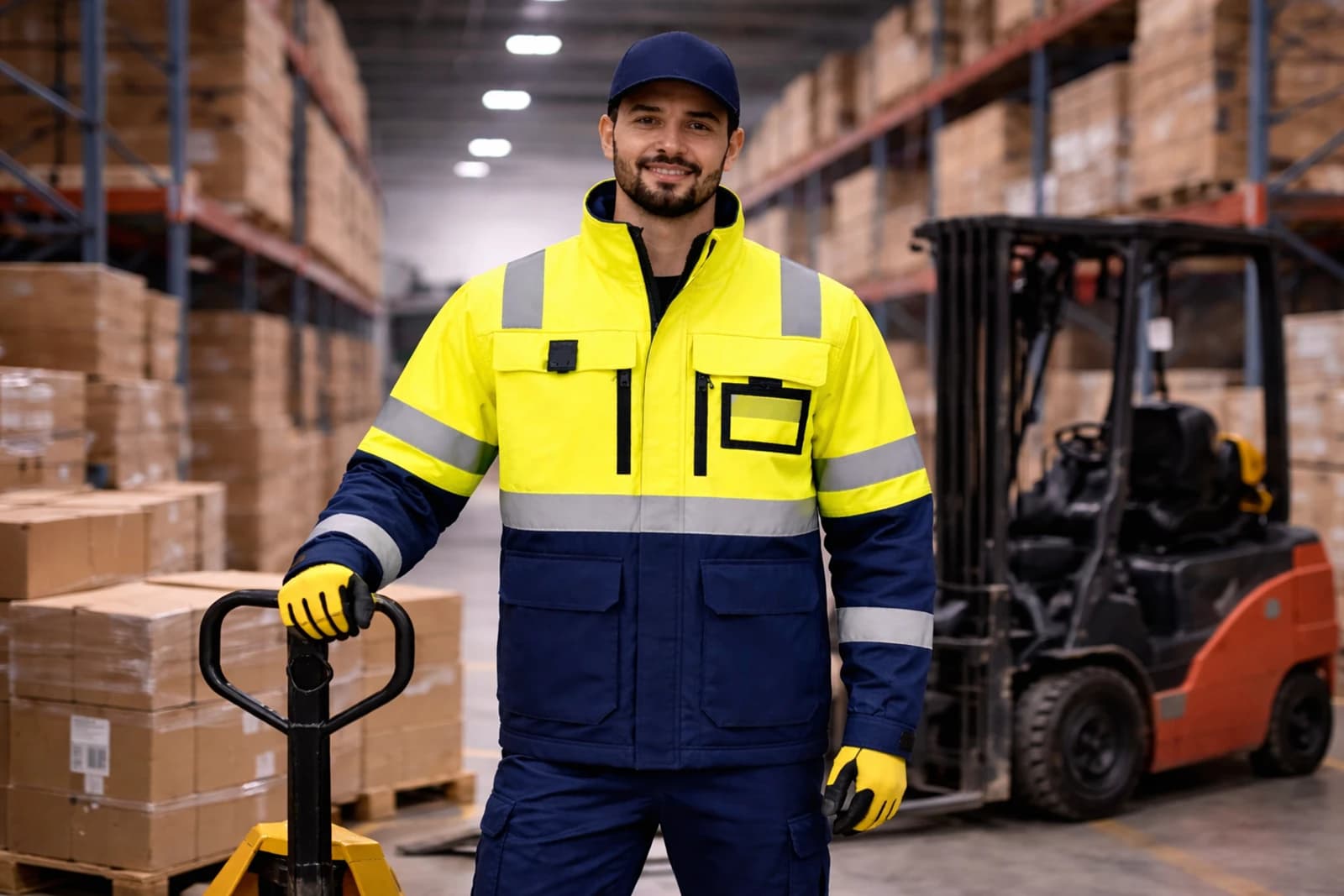
The solution is a two-garment logistics workwear system tailored for Middle East distribution hub operations: the Logistics Polo Uniform as the primary daily-wear garment, supplemented by the Hi-Vis Safety Jacket for mixed-traffic and outdoor dock zones. Both are sourced from a Chinese workwear manufacturer with Gulf-optimized specifications. **Logistics Polo Uniform — primary daily garment:** The Logistics Polo Uniform is designed for warehouse pickers, packers, inventory controllers, and administrative staff in ambient 25–35 °C controlled zones. Key specifications for Gulf conditions: - **Moisture-wicking performance fabric** — 65% polyester / 35% cotton pique knit at 200 GSM, with a moisture-wicking finish that draws perspiration to the outer surface for rapid evaporation. Unlike standard 100% cotton polos that absorb and retain sweat, this fabric dries 3–4× faster, keeping workers comfortable through 10–12 hour shifts. The polyester component also resists pilling — tested through 50 industrial wash cycles with less than 5% surface fiber degradation. - **Reinforced collar and cuff construction** — the polo collar uses a fused interlining (polyester filament + resin-bonded non-woven) that withstands industrial laundering without curling or fraying. Cuffs use 1×1 ribbing with spandex core (3% spandex, 97% polyester) for shape retention through repeated stretching. Collar stays are removable for replacement, extending garment life. - **Pantone-matched custom branding** — the manufacturer supports both screen-printed and embroidered logos. Screen printing uses plastisol ink (crack-resistant, 30+ wash durability) or silicone ink (stretch-compatible, 50+ wash durability). Embroidery uses 40,000-stitch-high-speed machines with foam backing to prevent fabric distortion. Pantone color matching is certified within ΔE ≤ 2.0 for bulk production, ensuring brand consistency across all 3,500+ units. - **Extended size range — S to 5XL** — the size range accommodates a multinational Gulf workforce: S (34–36" chest), M (38–40"), L (42–44"), XL (46–48"), 2XL (50–52"), 3XL (54–56"), 4XL (58–60"), 5XL (62–64"). Garments are cut on a specialized block pattern that adjusts proportionally for taller frames (longer torso and sleeve lengths in 2XL+ sizes), correcting a common issue with standard Asian sizing templates. - **Gulf colorfastness** — fabric dyes are tested to ISO 105-B02 (lightfastness, 100 hours xenon-arc exposure) and ISO 105-C06 (washfastness, 60 °C, 20 washes). Colors maintain within 90% of original shade after 30 industrial washes, eliminating the fading issue common with locally sourced budget polos. - **Pocket configuration** — left-chest pen slot and phone/pager pocket (150×120 mm, with flap and button closure for security in movement zones). Optional: barcode-scanner holster loop on the front panel for pickers who scan items throughout their shift. **Hi-Vis Safety Jacket — mixed-traffic and outdoor complement:** The Hi-Vis Safety Jacket serves workers in vehicle-trafficked areas (forklift lanes, despatch bays, container staging zones, and outdoor yard operations). Key specifications: - **EN ISO 20471 Class 3 certification** — 0.80 m² of fluorescent background material (lime-yellow or orange) with 0.20 m² of retroreflective tape arranged in two 50 mm horizontal bands (torso) and two vertical bands (shoulders). This exceeds Class 2 requirements and ensures visibility from 360° — critical in busy distribution centers where vehicles approach from all directions. - **Breathable fabric for Gulf heat** — the jacket shell uses 100% polyester Oxford weave at 120 GSM (lighter than typical 150–180 GSM hi-vis shells), with a mesh lining that allows airflow. Workers in yard operations (despatch bays, container loading) do not overheat during summer months. The jacket is also packable into its own pocket — workers can stow it in a belt pouch when moving into non-trafficked indoor zones. - **Integrated design** — the jacket is designed to layer over the Logistics Polo Uniform without restriction. Sleeve armholes are cut 2 cm wider than standard to accommodate the polo underneath. The front zipper is covered with a storm flap and snap closures, preventing fabric snagging on moving equipment. - **ID card and radio pockets** — the jacket includes a clear ID card window (left chest) for facility access cards, a D-ring attachment point for radio/headset clips, and a zippered right-chest pocket for valuables. These eliminate the need for separate holders worn around the neck (a safety hazard near conveyor belts and moving equipment). - **Reflective tape with Gulf resilience** — retroreflective tape uses microglass-bead technology bonded with heat-activated adhesive, tested for adhesion after 25 industrial washes (EN 20471-compliant). The tape maintains ≥80% retroreflection through its certified life, versus locally sourced hi-vis clothing where tape peels after 10–12 washes. **B2B procurement and logistics:** The Chinese workwear manufacturer offers Middle East buyers: - FOB Shanghai or CIF Jebel Ali/Dammam pricing - Custom logo and brand integration at order (no separate branding charge for orders exceeding 2,000 units per SKU) - Bulk packing options: individual poly-bag with size/color tag, or bulk carton (50–100 units) for warehouse distribution - Sample production: 5–7 business days for logo-printed/embroidered samples, paid via sample deposit (refunded on bulk order) - Lead time: 25–35 days for first order (includes custom fabric dyeing if needed), 15–20 days for repeat orders - Quality control: AQL 2.5 (normal) inspection before shipment, with photos and measurement report
Recommended Products
Products that fit this use case

Logistics Uniform
Logistics Polo Uniform
Breathable uniform polo for warehouse, delivery, and last-mile teams.
Safety Uniform
Hi-Vis Safety Jacket
Reflective safety jacket for high-visibility site operations and road work crews.