What Makes Recycling Sort Line Workwear Fail in the First 30 Days?
Recycling materials recovery facilities (MRFs) present workwear failure modes that don't occur in other industrial environments — abrasion from mixed materials, cuts from sharp objects, staining from contaminated items, and fabric degradation from frequent washing. Standard workwear fabrics fail quickly because they don't address these specific hazards. This article covers the failure modes of recycling sort line workwear and how to specify a garment that survives the environment without over-specifying.
Buyer context
What procurement teams run into
Recycling materials recovery facilities (MRFs) present workwear failure modes that don't occur in other industrial environments. Workers who sort mixed recyclables on conveyor belts encounter broken glass, sharp metal edges, contaminated containers with residual chemicals, abrasive cardboard and plastic, and constant contact with conveyor belt surfaces. The result is a pattern of garment failure that standard workwear fabrics and constructions cannot survive — and that creates both safety risk and procurement cost if not addressed through proper specification. **1. The primary failure modes are specific to the recycling sort environment** Recycling sort line workwear fails in four distinct ways that are not seen in warehouse, manufacturing, or construction environments: - **Abrasion from mixed materials:** Workers handle rough cardboard, broken plastic containers, metal cans with sharp edges, and glass fragments. Every contact with these materials abrades the fabric surface. A standard 65/35 TC blend fabric that survives 75 wash cycles in a warehouse environment may show fabric thinning and pilling after 20–30 wash cycles on a recycling sort line — not from washing, but from abrasion during wear. - **Cuts from sharp objects:** Workers encounter broken glass, sharp metal edges, and occasionally needles or other sharp contaminants. Standard workwear fabrics do not provide cut resistance. A worker who reaches into a bag of mixed recyclables and contacts a broken glass bottle can sustain a laceration that penetrates the garment sleeve. Cut-resistant gloves address hand protection, but the forearm and upper arm remain exposed. - **Staining from contaminated items:** Recycling streams include containers with residual food, oil, chemicals, and biological contaminants. These contaminants stain garments quickly and create hygiene concerns. Workers in recycling facilities typically wash garments more frequently than in other industrial environments — often after every shift — to remove contamination. This frequent washing accelerates fabric degradation. - **Fabric degradation from frequent washing:** The combination of contamination exposure and frequent washing (often daily) means recycling sort line garments undergo 2–3× the wash cycles of garments in other environments. A garment specified for 75 wash cycles may reach that limit in 4–6 weeks instead of 3–4 months. The fabric loses tensile strength, seams weaken, and the garment fails structurally. **2. Standard workwear fabrics and constructions do not address these failure modes** The instinct is to specify a standard industrial workwear garment — a TC blend coverall or two-piece set — and accept that it will need frequent replacement. But this approach creates two problems: - **Safety risk:** A garment that has lost tensile strength due to abrasion and frequent washing no longer provides adequate protection against cuts, abrasion, or contamination exposure. A worker wearing a degraded garment is at higher risk of laceration or contamination contact. - **Procurement cost:** Replacing garments every 4–6 weeks instead of every 3–4 months increases annual workwear cost per worker by 2–3×. For a facility with 50 sort line workers, this represents a significant budget increase that could be avoided through proper specification. The alternative is to specify a garment that addresses the specific failure modes of the recycling sort environment — but this requires understanding the tradeoffs involved. **3. The fabric weight tradeoff: heavier fabric resists abrasion but increases heat stress** The first instinct when addressing abrasion is to specify a heavier fabric — moving from 200 GSM to 240 GSM or 280 GSM. Heavier fabric does resist abrasion better, but recycling facilities are often warm environments (partially open buildings, heat from conveyor motors, ambient temperature in summer). A heavier fabric increases heat stress, reduces worker comfort, and can lead to heat-related illness in warm conditions. The correct approach is not to increase fabric weight, but to specify a fabric construction that resists abrasion without adding weight: - **Ripstop construction:** A ripstop weave (with reinforced threads at regular intervals) prevents small tears from propagating into larger failures. A 220 GSM TC ripstop fabric provides better tear and abrasion resistance than a 240 GSM plain weave fabric, without the weight penalty. - **Tight weave density:** A tighter weave (higher thread count per inch) creates a smoother fabric surface that resists abrasion better than a loose weave. A 220 GSM fabric with 120×60 thread count will outperform a 240 GSM fabric with 100×50 thread count in abrasion resistance. - **Polyester-rich blend:** A 80/20 polyester-cotton blend (instead of 65/35) provides better abrasion resistance because polyester fibres are more abrasion-resistant than cotton fibres. The tradeoff is slightly reduced breathability, but the abrasion resistance benefit outweighs this in a recycling sort environment. **4. Cut-resistant sleeves address one hazard but create dexterity issues** The second instinct is to specify cut-resistant sleeves or arm guards to protect against sharp objects. Cut-resistant sleeves (made from materials like Dyneema, Kevlar, or glass fibre blends) provide excellent cut resistance — but they reduce dexterity, increase heat stress on the arms, and can create a snag hazard if they are loose-fitting. The correct approach is to specify cut-resistant protection only where it is needed: - **Forearm protection:** Workers who handle bags of mixed recyclables (and therefore encounter sharp objects when opening bags) need cut-resistant forearm protection. Specify sleeves that cover the forearm from wrist to elbow, made from a lightweight cut-resistant material (ANSI Cut Level A4 or higher). - **Upper arm and torso:** Workers who do not handle bags directly (e.g., workers who sort materials after bags have been opened) do not need cut-resistant protection on the upper arm or torso. Standard fabric is sufficient for these areas. - **Dexterity tradeoff:** Cut-resistant sleeves reduce dexterity by 10–20% compared to standard fabric. Workers who need to handle small items (e.g., sorting small plastic containers) may find cut-resistant sleeves impair their ability to work efficiently. The solution is to specify cut-resistant sleeves that are form-fitting (not loose) and made from a material that maintains flexibility (e.g., Dyneema blend rather than glass fibre). **5. Hi-vis requirements add cost and complexity** Recycling facilities typically have forklift traffic in the sort line area, loading dock, and yard. Workers in these areas need hi-vis garments that meet EN ISO 20471 requirements. But hi-vis garments are more expensive than standard garments, and the retroreflective tape degrades with frequent washing and abrasion. The correct approach is to specify hi-vis requirements based on actual traffic exposure: - **Sort line workers:** If the sort line is in a designated pedestrian zone with no forklift traffic, hi-vis is not required. Standard fabric is sufficient. - **Yard and loading dock workers:** Workers who operate in areas with forklift traffic need hi-vis garments. Specify a hi-vis jacket (EN ISO 20471 Class 2 or Class 3 depending on traffic speed and volume) that can be worn over the standard workwear garment. - **Retroreflective tape durability:** In a recycling environment, retroreflective tape degrades quickly due to abrasion and frequent washing. Specify tape that is validated for 50 wash cycles minimum, and inspect tape condition at regular intervals (e.g., every 2 weeks). Replace the hi-vis jacket immediately if tape shows cracking, peeling, or fading. **6. The procurement challenge: specifying a garment that survives without over-specifying** The procurement challenge is to specify a garment that addresses the specific failure modes of the recycling sort environment without over-specifying (which increases cost without adding value). The specification should include: - **Fabric:** 220 GSM TC ripstop, 80/20 polyester-cotton blend, tight weave density (120×60 thread count minimum) - **Construction:** Reinforced seams (bartacked stress points), no external pockets on the torso (to prevent snagging on conveyor equipment), elastic or snap cuffs that seal against contamination but can be released quickly - **Cut-resistant protection:** Lightweight cut-resistant sleeves (ANSI Cut Level A4) for workers who handle bags of mixed recyclables; standard fabric for other workers - **Hi-vis:** Hi-vis jacket (EN ISO 20471 Class 2) for workers in forklift traffic zones; standard fabric for workers in pedestrian-only zones - **Wash cycle life:** Specify minimum 50 wash cycles at 60°C with ≤5% dimensional change and fabric tensile strength maintained. This is lower than the 75-cycle specification for warehouse environments, but reflects the reality of recycling sort line conditions. The benefit: a garment that survives 6–8 weeks instead of 3–4 weeks, reducing annual workwear cost per worker by 30–40% while maintaining safety and compliance.
Sourcing approach
How a factory partner can respond
The solution for recycling sort line workwear is a specification that addresses the specific failure modes of the recycling environment — abrasion from mixed materials, cuts from sharp objects, staining from contaminated items, and fabric degradation from frequent washing — without over-specifying. **Step 1: Specify a fabric construction that resists abrasion without adding weight** For recycling sort line workwear, specify a ripstop construction with a polyester-rich blend: - Fabric weight: 220 GSM (not 240 GSM or 280 GSM — heavier fabric increases heat stress without proportional abrasion resistance benefit) - Construction: ripstop weave with reinforced threads at regular intervals to prevent tear propagation - Blend: 80% polyester / 20% cotton (polyester provides better abrasion resistance than cotton) - Weave density: 120×60 thread count minimum (tighter weave resists abrasion better than loose weave) Obtain test reports from the fabric manufacturer confirming abrasion resistance (e.g., Martindale abrasion test) and tensile strength after 50 wash cycles. Do not specify fabric weight alone — the fabric's abrasion resistance and wash durability are the critical requirements. **Step 2: Specify cut-resistant protection only where needed** For workers who handle bags of mixed recyclables (and therefore encounter sharp objects when opening bags), specify lightweight cut-resistant sleeves: - Cut resistance: ANSI Cut Level A4 or higher (validated by ASTM F2992 or equivalent test) - Material: Dyneema blend or similar lightweight cut-resistant material (maintains flexibility and dexterity) - Coverage: forearm from wrist to elbow (upper arm and torso do not need cut-resistant protection for workers who do not handle bags directly) - Fit: form-fitting (not loose) to prevent snag hazard and maintain dexterity For workers who sort materials after bags have been opened (and therefore do not encounter sharp objects directly), standard fabric is sufficient. Do not specify cut-resistant sleeves for all workers — this increases cost without adding value for workers who do not need it. **Step 3: Specify hi-vis requirements based on actual traffic exposure** For workers in forklift traffic zones (yard, loading dock), specify a hi-vis jacket: - Standard: EN ISO 20471 Class 2 (for areas with forklift traffic at speeds up to 20 km/h) or Class 3 (for areas with higher-speed traffic) - Retroreflective tape: validated for 50 wash cycles minimum with luminance meeting EN ISO 20471 after wash - Inspection: inspect tape condition every 2 weeks; replace jacket immediately if tape shows cracking, peeling, or fading For workers in pedestrian-only zones (sort line areas with no forklift traffic), standard fabric is sufficient. Do not specify hi-vis for all workers — this increases cost without adding value for workers who do not operate in traffic zones. **Step 4: Specify wash cycle life that reflects actual conditions** For recycling sort line workwear, specify a wash cycle life that reflects the reality of frequent washing: - Minimum 50 wash cycles at 60°C with ≤5% dimensional change - Fabric tensile strength maintained after 50 wash cycles (validated by test report) - Seam strength maintained after 50 wash cycles (bartacked stress points) This is lower than the 75-cycle specification for warehouse environments, but reflects the reality of recycling sort line conditions (frequent washing, abrasion, contamination exposure). Do not specify 75 cycles — the fabric will not survive that many cycles in a recycling environment, and the specification will create a compliance gap when garments fail before reaching the specified cycle count. **Step 5: Implement a condition-based replacement system** Replace garments based on actual condition, not calendar schedule: - Replace immediately if fabric shows visible thinning, pilling, or tearing (indicates abrasion damage) - Replace immediately if seams show separation or stitching failure (indicates wash degradation) - Replace immediately if cut-resistant sleeves show visible damage or loss of cut resistance (indicates cut-resistant material degradation) - Replace hi-vis jacket immediately if retroreflective tape shows cracking, peeling, or fading Track each garment's wash cycle count and inspect garments at regular intervals (e.g., every 2 weeks). Use condition-based replacement to avoid premature replacement of garments with remaining usable life, and to ensure damaged garments are removed from service before they create safety risk. **Step 6: Pilot the specification before full fleet commitment** Before committing to a full fleet order, pilot the recycling sort line workwear specification with 20–30 garments for 6–8 weeks of actual sort line use. Collect data on: - Garment condition after 30, 40, and 50 wash cycles (validate fabric abrasion resistance and wash durability) - Cut-resistant sleeve condition and worker feedback on dexterity (validate cut-resistant protection and dexterity tradeoff) - Hi-vis jacket tape condition after 30 and 50 wash cycles (validate retroreflective tape durability) - Worker feedback on comfort and mobility during full shifts in the sort line environment - Cost comparison versus previous standard workwear specification (validate cost reduction from extended garment life) Use pilot data to adjust fabric construction, cut-resistant sleeve specification, or hi-vis requirements before full fleet commitment. **Recommended garments for recycling sort line workwear:** - **Industrial coverall-pro** — specify the 220 GSM TC ripstop version (80/20 polyester-cotton blend, ripstop weave, 120×60 thread count, bartacked seams, no external pockets on torso, elastic cuffs) for sort line workers who need full-body protection from abrasion, cuts, and contamination. Specify lightweight cut-resistant sleeves (ANSI Cut Level A4) for workers who handle bags of mixed recyclables. Replace at 50 wash cycles or immediately if fabric shows visible thinning, pilling, or tearing. - **Hi-vis safety jacket** — specify the EN ISO 20471 Class 2 version (fluorescent background material, retroreflective tape validated for 50 wash cycles) for workers in forklift traffic zones (yard, loading dock). Inspect tape condition every 2 weeks and replace immediately if tape shows cracking, peeling, or fading. Do not specify hi-vis for workers in pedestrian-only zones.
Recommended Products
Products that fit this use case

Industrial Workwear
Industrial Coverall Pro
Hard-wearing one-piece coverall for plant, maintenance, and heavy-duty operations.
Safety Uniform
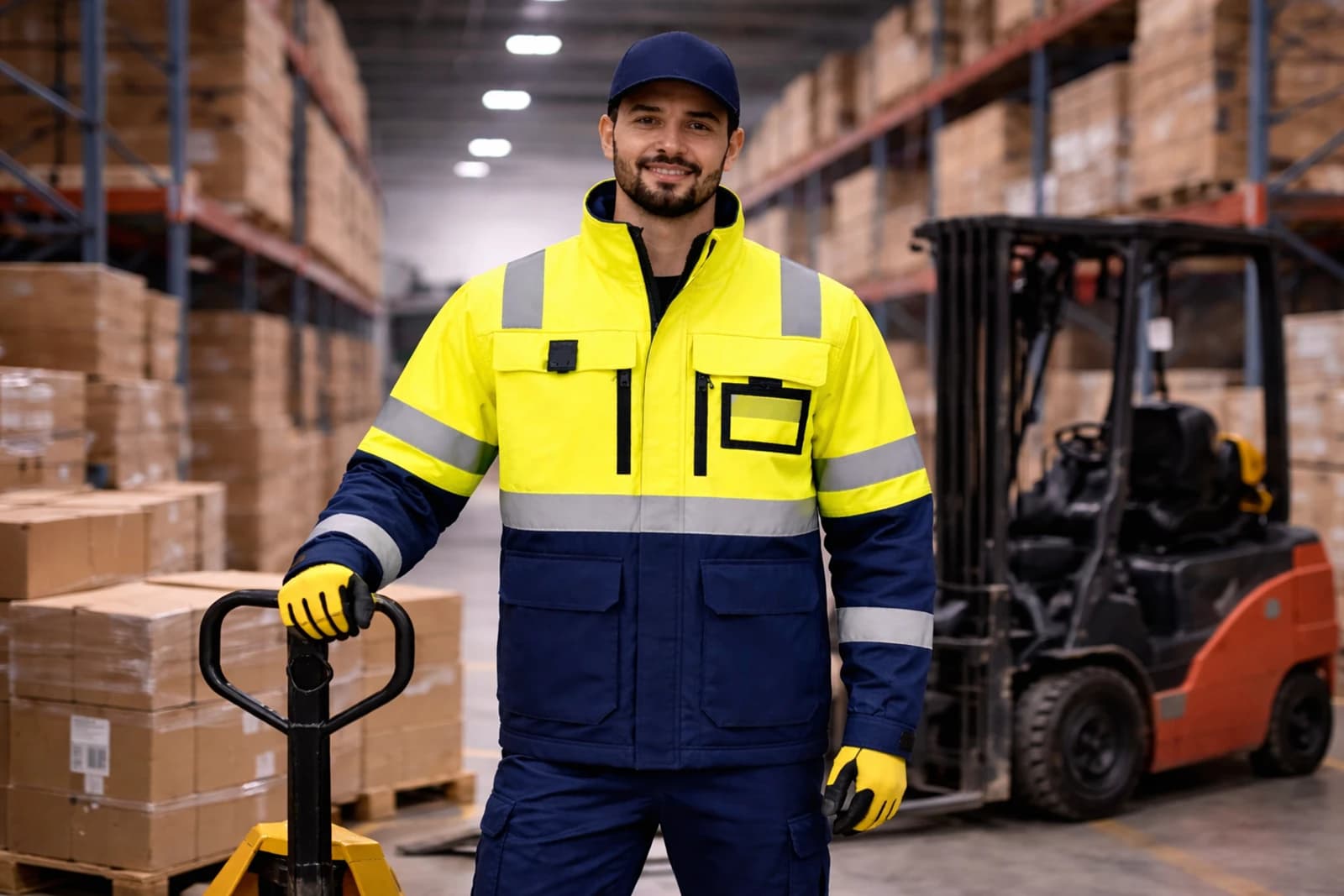
Hi-Vis Safety Jacket
Reflective safety jacket for high-visibility site operations and road work crews.