When Should Warehousing Buyers Place Workwear Orders to Avoid Seasonal Stockouts?
Warehousing operations have seasonal hiring peaks — Q4 holiday surge, back-to-school, or promotional events — but workwear replenishment lead times (4–6 weeks) are slower than the hiring cycle. The result: new hires start without workwear, or the buyer overstocks to avoid stockouts, tying up capital. This article covers the replenishment timing model that matches workwear orders to hiring velocity, the safety stock calculation that prevents stockouts without overstocking, and the procurement steps for negotiating flexible call-offs with suppliers.

Buyer context
What procurement teams run into
Warehousing and distribution operations present a replenishment timing problem that most buyers do not recognise until they see repeated seasonal stockouts. The core issue: warehousing operations have predictable seasonal hiring peaks — Q4 holiday surge (October–December), back-to-school (August–September), and promotional events — but workwear replenishment lead times (4–6 weeks for production and shipping) are slower than the hiring cycle. New hires are confirmed 1–2 weeks before their start date, but the workwear order takes 4–6 weeks to arrive. The result: new hires start without workwear on their first day, or the buyer overstocks workwear to avoid stockouts, tying up capital in inventory that may not be used. **1. The hiring cycle is faster than the replenishment cycle** Warehousing operations hire seasonal workers on a compressed timeline: - **Hiring decision:** The operations manager confirms the need for 50–100 seasonal workers based on order volume forecasts. The hiring decision is made 2–3 weeks before the workers start. - **Onboarding:** Workers are hired, complete paperwork, and start training within 1–2 weeks of the hiring decision. - **Workwear issue:** Workers need workwear on their first day — a polo uniform for warehouse picking and a hi-vis jacket for loading dock work. But the workwear replenishment cycle is: - **Order placement:** The buyer places the workwear order 4–6 weeks before the workers start (to allow for production and shipping). - **Production:** The supplier produces the garments in 2–3 weeks. - **Shipping:** The garments are shipped in 1–2 weeks (sea freight) or 3–5 days (air freight, at 3–5× the cost). The mismatch: the buyer must place the workwear order 4–6 weeks before the hiring decision, based on a forecast of how many seasonal workers will be hired. If the forecast is wrong (too few workers hired, or too many), the buyer either overstocks or stockouts. **2. The forecast error creates stockouts or overstock** The buyer forecasts seasonal hiring based on order volume projections from the sales team. But order volume projections are often revised 2–4 weeks before the season starts — after the workwear order has already been placed. The forecast error creates two problems: - **If the forecast is too low (fewer workers hired than expected):** The buyer has overstocked workwear. The excess inventory sits in the warehouse, tying up capital. If the garment design changes or the company rebrands the following year, the excess inventory becomes obsolete and must be written off. - **If the forecast is too high (more workers hired than expected):** The buyer has understocked workwear. New hires start without workwear, violating site safety requirements (hi-vis jackets are required for loading dock work). The buyer must place an emergency order, paying air freight costs (3–5× the sea freight cost) to receive the garments in time. Neither outcome is acceptable. The buyer needs a replenishment model that matches workwear orders to actual hiring velocity, not a forecast made 6 weeks in advance. **3. The safety stock model for seasonal hiring** The solution is to use a safety stock model that accounts for hiring velocity and lead time: - **Hiring velocity:** The number of workers hired per week during the seasonal peak. For example, if 100 seasonal workers are hired over 4 weeks, the hiring velocity is 25 workers per week. - **Lead time:** The workwear replenishment lead time (4–6 weeks for sea freight, 1 week for air freight). - **Safety stock:** The number of garments held in reserve to cover the gap between the hiring decision and the workwear delivery. Safety stock = (hiring velocity × lead time) + buffer. For example: - Hiring velocity: 25 workers per week - Lead time: 4 weeks (sea freight) - Buffer: 10% of safety stock (to account for forecast error) - Safety stock = (25 × 4) + 10 = 110 garments The buyer holds 110 garments in reserve at the warehouse site. When a new hire starts, the garment is issued from the safety stock. The buyer places a replenishment order when the safety stock falls below 50 garments (the reorder point), ensuring that the new garments arrive before the safety stock is exhausted. **4. The procurement mistake: placing a single annual order** The most common procurement error is to place a single annual workwear order at the start of the year, based on a forecast of total seasonal hiring. The logic: "If we order all the workwear at once, we get a better price and avoid multiple shipments." But this logic ignores the fact that hiring forecasts are revised throughout the year, and a single annual order cannot respond to forecast revisions. The buyer who places a single annual order faces two risks: - **Overstock:** If the forecast is too high, the buyer has excess inventory at the end of the year. The excess inventory ties up capital and may become obsolete if the garment design changes. - **Stockout:** If the forecast is too low, the buyer runs out of workwear mid-season and must place an emergency order at 3–5× the cost. The correct approach is to use a blanket order with flexible call-offs, allowing the buyer to adjust the order quantity based on actual hiring. **5. The blanket order with flexible call-offs** The solution is to negotiate a blanket order with the supplier, with call-offs based on actual hiring: - **Blanket order:** The buyer commits to a total annual volume (e.g., 500 polo uniforms and 300 hi-vis jackets) but does not specify the delivery schedule. The supplier reserves production capacity for the blanket order. - **Call-offs:** The buyer issues call-offs (delivery instructions) based on actual hiring. For example, the buyer issues a call-off for 100 polo uniforms and 60 hi-vis jackets 4 weeks before the seasonal peak, based on the confirmed hiring plan. - **Flexibility:** The blanket order allows the buyer to adjust the call-off quantity by ±20% without penalty. If the hiring forecast is revised, the buyer can increase or decrease the call-off quantity within the flexibility range. The blanket order with flexible call-offs allows the buyer to: - **Respond to forecast revisions:** The buyer adjusts the call-off quantity based on actual hiring, avoiding overstock and stockouts. - **Reduce inventory holding costs:** The buyer holds only the safety stock at the warehouse site, not the full annual order. The supplier holds the remaining inventory and ships it based on call-offs. - **Avoid emergency order costs:** The buyer places replenishment orders 4 weeks before the safety stock is exhausted, avoiding the need for air freight. **6. The pre-positioning strategy for critical garments** For critical garments (hi-vis jackets required for loading dock work), the buyer should pre-position stock at the warehouse site before the seasonal peak: - **Pre-positioning:** The buyer issues a call-off for 150 hi-vis jackets 6 weeks before the seasonal peak, based on the hiring forecast. The jackets are delivered to the warehouse site and held in reserve. - **Safety stock:** The buyer holds 50 hi-vis jackets as safety stock. When a new hire starts, the jacket is issued from the safety stock. - **Replenishment:** The buyer issues a replenishment call-off when the safety stock falls below 25 jackets, ensuring that the new jackets arrive before the safety stock is exhausted. The pre-positioning strategy ensures that new hires receive hi-vis jackets on their first day, even if the hiring forecast is revised upward. The buyer holds only the safety stock at the warehouse site, minimising inventory holding costs.
Sourcing approach
How a factory partner can respond
The solution for warehousing workwear replenishment is to use a safety stock model with flexible call-offs, matching workwear orders to actual hiring velocity rather than a forecast made 6 weeks in advance. **Step 1: Calculate the safety stock based on hiring velocity and lead time** - **Hiring velocity:** Determine the number of workers hired per week during the seasonal peak. For example, if 100 seasonal workers are hired over 4 weeks, the hiring velocity is 25 workers per week. - **Lead time:** Determine the workwear replenishment lead time (4 weeks for sea freight, 1 week for air freight). - **Safety stock:** Calculate safety stock = (hiring velocity × lead time) + buffer. For example, safety stock = (25 × 4) + 10 = 110 garments. - **Reorder point:** Set the reorder point at 50% of the safety stock. When the safety stock falls below 55 garments, issue a replenishment call-off. **Step 2: Negotiate a blanket order with flexible call-offs** - **Blanket order:** Commit to a total annual volume (e.g., 500 polo uniforms and 300 hi-vis jackets) but do not specify the delivery schedule. The supplier reserves production capacity for the blanket order. - **Call-offs:** Issue call-offs based on actual hiring. For example, issue a call-off for 100 polo uniforms and 60 hi-vis jackets 4 weeks before the seasonal peak. - **Flexibility:** Negotiate ±20% flexibility on call-off quantities without penalty. This allows the buyer to adjust the order quantity based on revised hiring forecasts. **Step 3: Pre-position critical garments before the seasonal peak** - **Pre-positioning:** Issue a call-off for critical garments (hi-vis jackets) 6 weeks before the seasonal peak, based on the hiring forecast. Deliver the garments to the warehouse site and hold them in reserve. - **Safety stock:** Hold 50 hi-vis jackets as safety stock. Issue jackets from the safety stock when new hires start. - **Replenishment:** Issue a replenishment call-off when the safety stock falls below 25 jackets, ensuring that new jackets arrive before the safety stock is exhausted. **Step 4: Use air freight for emergency replenishment only** - **Emergency replenishment:** If the safety stock is exhausted before the replenishment order arrives, use air freight to receive the garments in 3–5 days. Air freight costs 3–5× the sea freight cost, so use it only for emergency replenishment, not routine orders. - **Root cause analysis:** If emergency replenishment is required more than once per season, review the safety stock calculation and increase the buffer to account for forecast error. **Step 5: Review and adjust the safety stock after each season** - **Post-season review:** After the seasonal peak, review the safety stock consumption, call-off accuracy, and emergency replenishment frequency. - **Adjust the safety stock:** If the safety stock was exhausted before the replenishment order arrived, increase the buffer. If the safety stock was not consumed, reduce the buffer to minimise inventory holding costs. - **Adjust the lead time:** If the supplier's lead time was longer than expected, increase the lead time in the safety stock calculation. **Recommended garments for warehousing workwear:** - **Logistics polo uniform** — specify the 180–200 GSM polyester-cotton blend version for warehouse picking and packing workers. The polo provides comfort and breathability for indoor warehouse work, with moisture-wicking finish and reinforced seams for durability. Specify the polo in company colours with embroidered logos for professional appearance. Order the polo with flexible call-offs based on seasonal hiring velocity. - **Hi-vis safety jacket** — specify the 200 GSM polyester version with EN ISO 20471 Class 2 retroreflective tape for loading dock workers. The jacket provides hi-vis visibility for roadside and forklift safety. Pre-position the jackets at the warehouse site before the seasonal peak, and hold 50 jackets as safety stock. Issue jackets from the safety stock when new hires start, and replenish when the safety stock falls below 25 jackets.
Recommended Products
Products that fit this use case

Logistics Uniform
Logistics Polo Uniform
Breathable uniform polo for warehouse, delivery, and last-mile teams.
Safety Uniform
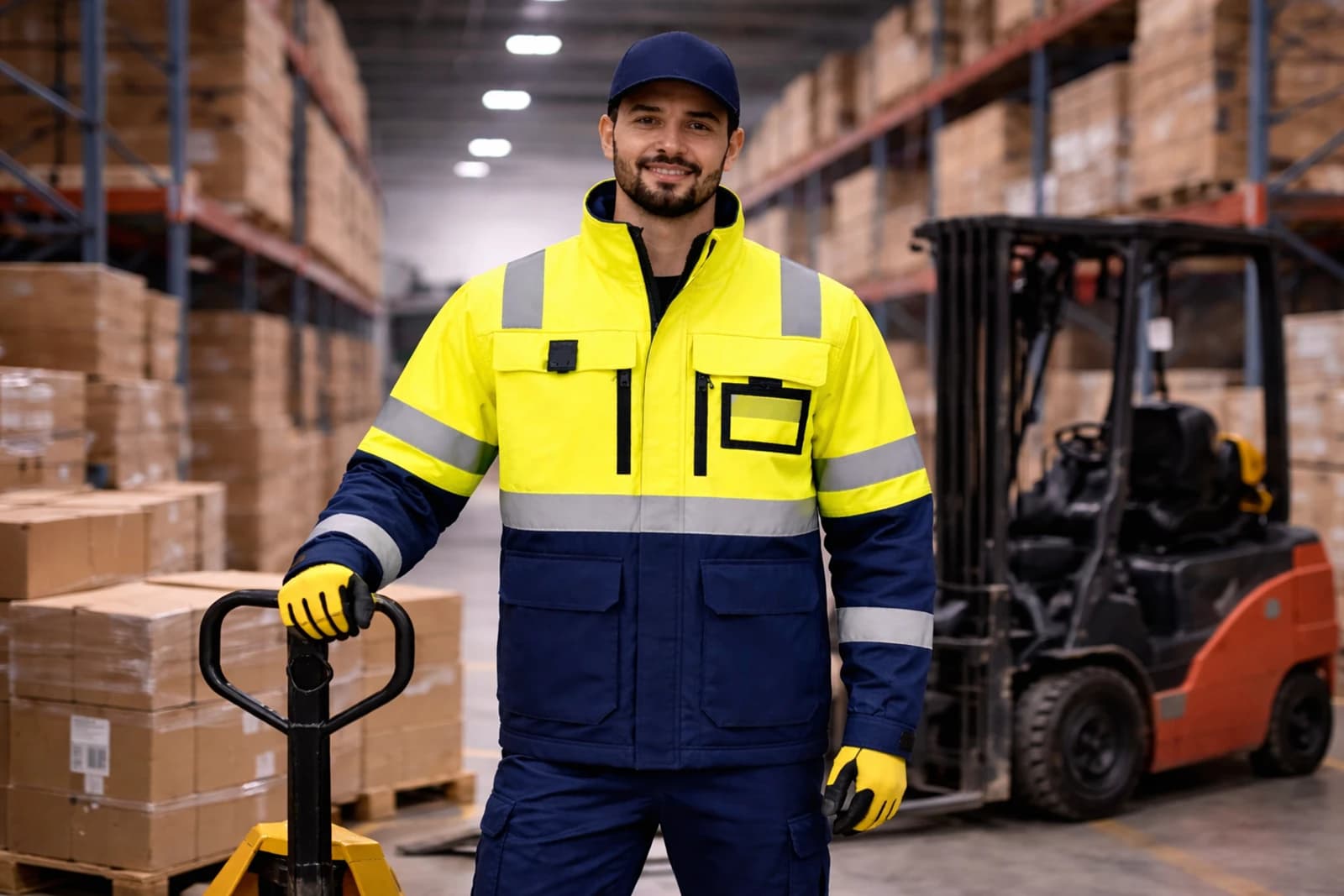
Hi-Vis Safety Jacket
Reflective safety jacket for high-visibility site operations and road work crews.