When Should a Wastewater Plant Request a Second Workwear Sample?
Wastewater treatment plant workwear samples evaluated under dry conditions pass inspection but fail in the wet, chemical environment of process areas — fabric absorbs moisture and becomes heavy, chemical splash degrades coatings, reflective tape delaminates, seams wick moisture, and closures corrode. The root cause: the sample evaluation protocol does not replicate wet-environment conditions that drive garment failure. This article covers the wet-environment failure modes that dry inspection cannot detect, the specific tests that should be performed on the first sample, the failure criteria that trigger a second sample request, and the protocol for evaluating and approving a second sample with enhanced specifications before bulk commitment.

Buyer context
What procurement teams run into
Wastewater treatment plants operate continuously in wet, chemically exposed environments. Process areas include aeration basins, clarifiers, sludge thickeners, dewatering centrifuges and belt presses, chemical feed rooms (chlorine, sodium hypochlorite, ferric chloride, alum, polyacrylamide), and outdoor channels and weirs where workers face constant moisture, chemical splash, and biological contaminants throughout every shift. Workwear samples submitted by suppliers are typically evaluated under dry conditions: visual inspection of fabric, stitch quality, closure function, reflective tape adhesion, and overall garment construction. The sample is approved based on this dry evaluation — and a bulk order is placed. But the garment's performance in the wet, chemical environment of a wastewater plant is fundamentally different from its performance in a dry inspection room. The root cause: the sample evaluation protocol does not replicate the wet-environment conditions that drive garment failure in wastewater treatment operations. The first sample passes dry inspection but fails in service. **1. Failure modes that dry inspection cannot detect** Wastewater plant workwear fails in service through mechanisms that are invisible during dry inspection: - **Moisture absorption and weight gain:** Standard cotton or cotton-blend fabric absorbs moisture from constant splashing, aerosol deposition, and high humidity in process areas. The fabric becomes heavy, saggy, and uncomfortable within 30–60 minutes of exposure. Workers complain about garment weight and restrict movement — reducing productivity and increasing fatigue. Dry inspection cannot detect moisture absorption rate or saturated fabric weight. - **Chemical degradation of fabric coatings:** Chemical feed areas expose garments to chlorine, sodium hypochlorite, ferric chloride, and polymer splash. These chemicals degrade fabric water-repellent coatings, weaken fiber integrity, and cause color fading within days of exposure. Dry inspection cannot detect chemical resistance — the fabric looks intact until chemical exposure reveals the degradation. - **Reflective tape delamination:** Hi-vis garments rely on reflective tape for visibility compliance. Standard reflective tape adhesive delaminates in constant moisture and chemical exposure — the tape peels off after 2–4 weeks in wet process areas. Dry inspection confirms tape adhesion at delivery, but cannot predict long-term adhesion in wet conditions. - **Seam wicking and weakening:** Garment seams are the primary moisture entry point. Standard sewing thread (polyester or cotton) wicks moisture through needle holes, weakening the seam and allowing moisture to reach the worker's skin. Seam strength decreases by 20–30% when saturated — increasing the risk of seam failure during physical tasks. Dry inspection confirms seam construction but cannot detect seam wicking or wet-strength loss. - **Closure corrosion and clogging:** Metal snaps, zippers, and other closures corrode in constant moisture and chemical exposure. Snap corrosion causes closures to seize or break. Zipper corrosion causes zippers to jam. Biological residues (sludge, biofilm) clog closure mechanisms. Dry inspection confirms closure function at delivery but cannot predict long-term corrosion and clogging resistance. **2. The cost of approving a first sample that fails in wet conditions** The buyer who approves the first sample based on dry inspection and places a bulk order faces: - **Premature garment replacement:** Garments degrade faster than expected — fabric thins, seams split, reflective tape delaminates, closures corrode — within 2–3 months instead of the expected 6–9 months. The buyer must place emergency replacement orders at premium cost. - **Worker complaints and non-compliance:** Workers experience discomfort (heavy, wet garments), visibility loss (delaminated reflective tape), and closure failures (jammed zippers, broken snaps). Workers complain, reject the garments, and revert to old garments or PPE that does not meet the plant's safety standards. - **Supplier disputes:** The buyer claims the garments failed to meet expectations. The supplier claims the garments met the specification (dry inspection criteria). The dispute delays resolution and damages the supplier relationship. - **Re-sampling and re-ordering costs:** The buyer must re-sample, re-evaluate, and re-order — adding 2–3 months to the procurement cycle and incurring additional sampling costs. **3. The procurement mistake: dry-only sample evaluation** The most common procurement error is to evaluate workwear samples under dry conditions only — visual inspection, fabric hand-feel, stitch quality, closure function — and approve the sample without testing wet-environment performance. The logic: "If the sample looks good and feels good, it will perform well in service." But this logic ignores the wet-environment failure modes that drive garment failure in wastewater treatment operations. The buyer who evaluates samples dry-only faces premature garment failure, worker complaints, supplier disputes, and re-sampling costs. The buyer who evaluates samples under wet-environment conditions identifies failure modes before bulk commitment — and requests a second sample with enhanced specifications before placing the order.
Sourcing approach
How a factory partner can respond
The solution for wastewater plant workwear sampling is to implement a wet-environment sample evaluation protocol that replicates wastewater plant conditions before approving the first sample for bulk production. **Step 1: Define wet-environment test conditions** Replicate the wet-environment conditions that drive garment failure in wastewater treatment operations: - **Moisture exposure:** Submerge fabric samples in clean water for 30 minutes, then measure moisture absorption rate, saturated fabric weight, and drying time. Compare with baseline dry fabric weight. Specify maximum moisture absorption of 30% weight gain (fabric should not become more than 30% heavier when saturated). - **Chemical exposure:** Apply chemical solutions (5% sodium hypochlorite, 10% ferric chloride, 1% polyacrylamide) to fabric samples for 24 hours, then evaluate fabric integrity, color fastness, and water-repellent coating retention. Specify no fabric degradation, no color fading greater than 20%, and water-repellent coating retention greater than 70% after chemical exposure. - **Reflective tape adhesion:** Submerge reflective tape samples in clean water for 72 hours, then measure tape adhesion strength. Specify minimum adhesion strength of 2 N/cm after 72-hour water immersion — confirming that the tape will not delaminate in wet conditions. - **Seam wicking test:** Sew test seams using the specified thread and construction, submerge in water for 30 minutes, then measure moisture wicking through needle holes and seam strength when wet. Specify maximum seam wicking of 5 mm from the waterline and minimum wet seam strength of 80% of dry seam strength. - **Closure corrosion test:** Expose metal closures (snaps, zippers) to salt spray (5% NaCl solution) for 48 hours, then evaluate closure function and corrosion. Specify no corrosion that impairs closure function after 48-hour salt spray exposure. **Step 2: Perform wet-environment tests on the first sample** Request the supplier to provide wet-environment testing data for the first sample — or perform the tests internally if the buyer has testing capability. The tests should be performed on the same fabric, thread, reflective tape, and closures used in the first sample — confirming that the actual production materials meet wet-environment performance criteria. If the supplier cannot provide wet-environment testing data, request that the supplier perform the tests and provide test reports. If the supplier refuses or cannot perform the tests, this is a red flag — the supplier may not have the capability to produce garments that perform in wet environments. **Step 3: Evaluate first-sample performance against failure criteria** Compare the first sample's wet-environment test results against the failure criteria defined in Step 1: - **If moisture absorption exceeds 30% weight gain:** The fabric will become heavy and uncomfortable in wet process areas. Request a second sample with fabric that has lower moisture absorption (synthetic fiber blend or chemical water-repellent treatment). - **If chemical exposure causes fabric degradation or color fading greater than 20%:** The fabric will degrade in chemical feed areas. Request a second sample with fabric that has higher chemical resistance (inherent chemical-resistant fiber or chemical-resistant fabric treatment). - **If reflective tape adhesion is less than 2 N/cm after 72-hour water immersion:** The tape will delaminate in wet conditions. Request a second sample with moisture-resistant reflective tape (thermally bonded tape or tape with moisture-resistant adhesive). - **If seam wicking exceeds 5 mm or wet seam strength is less than 80% of dry strength:** The seams will wick moisture and weaken in wet conditions. Request a second sample with sealed seams (taped or welded seams) or water-resistant sewing thread. - **If closures corrode or impair function after 48-hour salt spray:** The closures will corrode in wet, chemical conditions. Request a second sample with corrosion-resistant closures (stainless steel, plastic, or coated metal closures). **Step 4: Request a second sample if the first sample fails** If the first sample fails any wet-environment test, request a second sample with enhanced specifications that address the failure modes. The second sample should: - Use fabric with lower moisture absorption or chemical water-repellent treatment. - Use fabric with higher chemical resistance or inherent chemical-resistant fiber. - Use moisture-resistant reflective tape. - Use sealed seams or water-resistant sewing thread. - Use corrosion-resistant closures. Evaluate the second sample using the same wet-environment tests. If the second sample passes all tests, approve for bulk production. If the second sample fails, request a third sample or consider alternative suppliers. **Step 5: Document wet-environment test results in the procurement specification** Include wet-environment test results and acceptance criteria in the procurement specification for future orders. The specification should require the supplier to provide wet-environment testing data for every bulk order — confirming that production garments meet the same wet-environment performance criteria as the approved sample. **Recommended garments for wastewater treatment plant workwear:** - **Industrial coverall-pro** — specify the coverall for process area workers (aeration basin operators, clarifier mechanics, sludge dewatering operators, chemical feed technicians) who face constant moisture and chemical splash. Specify with wet-environment testing data: moisture absorption less than 30% weight gain, chemical resistance to sodium hypochlorite and ferric chloride, sealed seams or water-resistant thread, and corrosion-resistant closures. Request the supplier to provide wet-environment testing data for the first sample before approving bulk production. - **Hi-vis safety jacket** — specify the hi-vis jacket for outdoor workers (yard operators, maintenance crew, vehicle traffic areas) who need visibility and weather protection. Specify with moisture-resistant reflective tape (thermally bonded or moisture-resistant adhesive), water-resistant outer shell, and corrosion-resistant closures. Request the supplier to provide reflective tape adhesion testing data after 72-hour water immersion before approving bulk production.
Recommended Products
Products that fit this use case

Industrial Workwear
Industrial Coverall Pro
Hard-wearing one-piece coverall for plant, maintenance, and heavy-duty operations.
Safety Uniform
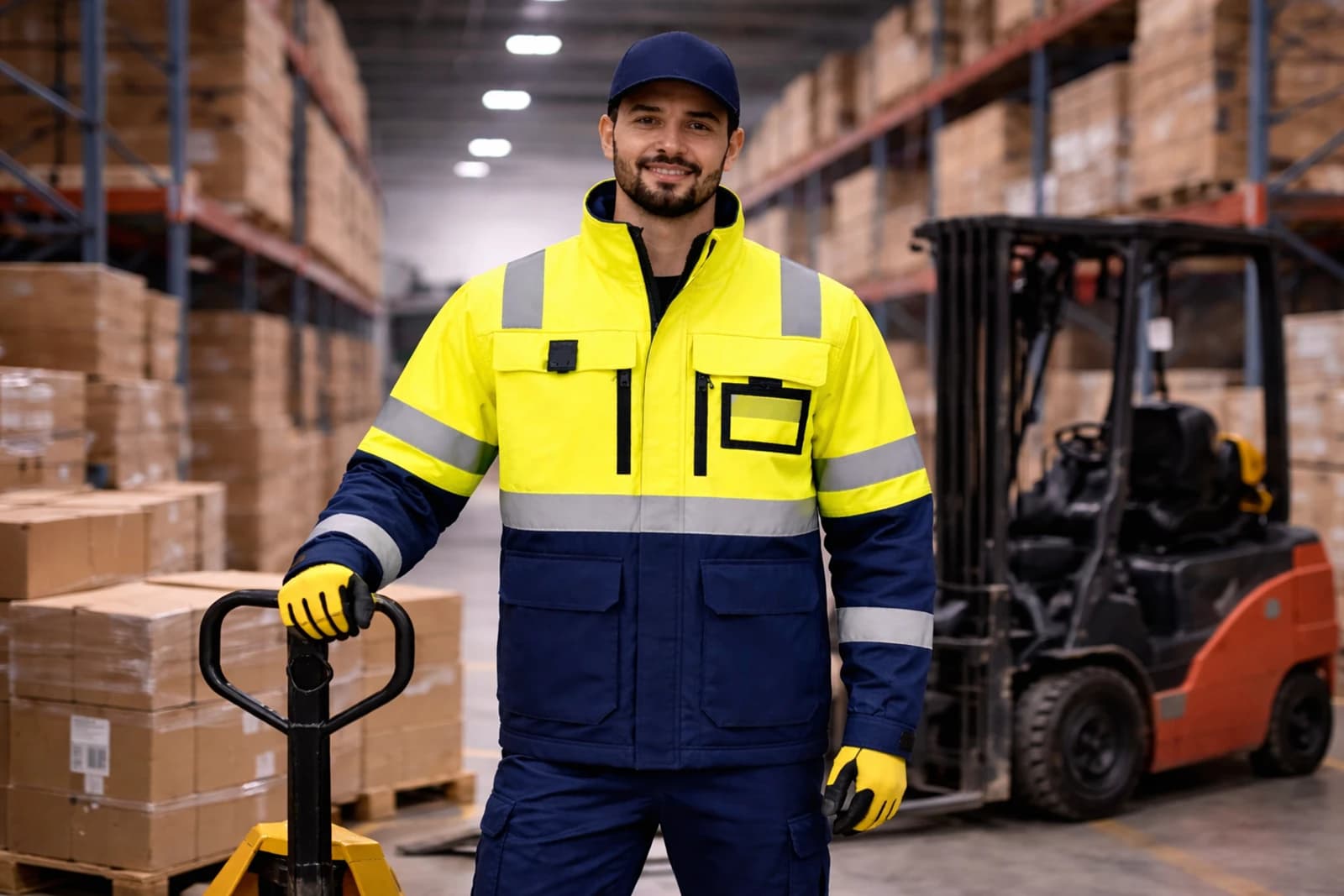
Hi-Vis Safety Jacket
Reflective safety jacket for high-visibility site operations and road work crews.