Why Do Bakery Workers Replace Uniforms Every Three Months Instead of Six?
Commercial bakery uniforms fail at three to four months while buyers specify six-month replacement cycles based on general industry norms. The root cause: bakery workwear faces high-temperature daily washing (60°C+), flour dust abrasion, sugar and oil staining, and heavy sweat exposure that degrade fabric faster than most industrial environments. The result: workers wear degraded uniforms that compromise hygiene standards, or buyers replace too early and waste 40-60% of annual workwear budget. This article covers the mechanism that accelerates bakery uniform degradation, the fabric and construction criteria that extend usable life, and the condition-based replacement protocol that matches actual garment condition to hygiene requirements.
Buyer context
What procurement teams run into
Commercial bakeries produce bread, pastries, cakes, and baked goods through mixing, proofing, baking, cooling, packaging, and dispatch operations. Production workers, bakers, packaging operators, and dispatch staff work in environments where uniform degradation accelerates far beyond general industrial norms: - **High-temperature daily washing for hygiene compliance:** Bakery uniforms contact food products directly and must be washed daily at 60°C or higher to meet food safety hygiene requirements (HACCP, BRC, SQF standards). The high-temperature washing cycle breaks down fabric fibers, degrades color fastness, and reduces fabric integrity far faster than standard industrial washing at 40°C. - **Flour dust abrasion:** Flour dust is airborne throughout mixing, dividing, molding, and baking areas. Flour particles settle on uniform surfaces and work into fabric structure during worker movement. Flour dust is abrasive — it acts as a mild sandpaper against fabric fibers during movement and washing. The abrasive action wears fabric surfaces, creates pilling, and reduces fabric strength over repeated wash cycles. - **Sugar and oil staining:** Production workers contact sugar syrups, butter, oils, and egg wash throughout production. These substances penetrate fabric and create stubborn stains that require aggressive washing (high temperature, strong detergents, extended cycle time) to remove. The aggressive washing required to remove sugar and oil stains accelerates fabric degradation. - **Heavy sweat exposure:** Bakery ovens operate at 180-230°C and radiate significant heat into production areas. Ambient temperature in baking areas reaches 30-38°C with high humidity from proofing cabinets and steam injection. Workers sweat heavily throughout shifts. Sweat contains salts and acids that degrade fabric fibers, particularly at collar, underarm, and cuff areas where sweat accumulates. - **Frequent washing cycle:** Bakery uniforms require daily washing — workers receive fresh uniforms every shift. A uniform that survives 6 months in a standard industrial environment (washed 2-3 times per week) faces 150+ wash cycles in 3 months of daily bakery use. The wash frequency alone reduces usable life by 50-60%. The workwear specification must deliver three protections simultaneously: - **Hygiene compliance:** fabric must withstand daily high-temperature washing without degrading to the point where it cannot be cleaned effectively - **Durability:** fabric must resist flour abrasion, sugar/oil staining, and sweat degradation for a reasonable replacement cycle (minimum 4-5 months) - **Comfort:** fabric must enable heat and moisture vapor dissipation in warm, humid baking areas These three requirements conflict in standard fabric constructions. The mechanism: **1. Standard uniform fabric degrades rapidly in bakery conditions** Standard workwear fabrics (cotton, cotton-polyester blends in 150-200 GSM) are designed for general industrial use — moderate washing (2-3 times per week at 40°C), moderate abrasion, and moderate sweat exposure. In bakery conditions, these fabrics face: - **150+ wash cycles in 3 months vs. 30-40 wash cycles in standard industrial use:** Each wash cycle breaks down fiber structure, degrades color fastness, and reduces fabric strength. Standard fabric that survives 6 months (30-40 washes) in general industry fails at 3-4 months (150 washes) in bakery conditions. - **High-temperature washing (60°C+) vs. standard 40°C washing:** High-temperature washing accelerates fiber breakdown, color fading, and fabric shrinkage. Standard fabric that maintains appearance and integrity at 40°C degrades visibly at 60°C+ after 50-70 wash cycles. - **Flour abrasion + sugar/oil staining + sweat degradation:** The combination of abrasive flour dust, aggressive stain removal washing, and sweat acids creates a triple degradation mechanism that standard fabric cannot resist. Standard fabric develops pilling, color fading, fabric thinning, and collar/cuff degradation within 3-4 months. The result: standard bakery uniforms fail at 3-4 months. Workers wear degraded uniforms that look worn, feel rough, and may not meet hygiene standards (fabric becomes difficult to clean effectively). Buyers face a choice: replace at 3 months (high cost) or extend to 6 months (workers wear degraded uniforms). **2. Heavy-duty fabric resists degradation but traps heat** Heavy-duty fabrics (250-300 GSM, tight weave, heavy polyester content) achieve durability through high fabric weight, tight construction, and synthetic fiber content. The heavy, dense construction resists flour abrasion, withstands high-temperature washing, and resists stain penetration. But the same heavy, dense construction that delivers durability also traps heat: - **Heavy fabric has low air permeability:** Air cannot pass through the dense fabric structure. Body heat and moisture vapor generated by the worker cannot dissipate through the fabric. Workers in baking areas (30-38°C ambient temperature) experience heat buildup under the garment within 30-60 minutes. - **Heavy synthetic fabric has low moisture vapor transmission:** Polyester-dominant fabrics do not absorb or transmit moisture vapor effectively. Sweat vapor generated by workers cannot pass through the fabric and accumulates between skin and garment. Workers experience clamminess, discomfort, and heat stress. - **Heavy fabric adds garment weight:** The heavy-duty garment weighs 25-35% more than standard workwear. The additional weight adds to worker fatigue over 8-10 hour shifts in warm baking areas. The result: a fabric that resists bakery degradation causes heat stress for workers. Workers experience heat exhaustion, reduce productivity, and may seek relief by adjusting garments or taking additional breaks — creating potential hygiene risk when garments are adjusted in production areas. **3. The procurement mistake: specifying a calendar-based replacement cycle without understanding bakery wash impact** The most common procurement error is to specify a 6-month replacement cycle based on general industry norms without accounting for bakery-specific wash frequency and degradation mechanisms: - **Specify 6-month replacement and accept degraded uniforms:** Workers wear uniforms that have undergone 150+ wash cycles. Uniforms look worn, feel rough, have faded color, developed pilling, and may not clean effectively. The bakery faces hygiene compliance risk (degraded fabric may harbor bacteria), worker complaints about appearance and comfort, and potential audit findings. - **Replace at 3 months and accept high cost:** The bakery replaces uniforms every 3 months to maintain appearance and hygiene standards. Annual workwear cost per worker doubles or triples compared to general industry norms. The bakery faces budget pressure and questions the cost-effectiveness of workwear programme. The buyer who specifies 6-month replacement faces hygiene risk and worker complaints. The buyer who replaces at 3 months faces unsustainable workwear costs. **4. The secondary driver: no condition-based replacement protocol** Many bakeries lack a condition-based replacement protocol that matches actual garment condition to hygiene requirements. Replacement decisions are made by calendar (replace at 3 or 6 months) rather than by actual garment condition. The result: - **Some uniforms are replaced too early:** Uniforms that have undergone minimal wear (workers in cooler areas, workers with lighter duties) are replaced at 3 months even though they remain in good condition. The bakery wastes 30-40% of uniform lifespan. - **Some uniforms are replaced too late:** Uniforms that have undergone heavy wear (workers in baking areas, workers with heavy flour/oil exposure) are worn beyond 4 months even though they are degraded. The bakery faces hygiene risk and worker complaints. - **No data to optimize replacement timing:** The bakery lacks data on actual uniform condition by role, zone, and exposure level. Without data, the bakery cannot optimize replacement timing to match actual garment condition. **5. The cost of getting it wrong** The buyer who specifies 6-month replacement without understanding bakery wash impact faces: - Hygiene compliance risk — degraded fabric may harbor bacteria, fail audit requirements - Worker complaints — uniforms look worn, feel rough, cause discomfort - Potential audit findings — food safety auditors may flag degraded uniforms as hygiene risk The buyer who replaces at 3 months without optimizing faces: - Annual workwear cost per worker doubles or triples — 100 workers × 4 replacements per year vs. 2 replacements per year = 100% cost increase - Budget pressure — workwear programme consumes disproportionate share of operational budget - No data to justify cost — management questions workwear cost without data on actual garment condition and replacement need
Sourcing approach
How a factory partner can respond
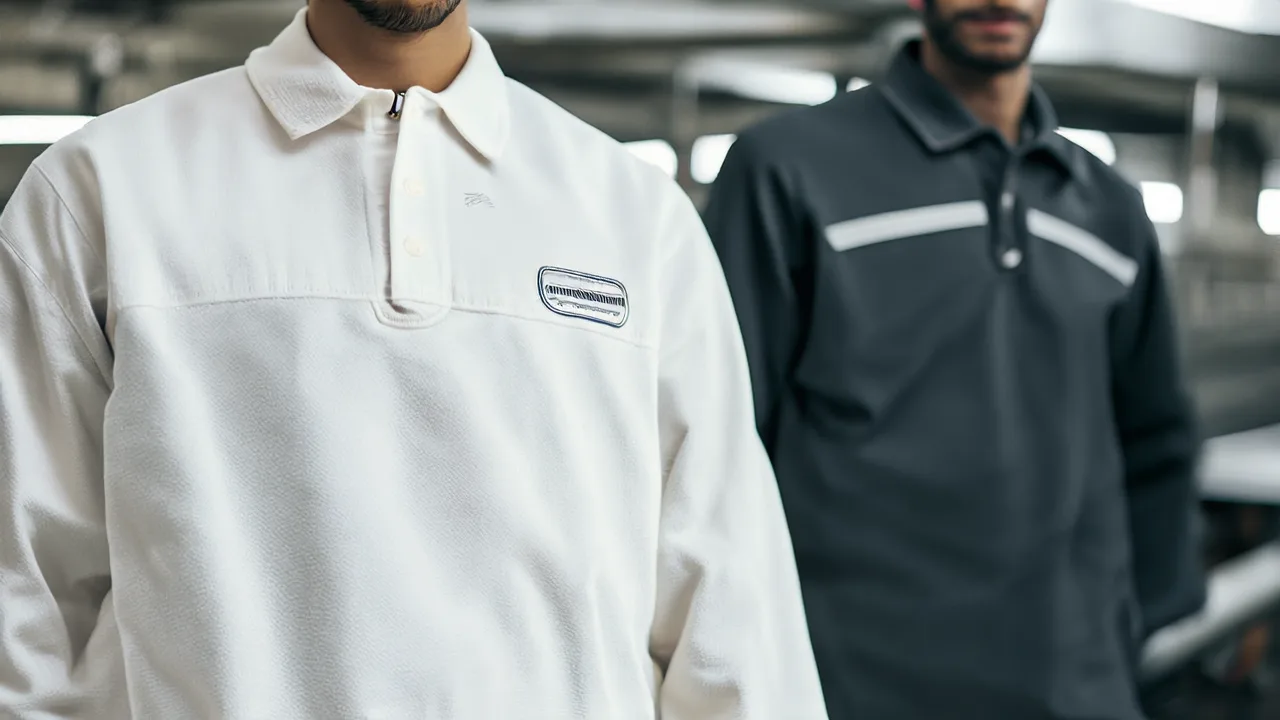
The solution for bakery workwear is to specify fabric constructions that resist bakery-specific degradation mechanisms (high-temperature washing, flour abrasion, sugar/oil staining, sweat degradation) AND implement a condition-based replacement protocol that matches actual garment condition to hygiene requirements. **Step 1: Specify fabric constructions that resist bakery degradation** Work with the supplier to identify fabric constructions that deliver durability in bakery conditions while enabling comfort in warm baking areas. The fabric construction criteria: - **Polyester-dominant blend (65% polyester / 35% cotton or 80% polyester / 20% cotton):** Polyester resists high-temperature washing degradation, color fading, and shrinkage far better than cotton. The polyester-dominant blend maintains fabric integrity after 150+ wash cycles at 60°C. Cotton content provides some moisture absorption and comfort. - **Moderate fabric weight (180-220 GSM):** Specify fabric in the 180-220 GSM range — heavy enough to resist flour abrasion and withstand high-temperature washing, but light enough to enable air circulation and moisture vapor transmission in warm baking areas. Avoid extremely heavy fabrics (250+ GSM, which trap heat) and extremely light fabrics (below 150 GSM, which degrade rapidly). - **Tight weave construction:** Specify fabric with tight weave density that resists flour dust penetration and sugar/oil staining. The tight weave prevents abrasive flour particles from working into fabric structure and prevents stains from penetrating deeply. Tight weave also maintains fabric strength after repeated washing. - **Color fastness to high-temperature washing:** Specify fabric with color fastness rated for 60°C+ washing (ISO 105-C06 or equivalent test standard). The fabric must maintain color after 150+ wash cycles at 60°C. Require the supplier to provide color fastness testing data. - **Shrinkage resistance:** Specify fabric with shrinkage resistance rated for 60°C+ washing (maximum 3% shrinkage after 5 wash cycles at 60°C per ISO 6330). The fabric must maintain size and fit after repeated high-temperature washing. - **Moisture-wicking treatment or construction:** Specify fabric with moisture-wicking capability to enable sweat vapor transmission in warm baking areas. The moisture-wicking capability keeps workers cool and dry despite polyester-dominant fabric construction. The supplier should provide fabric construction data — fiber content, fabric weight, weave density, color fastness testing data, shrinkage testing data, and air permeability — and confirm that the construction delivers durability in bakery conditions while enabling comfort. **Step 2: Implement condition-based replacement protocol** Replace bakery uniforms based on actual garment condition, not by calendar. The condition-based replacement protocol: - **Define replacement criteria by condition:** Establish clear replacement criteria based on garment condition: - **Replace when fabric develops pilling that cannot be removed by washing** — pilling indicates fiber degradation and reduces fabric appearance - **Replace when color fades below acceptable threshold** — faded color indicates fabric degradation and creates unprofessional appearance - **Replace when fabric develops thinning or transparency** — thinning fabric indicates fiber breakdown and may compromise hygiene (fabric may not clean effectively) - **Replace when collar, cuffs, or high-wear areas develop fraying or damage** — damaged areas indicate fabric degradation and create hygiene risk - **Replace when stains cannot be removed by standard washing** — permanent stains indicate fabric degradation and create unprofessional appearance - **Inspect uniforms at defined intervals:** Inspect uniforms at 2-month intervals (after 60+ wash cycles) to assess condition. Use the replacement criteria to determine if uniform should continue in service or be replaced. Document inspection results. - **Track replacement data by role and zone:** Record replacement date, reason for replacement, worker role, and work zone for each uniform. Use replacement data to identify: - Which roles/zones have shortest uniform lifespan (e.g., bakers in baking areas vs. packaging operators in cooler areas) - Which degradation mechanisms are most common (pilling, color fading, thinning, collar/cuff damage, permanent stains) - Actual average uniform lifespan by role/zone - **Optimize replacement timing based on data:** Use replacement data to optimize replacement timing. If data shows that bakers in baking areas need replacement at 4 months but packaging operators can extend to 6 months, specify different replacement cycles by role. The goal: replace each uniform at the point where it meets replacement criteria, not before (to avoid waste) and not after (to avoid hygiene risk). **Step 3: Implement size management for high-turnover environments** Bakeries often have worker turnover (seasonal workers, part-time workers, temporary staff) that creates size management challenges. The size management protocol: - **Maintain size inventory buffer:** Maintain a buffer stock of each size (S, M, L, XL, XXL) equal to 15-20% of total uniform count per size. The buffer enables immediate replacement when workers join, leave, or change size requirements. - **Track uniform sizes issued to each worker:** Record the size issued to each worker. When workers leave, retrieve uniforms and return to inventory. When workers join, issue uniforms from buffer stock. - **Re-assess sizes seasonally:** Worker body sizes may change over time (weight gain/loss). Re-assess uniform sizes annually or when workers report fit issues. Retrieve ill-fitting uniforms and issue correct sizes from buffer stock. - **Label uniforms with size and issue date:** Label each uniform with size and issue date. The label enables quick identification of uniform size when retrieving from inventory and tracks uniform age for replacement planning. **Step 4: Evaluate samples under bakery-environment conditions** When the supplier submits samples, evaluate durability and comfort under conditions that replicate bakery environment: - **High-temperature wash test:** Subject fabric samples to 150 wash cycles at 60°C (represents 6 months of daily bakery washing). Evaluate fabric integrity, color fastness, shrinkage, and appearance after washing. Confirm that fabric maintains integrity and appearance after 150 washes. - **Flour abrasion test:** Expose fabric samples to flour dust in controlled conditions — simulate worker movement and flour dust exposure over 3-4 months. Evaluate fabric surface for pilling, abrasion, and fiber degradation. Confirm that fabric resists flour abrasion. - **Stain removal test:** Apply sugar syrup, butter, and oil stains to fabric samples. Wash samples at 60°C using standard bakery washing protocol. Evaluate stain removal effectiveness. Confirm that fabric enables effective stain removal without excessive washing aggression. - **Comfort evaluation:** Have workers wear sample garments in baking area conditions (30-38°C ambient temperature, high humidity) for a full shift. Evaluate heat stress, moisture vapor transmission, and comfort. Confirm that fabric enables comfort in warm baking conditions. If the sample passes durability evaluation but fails comfort (fabric traps heat), request a second sample with enhanced breathability — lighter weight, moisture-wicking treatment, or engineered weave construction. If the sample passes comfort but fails durability (fabric degrades rapidly), request a second sample with enhanced durability — higher polyester content, tighter weave, or heavier weight. **Step 5: Implement wash protocol optimization** Work with the laundry provider to optimize washing protocol that balances hygiene compliance with fabric preservation: - **Use mildest effective washing protocol:** Specify washing protocol that achieves hygiene compliance (60°C minimum, appropriate detergent concentration, adequate cycle time) but avoids excessive aggression. Avoid higher temperatures (70°C+), excessive detergent concentrations, or extended cycle times that degrade fabric unnecessarily. - **Use appropriate detergents:** Specify detergents that effectively remove sugar, oil, and flour stains without excessive fabric degradation. Avoid harsh chemicals (chlorine bleach, strong alkalis) that degrade fabric fibers. - **Avoid over-drying:** Specify drying protocol that avoids over-drying (excessive temperature, extended drying time). Over-drying degrades fabric fibers and accelerates shrinkage. - **Monitor washing machine load size:** Avoid overloading washing machines. Overloaded machines create excessive mechanical action that degrades fabric. Maintain appropriate load size per washing machine capacity. **Recommended garments for bakery workwear:** - **Industrial coverall-pro** — specify the 180-220 GSM polyester-dominant blend (65% polyester / 35% cotton or 80% polyester / 20% cotton) for production workers (bakers, mixing operators, molding operators) who work in baking areas and face high flour dust, sugar/oil exposure, and heavy sweat. The coverall provides full-body coverage for hygiene compliance, with tight weave construction that resists flour abrasion and stain penetration. Specify the coverall with color fastness and shrinkage resistance rated for 60°C+ washing, and moisture-wicking capability for comfort in warm baking areas. Request the supplier to provide fabric testing data (color fastness, shrinkage, air permeability) before approving bulk production. - **Logistics polo uniform** — specify the 180-220 GSM polyester-dominant blend for dispatch staff, delivery drivers, and warehouse workers who work in cooler areas (dispatch, warehouse, outdoor) and face lower flour/oil exposure. The polo provides comfort and professional appearance for customer-facing roles. Specify the polo with polyester-dominant fabric construction that withstands daily washing at 60°C and maintains appearance after 150+ wash cycles.",
Recommended Products
Products that fit this use case

Industrial Workwear
Industrial Coverall Pro
Hard-wearing one-piece coverall for plant, maintenance, and heavy-duty operations.

Logistics Uniform
Logistics Polo Uniform
Breathable uniform polo for warehouse, delivery, and last-mile teams.