Why Do Recycling Sorters Remove Cut-Resistant Garments Before the Shift Ends?
Materials recovery facility workwear must resist cuts and punctures from sharp objects on sorting lines while enabling the dexterity and breathability workers need for fast manual sorting. Standard cut-resistant fabrics use heavy, stiff constructions that trap heat and restrict hand movement. Standard breathable fabrics offer no cut protection and workers contact sharp metal edges and broken glass within minutes. The result: buyers choose between cut protection that causes heat stress and comfort that fails within the first hour. This article covers the mechanism that makes cut resistance and dexterity conflict, the fabric and design criteria that can deliver both, and the zone-based specification that matches garment properties to the specific exposure profile of each MRF area.

Buyer context
What procurement teams run into
Materials recovery facilities (MRFs) process commingled recyclables through receiving, pre-sort, disc screen, manual sorting lines, bale press, and yard storage operations. Sorting line workers stand alongside conveyor belts and pick mixed recyclables by hand at rates of 15–25 picks per minute throughout every shift. The work environment exposes garments to three simultaneous constraints: - **Cut and puncture exposure:** The material stream contains sharp metal can edges, broken glass fragments, protruding wire, plastic strapping, and occasional needles or syringes. Sorting line workers reach into the material stream constantly — forearms, hands, and torso front contact sharp objects on every pick. Cut-resistant fabric must resist laceration from sharp metal edges and puncture from wire or glass. - **Heat stress in semi-open facility:** MRFs are typically semi-open structures with high ceilings, overhead doors, and limited air conditioning. Ambient temperature in sorting areas reaches 30–40°C during summer months. Workers generate body heat from continuous manual sorting activity. Garments must enable heat and moisture vapor dissipation to prevent heat stress. - **Dexterity requirement:** Sorting line workers must identify materials by type (PET, HDPE, aluminum, steel, paper grade) and quality (contaminated, clean, damaged) at high speed. Workers handle small items (bottle caps, small containers) and must manipulate materials quickly. Garments must not restrict arm movement, wrist flexion, or hand dexterity. The workwear specification must deliver three protections simultaneously: - **Cut resistance:** fabric must resist cuts from sharp metal edges and punctures from wire or glass - **Heat dissipation:** fabric must enable air circulation and moisture vapor transmission to prevent heat stress - **Dexterity:** garment must enable full range of motion for fast manual sorting without restriction These three requirements conflict in standard fabric constructions. The mechanism: **1. Cut-resistant fabric traps heat and restricts movement** Cut-resistant fabrics achieve their performance through heavy fabric weight (high grams per square meter), tight weave density, and stiff fiber content (glass fiber, steel fiber, or high-modulus polyethylene). The heavy, dense, stiff construction resists cut penetration — sharp objects cannot easily slice through the dense fiber mass. But the same heavy, dense, stiff construction that resists cuts also traps heat and restricts movement: - **Heavy fabric has low air permeability:** Air cannot pass through the dense fabric structure. Body heat and moisture vapor generated by the worker cannot dissipate through the fabric. The worker experiences heat buildup under the garment within 60–90 minutes of work in MRF ambient temperatures of 30–40°C. - **Stiff fabric restricts arm movement:** The stiff fabric resists bending and stretching. Workers must exert additional force to reach into the material stream, bend elbows, and flex wrists. Workers report fatigue and restricted movement within 2–3 hours of wear. Sorting speed decreases as workers compensate for restricted mobility. - **Heavy fabric adds garment weight:** The cut-resistant garment weighs 25–40% more than standard workwear. The additional weight adds to worker fatigue over an 8–10 hour shift of continuous manual sorting. - **Low moisture vapor transmission:** Dense cut-resistant fabric does not enable sweat vapor to pass through. Moisture accumulates between the worker's skin and the garment, creating clamminess and discomfort. The result: a fabric that resists cuts causes heat stress, restricted movement, and worker fatigue. Workers remove garments within 2–3 hours of the shift to seek relief — creating cut exposure risk for the remaining 5–7 hours of the shift. **2. Breathable fabric offers no cut protection** Breathable fabrics achieve their performance through lightweight construction (low grams per square meter), open weave structure, and flexible fiber content. The light, open, flexible construction enables air circulation and full range of motion — workers stay cool and move freely throughout the shift. But the same light, open, flexible construction that enables breathability and dexterity also offers no cut protection: - **Lightweight fabric has low fiber mass:** Sharp metal edges cut through lightweight fabric easily because there is insufficient fiber mass to resist the cut. The fabric provides no meaningful cut protection. - **Open weave structure has larger gaps between yarns:** Sharp objects pass through the gaps in the weave and contact the worker's skin without significant resistance. The fabric does not resist cut or puncture. - **Flexible fibers do not resist cut:** Flexible fibers (standard polyester, cotton) bend when contacted by sharp objects rather than resisting the cut. The sharp object slices through the flexible fibers without significant resistance. The result: a fabric that enables breathability and dexterity offers no cut protection. Workers experience lacerations and punctures within the first hour of exposure to the material stream. The garment that is comfortable becomes a safety liability. **3. The procurement mistake: specifying one fabric property and accepting the tradeoff on the other** The most common procurement error is to specify workwear for one requirement and accept the tradeoff on the other: - **Specify cut-resistant fabric and accept heat stress and restricted movement:** Workers experience heat exhaustion, restricted movement, and fatigue. Workers remove garments within 2–3 hours to seek relief — creating cut exposure for the remaining shift. The MRF faces cut injury incidents in the afternoon shift and worker complaints about garment comfort. - **Specify breathable fabric and accept cut injuries:** Workers experience lacerations and punctures throughout every shift. Workers contact sharp metal edges and broken glass without meaningful fabric resistance. The MRF faces cut injury incidents, first aid treatments, and potential regulatory non-compliance with occupational safety requirements for cut hazard protection. The buyer who chooses cut resistance without breathability faces heat stress and worker rejection within hours. The buyer who chooses breathability without cut resistance faces cut injuries throughout every shift. **4. The secondary driver: one garment specified for all MRF zones** Many MRFs specify one workwear garment for all operational workers — the same fabric, the same design — regardless of the worker's specific zone and its exposure profile. But MRFs have distinct zones with different combinations of cut exposure, heat stress, and visibility requirements: - **Manual sorting lines:** High cut exposure (sharp objects in material stream), high heat stress (semi-open, warm ambient temperature), low visibility requirement (workers are away from vehicle traffic). The primary garment requirement is cut resistance with breathability. - **Pre-sort and disc screen areas:** Moderate cut exposure (larger objects, less fine sharp material), moderate heat stress, low visibility requirement. The primary garment requirement is moderate cut resistance with breathability. - **Yard operations (forklift, loader, bale wire handling):** Low cut exposure (handled materials are baled or pre-sorted), moderate heat stress (outdoor), high visibility requirement (workers near vehicle traffic). The primary garment requirement is visibility compliance with general durability. - **Bale press and equipment operation:** Low cut exposure (handled materials are baled), moderate heat stress, moderate visibility requirement. The primary garment requirement is general durability and comfort. The buyer who specifies one garment for all zones must choose a compromise fabric that delivers moderate cut resistance and moderate breathability — but the compromise fabric does not fully meet the primary requirement of any zone. Sorting line workers still experience heat stress. Yard workers lack visibility compliance. The compromise satisfies no zone fully. **5. The cost of getting it wrong** The buyer who specifies only cut resistance without breathability faces: - Heat stress for sorting line workers — workers experience heat exhaustion, restricted movement, and fatigue - Garment removal within 2–3 hours — workers remove garments to seek relief, creating cut exposure for the remaining shift - Cut injury incidents in afternoon shift — workers without garments contact sharp objects and experience lacerations - Worker complaints and high garment rejection — sorting line workers reject the garments and seek alternatives that do not meet cut protection requirements The buyer who specifies only breathability without cut resistance faces: - Cut injuries throughout every shift — workers experience lacerations and punctures from sharp objects - First aid treatments and potential lost-time injuries — cut incidents require medical treatment and may result in lost work time - Potential regulatory non-compliance with occupational safety requirements for cut hazard protection - Worker complaints about safety — workers feel unprotected and request additional PPE (arm guards, aprons) that create additional heat stress
Sourcing approach
How a factory partner can respond
The solution for MRF workwear is to specify zone-based garment requirements — matching fabric properties to the specific exposure profile of each MRF zone — and to specify fabric constructions that deliver both cut resistance and breathability for workers on sorting lines where both requirements apply. **Step 1: Map MRF zones by exposure profile** Before specifying workwear, map the MRF's operational areas by their cut exposure level, heat stress level, and visibility requirement: - **High cut / high heat stress:** Manual sorting lines. Primary requirement: cut resistance with breathability. - **Moderate cut / moderate heat stress:** Pre-sort and disc screen areas. Primary requirement: moderate cut resistance with breathability. - **Low cut / moderate heat stress / high visibility:** Yard operations. Primary requirement: visibility compliance with general durability. - **Low cut / moderate heat stress:** Bale press and equipment operation. Primary requirement: general durability and comfort. The zone mapping identifies which workers need cut-resistant fabric, which workers need breathable fabric, and which workers need visibility-compliant garments. **Step 2: Specify fabric constructions that deliver both cut resistance and breathability** For sorting line workers who need both cut resistance and breathability, work with the supplier to identify fabric constructions that deliver both properties. The fabric construction criteria: - **Moderate weight cut-resistant fabric:** Specify fabric in the 180–220 GSM range that achieves cut resistance without excessive weight. Avoid extremely heavy fabrics (250+ GSM, which trap heat and restrict movement) and extremely light fabrics (below 150 GSM, which offer no cut protection). - **Cut-resistant fiber in lightweight construction:** Specify high-performance cut-resistant fibers (high-modulus polyethylene, glass fiber blend, or engineered yarn) in a lightweight, breathable construction. The cut-resistant fiber provides cut resistance; the lightweight, breathable construction enables heat dissipation. - **Breathable back panels:** Specify garments with breathable back panels (mesh-lined or open-weave fabric) in areas that do not contact sharp objects. The breathable back panel enables heat dissipation from the worker's back — a major heat generation area — without compromising cut resistance on the front and arms where cut exposure occurs. - **Strategic cut-resistant panels:** Specify cut-resistant fabric panels on forearms, torso front, and other areas that contact the material stream. Non-exposure areas (back, underarms) use breathable fabric. The strategic panel approach delivers cut protection where needed and breathability where possible. - **Moderate fabric stiffness:** Specify fabric with moderate stiffness — enough to resist cut but flexible enough to enable arm movement. Avoid extremely stiff fabrics (which restrict movement) and extremely flexible fabrics (which do not resist cut). The supplier should provide fabric construction data — weight, cut resistance rating (ASTM F2992 or ISO 13997), air permeability, and flexibility — and confirm that the construction achieves both cut resistance and breathability. **Step 3: Specify zone-specific garment types** Based on the zone mapping, specify different garment types for different zones: - **Sorting line workers (high cut, high heat stress):** Specify a garment with cut-resistant fabric construction — moderate weight cut-resistant fiber, breathable back panels, strategic cut-resistant panels on forearms and torso front. The garment must resist cuts from sharp objects AND enable heat dissipation for workers in warm MRF conditions. Require the supplier to provide cut resistance testing data and air permeability testing data before approving bulk production. - **Pre-sort workers (moderate cut, moderate heat stress):** Specify a garment with moderate cut-resistant fabric construction — moderate weight, breathable construction, general durability. The garment must resist cuts from larger sharp objects and enable comfort during pre-sort operations. - **Yard operations workers (low cut, high visibility):** Specify a hi-vis garment with general durability construction. The garment must provide visibility compliance for workers near vehicle traffic and enable comfort during outdoor work. Cut resistance is secondary because handled materials are baled or pre-sorted. - **Bale press and equipment operators (low cut, moderate heat stress):** Specify a garment with general durability and comfort construction. The garment must survive equipment operation and enable comfort during shift. **Step 4: Specify design features that enable dexterity** In addition to fabric properties, specify design features that enable dexterity for fast manual sorting: - **Articulated sleeves:** Specify garments with articulated sleeve patterns that follow the natural bend of the elbow. Articulated sleeves reduce fabric bunching at the elbow and enable full elbow flexion without restriction. - **Gusseted underarms:** Specify garments with gusseted underarms that enable full arm reach without fabric tension. Gusseted underarms reduce fabric restriction when workers reach into the material stream. - **Elastic or fitted cuffs:** Specify elastic or fitted cuffs that do not restrict wrist movement. Loose cuffs catch on materials and restrict wrist flexion. Elastic cuffs enable full wrist movement while preventing material from entering the garment. - **Smooth closures:** Specify smooth closures (concealed zippers, covered snaps) that do not catch on materials. Exposed buttons or rough-textured closures catch on sharp objects and create snag hazards. - **Minimal external pockets on arms:** Specify garments with minimal external pockets on forearms and arms. External pockets create ledges that catch on sharp objects and restrict arm movement. **Step 5: Evaluate samples under MRF-environment conditions** When the supplier submits samples, evaluate both cut resistance and breathability under conditions that replicate the MRF environment: - **Cut resistance evaluation:** Expose the fabric sample to sharp metal edges and broken glass under controlled conditions — confirm that the fabric resists cuts and punctures. Use standardized cut resistance testing (ASTM F2992 or ISO 13997) to quantify cut resistance level. - **Breathability evaluation:** Measure the fabric's air permeability and moisture vapor transmission rate — confirm that the fabric enables heat and moisture vapor to pass through. If possible, have workers wear the garment in MRF conditions for a full shift and confirm that they do not experience excessive heat buildup or sweating. - **Dexterity evaluation:** Have sorting line workers perform sorting tasks in sample garments — confirm that the garment does not restrict arm movement, wrist flexion, or hand dexterity. Measure sorting speed and accuracy in sample garments compared to current garments. - **Heat stress evaluation:** Have workers wear the garment in MRF conditions (30–40°C ambient temperature) for a full shift — confirm that workers do not experience heat exhaustion or remove garments before the shift ends. Track garment wear time and worker comfort feedback. - **Wash test:** Subject samples to repeated wash cycles (minimum 25 wash cycles) — confirm that the fabric maintains cut resistance, breathability, and color fastness after washing. If the sample passes cut resistance evaluation but fails breathability (fabric traps heat), request a second sample with enhanced breathability — breathable back panels, lighter weight, or more breathable fiber construction. If the sample passes breathability but fails cut resistance (fabric allows cuts), request a second sample with enhanced cut resistance — higher cut-resistant fiber content, strategic cut-resistant panels, or higher cut resistance rating. **Step 6: Implement zone-based replacement and wear tracking** MRF workwear replacement should be managed by zone and by actual wear condition, not by calendar: - **Sorting line garments:** Replace garments when cut damage compromises fabric integrity (visible cuts through fabric, puncture holes, frayed cut-resistant fibers). Track replacement by zone and by garment type. Do not replace on calendar basis — replace based on actual cut damage. - **Yard operations garments:** Replace garments when visibility compliance degrades (faded hi-vis color, damaged reflective tape) or when general fabric integrity is compromised. - **Wear tracking:** Implement a wear tracking system that records garment issue date, replacement date, and reason for replacement. Use wear data to identify garments that fail prematurely and adjust specifications accordingly. **Recommended garments for MRF workwear:** - **Industrial coverall-pro** — specify the coverall for sorting line workers who face cut exposure from sharp objects throughout every shift and need cut resistance with breathability. Specify the coverall with cut-resistant fabric construction: moderate weight (180–220 GSM) high-performance cut-resistant fiber, breathable back panels, strategic cut-resistant panels on forearms and torso front, articulated sleeves, and gusseted underarms. Request the supplier to provide cut resistance testing data (ASTM F2992 or ISO 13997) and air permeability testing data before approving bulk production. - **Hi-vis safety jacket** — specify the hi-vis jacket for yard operations workers (forklift operators, loader operators, bale wire handlers) who work near vehicle traffic and need visibility compliance with general durability. Specify the hi-vis jacket with visibility-compliant fabric construction and general durability for outdoor MRF yard conditions. Request the supplier to provide visibility compliance certification before approving bulk production.
Recommended Products
Products that fit this use case

Industrial Workwear
Industrial Coverall Pro
Hard-wearing one-piece coverall for plant, maintenance, and heavy-duty operations.
Safety Uniform
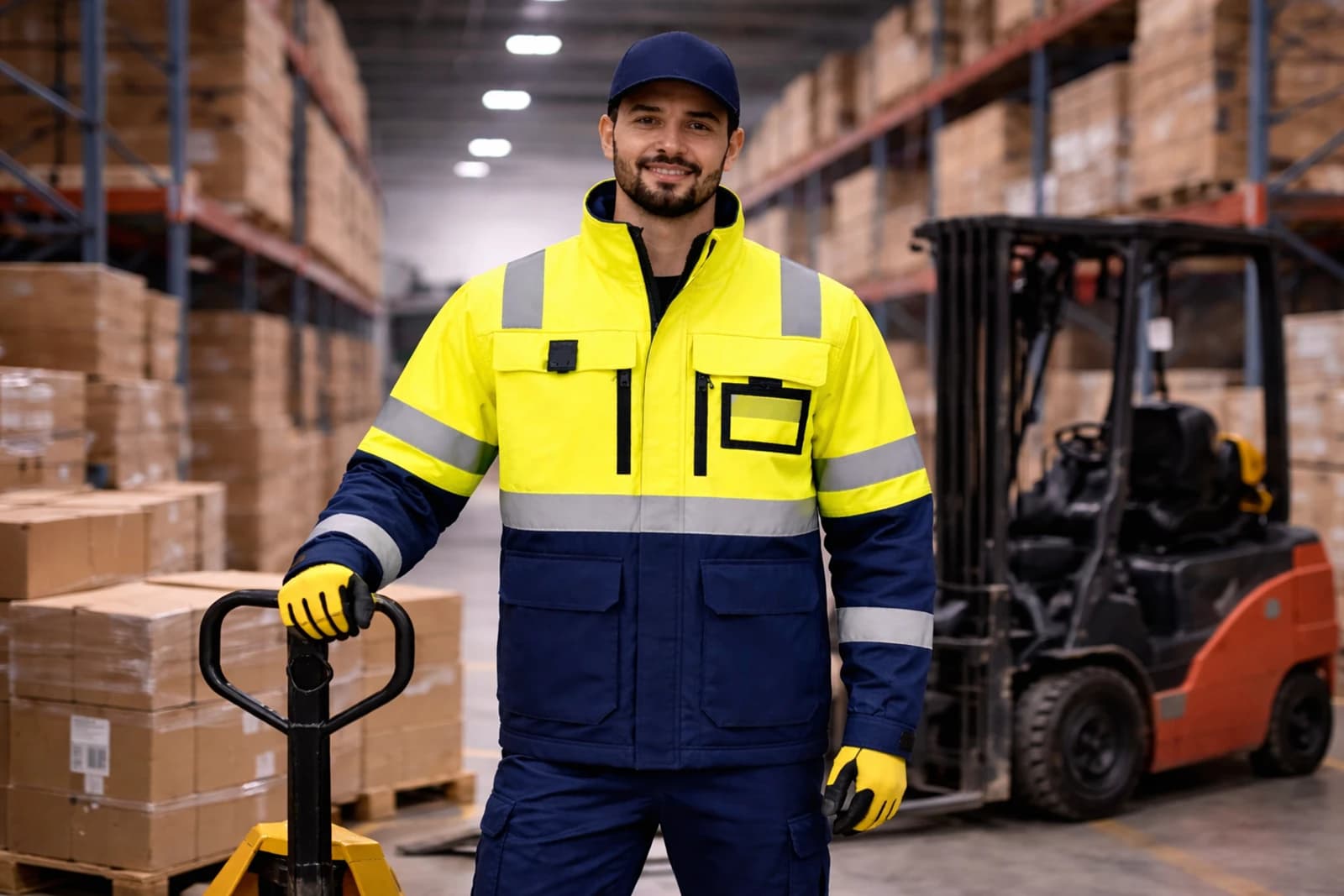
Hi-Vis Safety Jacket
Reflective safety jacket for high-visibility site operations and road work crews.