Why Dubai Logistics Teams Are Switching to Technical Polo Uniforms
Warehouse and delivery crews across Dubai, Riyadh, and Doha spend 8–10 hours in uniform under intense heat and air-conditioned cold zones. Standard cotton polos absorb sweat and fade within months. This article explains why more GCC logistics operators are switching to moisture-wicking technical polo uniforms and what B2B buyers should look for when sourcing them from a Chinese OEM manufacturer.

Buyer context
What procurement teams run into
Logistics and warehousing operations in the Middle East face a uniform problem that conventional apparel brands do not solve well. A warehouse picker in Dubai starts their shift at 7:00 AM in a 20°C air-conditioned sorting hall, moves into a 45°C loading bay by 10:00 AM, and spends midday inside a non-air-conditioned container yard. A standard cotton or cotton-blend polo absorbs sweat during the hot phase and stays wet against the skin through the cold phase, creating discomfort that reduces focus and productivity. On top of that, Gulf region logistics workers operate in environments rich in dust and fine sand. Cotton fibres trap these particles, which abrade the fabric from the inside out. The result: collars curl after three washes, colours fade from daily laundering at industrial laundries using high-temperature water, and polo uniforms need replacement every four to six months. For a company outfitting 500 or 1,000 staff, that replacement cycle becomes a significant recurring procurement cost. Many GCC logistics operators initially choose low-cost polo uniforms from local suppliers or from Chinese manufacturers offering basic 65/35 poly-cotton pique at competitive prices. The per-unit cost is attractive, but the total cost of ownership over 12 months often exceeds the cost of a better-constructed technical polo from the start. The challenge is that most B2B buyers do not know which fabric blends, construction details, and finishing treatments actually perform in the Gulf logistics environment, and which are just marketing labels.
Sourcing approach
How a factory partner can respond
Technical polo uniforms designed for the Gulf logistics environment share three spec changes that distinguish them from standard poly-cotton polos. First, the fabric blend. Instead of 65/35 cotton-polyester, a high-performing logistics polo uses 100% polyester yarn that is engineered for moisture wicking, or a 50/50 cotton-polyester blend with a double-layer construction where the inner layer is hydrophobic (repels moisture from the skin) while the outer layer remains soft and professional looking. The key spec to look for is the fabric's moisture management rating. A garment labelled "moisture wicking" without a test standard may not sustain performance through 50 industrial launderings. Indian and Southeast Asian manufacturers often use silicone-based wicking finishes that wash out after 20 cycles. Chinese OEM factories serving European and Australian technical uniform markets use embedded wicking fibres (Coolmax-type or recycled polyester with permanent wicking) that survive 100+ washes. Second, anti-curling collar construction is non-negotiable. Logistics polo uniforms worn five to six days per week see the collar folded, twisted, and heat-pressed against the back of a neck during truck driving and lifting. To survive this, the collar needs a fusible woven interlining across the entire collar piece, not just a narrow strip at the fold line. The collar band should be 3.5 to 4 cm tall for men's uniforms — shorter collars curl faster. Third, fabric weight matters. In the Gulf, a 180–200 gsm pique knit strikes the right balance: heavy enough to resist snagging on rack shelving and cargo edges but light enough to breathe. Fabrics below 170 gsm have poor opacity (visible undershirt) and snag easily on pallet straps. Fabrics above 220 gsm trap too much heat during outdoor loading. For B2B buyers sourcing from China, a reliable approach is to request a sample yardage of three fabric options — 100% polyester moisture-wicking pique at 190 gsm, 50/50 cotton-poly pique with a wicking finish at 195 gsm, and 100% polyester interlock at 180 gsm — and run an in-house wash test (10 cycles at 60°C) before choosing the bulk fabric. This step costs a few hundred dollars and avoids a container full of uniforms whose performance claims evaporate after the first industrial wash cycle.
Recommended Products
Products that fit this use case

Logistics Uniform
Logistics Polo Uniform
Breathable uniform polo for warehouse, delivery, and last-mile teams.
Safety Uniform
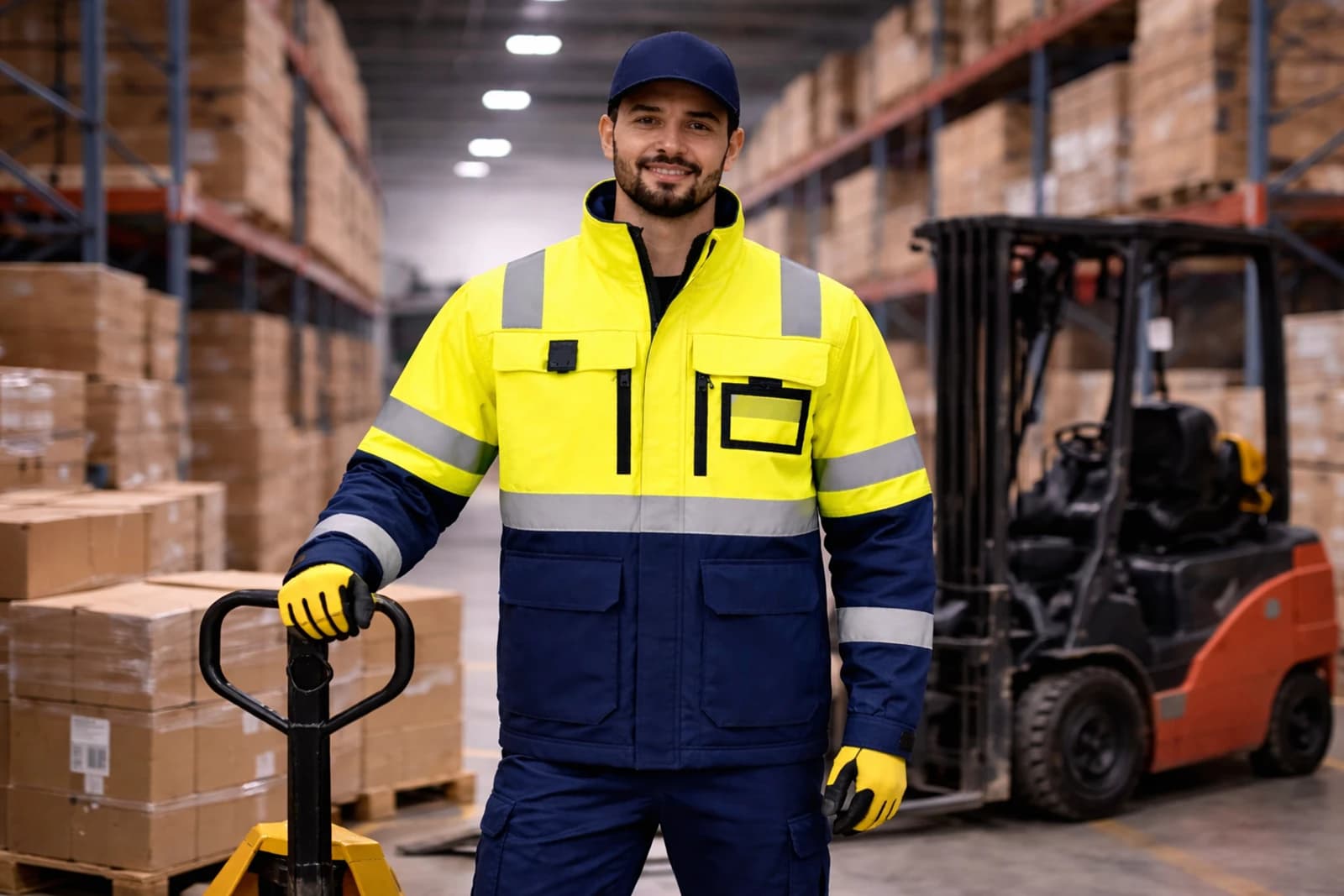
Hi-Vis Safety Jacket
Reflective safety jacket for high-visibility site operations and road work crews.