Workwear Certifications for the Middle East: What B2B Buyers Need to Know When Sourcing from China
Middle East B2B buyers sourcing workwear from China must navigate SASO conformity, ISO 20471, EN standards, and local Gulf safety regulations. This guide explains which certifications your coveralls, hi-vis jackets, and uniforms need to clear customs and pass on-site inspection in Saudi Arabia, UAE, Qatar, and Kuwait.

Buyer context
What procurement teams run into
<p>You have placed a 1,000-piece order for hi-vis safety jackets from a Chinese workwear manufacturer. The factory shares photos of the finished goods — good stitching, clean reflective tape application, correct colours. The shipment arrives at Dammam port three weeks later. Then customs flags it. The SASO certificate is missing the correct product classification code, and the consignment is held until a local testing lab verifies the retroreflective performance of the tape.</p> <p>This delay costs you demurrage fees, a missed delivery deadline to your end customer, and credibility with your procurement team. All because the certification paperwork did not match what Saudi customs expected.</p> <p>Middle East B2B buyers sourcing workwear from China face a compliance landscape that is more demanding than most other markets. Each Gulf country has its own conformity assessment programme — SASO in Saudi Arabia, ESMA in the UAE, MOCI in Qatar, PAI in Kuwait — and they do not always accept each other's certifications. Add to that the international standards that Gulf contractors increasingly require (ISO 20471 for hi-vis, EN 343 for weather resistance, EN 1149 for anti-static), and the compliance map can feel like a maze.</p> <p>Understanding exactly which certifications your products need — and how to get them from your Chinese supplier before shipping — is the difference between a smooth delivery and a container stuck at customs for two weeks.</p>
Sourcing approach
How a factory partner can respond
<h2>ISO 20471: The Universal Hi-Vis Standard for the Gulf</h2> <p>ISO 20471 is the international standard for high-visibility clothing and is the baseline requirement across all Gulf markets. It specifies minimum areas of fluorescent background material and retroreflective tape for three performance classes (Class 1, 2, and 3), along with colour fastness and mechanical strength requirements.</p> <p>For Middle East procurement: specify Class 3 for outdoor workers on highways, Class 2 for construction sites and warehouse operations, and Class 1 only for low-risk indoor environments where visibility is secondary. Most Chinese workwear manufacturers certified to ISO 20471 can provide third-party test reports from accredited labs (such as SGS, TÜV, or Intertek). <strong>Do not accept a supplier's in-house test report</strong> — only independent lab reports satisfy Gulf customs and end-client auditors.</p> <p>Key verification points when reviewing your supplier's ISO 20471 certificate:</p> <ul> <li>Test date must be within the last 12 months (Gulf customs often flags reports older than 18 months)</li> <li>The retroreflective coefficient (RA value) must be tested at 5° and 20° observation angles</li> <li>After 5 wash cycles at 60 °C, the RA value must not fall below the minimum threshold for the declared class</li> <li>The reported class (1, 2, or 3) must match your purchase order — Class 3 garments cannot be sold as Class 2 in the UAE</li> </ul> <h2>SASO Conformity: Saudi Arabia's Gatekeeper</h2> <p>The Saudi Standards, Metrology and Quality Organization (SASO) enforces the most rigorous import compliance regime in the Gulf. All workwear imported into Saudi Arabia must carry a <strong>SASO Certificate of Conformity (CoC)</strong> issued by an accredited conformity assessment body (such as SGS Saudi Arabia, Bureau Veritas, or TÜV Rheinland).</p> <p>For workwear, specific SASO requirements include:</p> <ul> <li>Textile products must meet SASO 2685 (fibre composition labelling) and SASO 2601 (flammability limits for workwear fabrics)</li> <li>Hi-vis garments must additionally meet SASO-GSO 2376 (adapted from ISO 20471 with added Gulf-specific test conditions, including 50 °C ambient temperature exposure)</li> <li>Garments classified as personal protective equipment (PPE) must be registered on the SASO PPE Portal before shipment</li> </ul> <p>Your Chinese manufacturer must coordinate with a SASO-accredited lab during production — not after. The required fabric tests (flammability, composition analysis, colour fastness to light, and dimensional stability after laundering) must be conducted by the same lab that issues the CoC. Retesting after shipment is expensive and time-consuming, with turnaround times of 4 to 6 weeks in Jeddah or Riyadh labs.</p> <h2>ESMA and UAE EmCon Mark</h2> <p>The Emirates Authority for Standardization and Metrology (ESMA) requires the <strong>Emirates Conformity Assessment Scheme (EmCon)</strong> mark for workwear classified as PPE under UAE Cabinet Resolution No. 24 of 2018. For non-PPE industrial clothing — coveralls without hi-vis or anti-static claims — an ESMA Certificate of Conformity based on self-declaration plus lab testing is sufficient.</p> <p>Practical note: The UAE accepts ISO 20471 test reports from labs accredited by ILAC (International Laboratory Accreditation Cooperation). Most Chinese factories already have access to ILAC-accredited labs in Shanghai, Guangzhou, or Shenzhen. Check that your supplier's chosen lab appears on the ILAC MRA signatory list before production starts.</p> <h2>EN Standards Commonly Referenced by Gulf Contractors</h2> <p>Large Gulf construction and oil and gas operators — Saudi Aramco, ADNOC, QatarEnergy — often reference European EN standards in their procurement specifications even when local regulations only require SASO or ESMA compliance. The most frequently requested EN standards for workwear in the Middle East are:</p> <table> <tr><th>Standard</th><th>Purpose</th><th>Typical Requirement</th></tr> <tr><td>EN 343</td><td>Weather resistance (rain, wind)</td><td>Class 3/1 (water penetration/breathability) for outdoor industrial workwear</td></tr> <tr><td>EN 1149</td><td>Anti-static performance</td><td>EN 1149-5 (garment system) for oil and gas zones</td></tr> <tr><td>EN 13034</td><td>Protection against liquid chemicals</td><td>Type 6 (limited splash protection) for industrial cleaning and chemical handling</td></tr> <tr><td>EN ISO 11611/11612</td><td>Protection against heat and flame</td><td>Welding and hot-work environments; increasingly specified by ADNOC contractors</td></tr> </table> <p>When requesting EN-compliant workwear from a Chinese manufacturer, ensure the test report explicitly references the EN version (not a Chinese equivalent like GB 8965.1) unless the client specifically accepts Chinese GB standards. Gulf QHSE departments are trained to look for the EN designation and may reject paperwork showing only GB test results.</p> <h2>How to Verify Your Chinese Manufacturer's Certifications</h2> <p>Before placing a production order, request the following from your supplier and verify each independently:</p> <ol> <li><strong>Third-party test reports</strong> — PDF copies from SGS, TÜV, Intertek, or BV for the specific standard(s) your product requires. Check the report date, the sample description matches your product, and the testing lab accreditation is current.</li> <li><strong>SASO CoC or ESMA EmCon registration</strong> — The certificate must list your importing entity as the applicant or consignee. Transferring a certificate from another buyer is possible but adds administrative delays of 2–3 weeks.</li> <li><strong>Fabric supplier certifications</strong> — Certifications for the raw fabric (flame retardancy, anti-static, etc.) must be from the fabric mill, not the garment factory. If your workwear is made from certified flame-retardant fabric, the fabric mill's test report is the document that customs will ask for.</li> <li><strong>Lab accreditation</strong> — Verify the testing lab's ILAC MRA or IAF MLA membership through the respective directories. Counterfeit test reports are an industry problem; do not skip this step.</li> </ol> <h2>Planning Your Certification Timeline</h2> <p>Certification work should start at the sampling stage, not after bulk production. A realistic timeline for full certification of custom workwear from China to the Middle East is:</p> <ul> <li><strong>Weeks 1–2:</strong> Fabric sample testing at an ILAC-accredited lab (flammability, composition, colour fastness). Cost: $200–$500 per fabric type.</li> <li><strong>Weeks 3–4:</strong> Garment sample testing for applicable EN/ISO/SASO standards. Cost: $300–$800 per garment style.</li> <li><strong>Week 5:</strong> SASO CoC or ESMA EmCon registration filing. Cost: $150–$400 depending on the conformity assessment body.</li> <li><strong>Week 6:</strong> Certificate issuance and shipping documentation preparation.</li> </ul> <p>Total certification cost for a typical workwear order (one fabric, two styles, one standard) is roughly $700–$1,700. This is a small fraction of the demurrage, storage, and re-testing costs if your shipment is held at customs for non-compliance.</p>
Recommended Products
Products that fit this use case
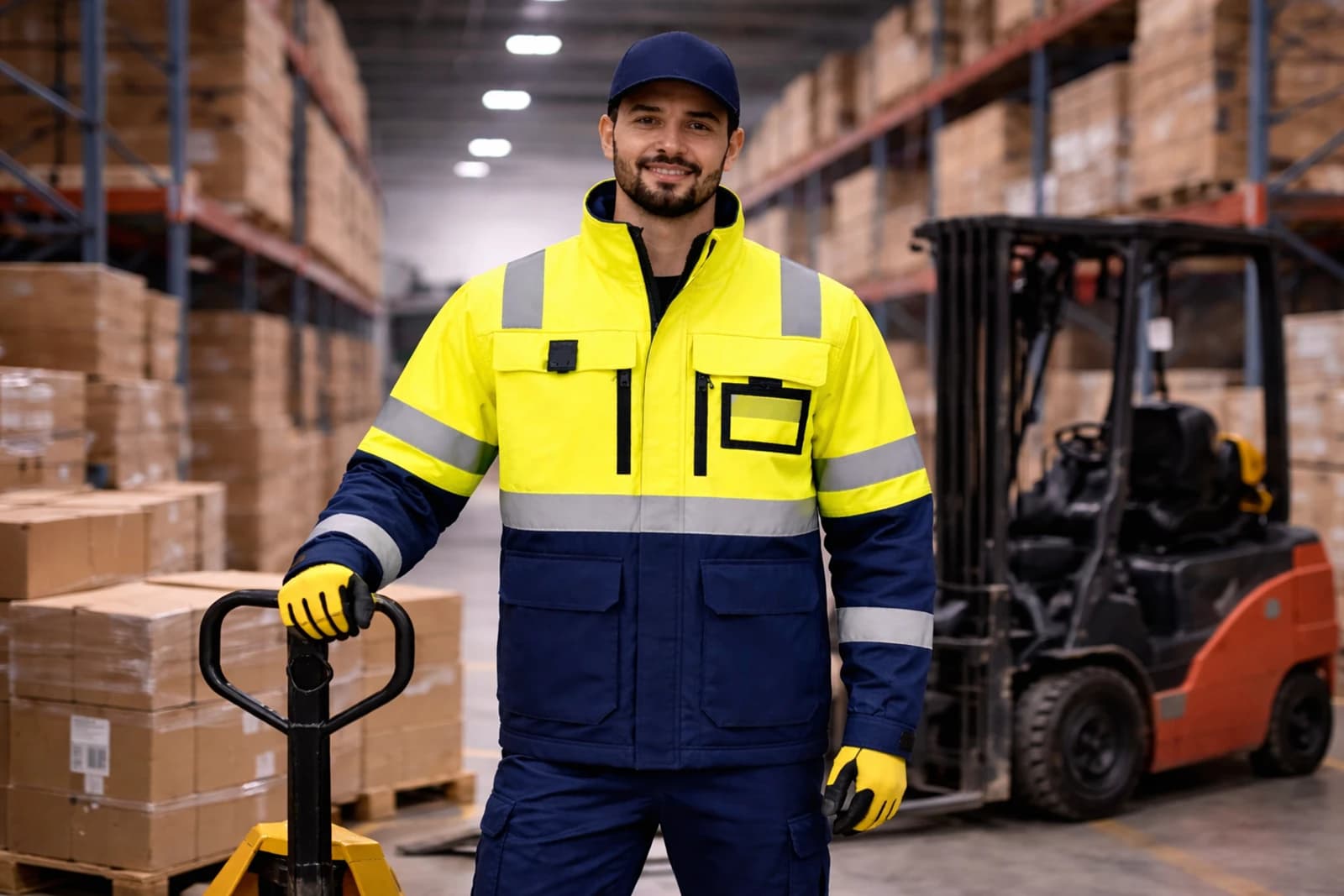
Safety Uniform
Hi-Vis Safety Jacket
Reflective safety jacket for high-visibility site operations and road work crews.

Industrial Workwear
Industrial Coverall Pro
Hard-wearing one-piece coverall for plant, maintenance, and heavy-duty operations.