Choosing the Right Workwear Fabric for Gulf Climate: Cotton, Poly-Cotton, and Performance Blends
GCC construction, logistics, and industrial buyers face a constant trade-off: workwear that is tough enough for the job but breathable enough for 45°C summer days. This guide compares cotton, poly-cotton, ripstop, and moisture-wicking performance fabrics across hi-vis jackets, polo uniforms, coveralls, and softshell sets — and shows how fabric choice directly affects worker safety, comfort, and garment lifespan in Gulf conditions.
Buyer context
What procurement teams run into
<p>A Doha construction contractor orders 2,000 hi-vis safety jackets in a standard polyester-cotton blend for his Lusail tower project. The jackets meet EN ISO 20471 and carry the required reflective tape. Within two weeks of distribution, site supervisors report that workers are removing the jackets during breaks and at mid-shift — the fabric traps heat and perspiration, and after four hours in 42°C ambient temperature with direct sun exposure, the inner lining is soaked. Workers drape the jackets over scaffolding instead of wearing them. The safety manager is frustrated: the jackets are certified, high-visibility, and correctly sized. But the fabric choice made them unbearable to wear in the Gulf summer, defeating the safety purpose entirely.</p> <p>In Sharjah, an industrial laundry processing 1,500 coveralls for a facilities management contract notices that the poly-cotton blend coveralls start showing frayed cuffs and collar edges after only 12 industrial wash cycles. The contract specifies that the coveralls must last at least 40 washes before replacement. The facilities manager calculates that at the current rate of wear, the coveralls will need replacing three months ahead of schedule — a budget overrun of approximately AED 45,000. The coveralls were well-constructed with reinforced seams, but the fabric itself could not withstand the combination of high wash temperature (75°C), mechanical abrasion in the tumble dryer, and the alkaline detergents used for industrial laundering.</p> <p>Both problems trace to the same root: the buyer selected the garment based on price and certification compliance without evaluating whether the fabric would perform under the specific climate and usage conditions of the Gulf. A hi-vis jacket that works perfectly in a temperate climate may be unwearable in Doha or Riyadh from June to September, and a coverall that performs at 30 wash cycles in a home machine may fail at 30 cycles in an industrial tunnel washer running at 80°C. Fabric selection is not a secondary consideration — it is the primary determinant of whether a workwear programme succeeds in the Gulf region.</p>
Sourcing approach
How a factory partner can respond
<h2>Fabric Categories and Their Gulf Performance Profiles</h2> <p><strong>100% Cotton — Twill and Canvas (150–300 gsm)</strong></p> <p>Pure cotton remains the first reference point for many GCC buyers because of its natural breathability and comfort against the skin. A 200 gsm cotton twill is very comfortable for indoor or shaded work environments such as warehouses, packing areas, or maintenance workshops where air conditioning or airflow is available. The cotton fibres absorb moisture away from the skin and release it through evaporation, keeping the wearer drier than a polyester-dominant fabric in moderate heat. Cotton also handles screen printing and embroidery well, making it a strong choice for branded polo uniforms in logistics and customer-facing roles.</p> <p>The major limitation for outdoor Gulf work: cotton absorbs sweat fully, and when saturated, the fabric becomes heavy, slow to dry, and prone to chafing. In 40°C+ conditions, a saturated cotton polo or coverall can actually trap heat against the body as the moisture in the fabric warms up. Cotton also shrinks — typically 3 to 5% on the first wash — so GCC buyers ordering cotton workwear must specify pre-shrunk fabric or order one size up to account for shrinkage, and must confirm the shrinkage test result (AATCC 135 or ISO 6330) before bulk production. For hi-vis applications, cotton is rarely used as the primary shell fabric because it does not achieve the same colour fastness for fluorescent orange or yellow compared to polyester blends, and the EN ISO 20471 retroreflective standard requires the background material to retain its fluorescent properties for a defined lifespan — cotton's colour retention is inferior.</p> <p><strong>Poly-Cotton Blends (65% Polyester / 35% Cotton or 50/50 — 180–260 gsm)</strong></p> <p>Poly-cotton is the most widely used workwear fabric in the GCC region — and for good reason. The polyester content provides strength, dimensional stability (minimal shrinkage), and faster drying compared to pure cotton, while the cotton content retains breathability and comfort. A 65/35 poly-cotton twill at 210 gsm is the standard specification for most hi-vis safety jackets, polo shirts, and coveralls ordered by Gulf construction, logistics, and industrial companies.</p> <p>In practice, poly-cotton offers the best balance for B2B workwear in the Gulf because it performs adequately across all three critical dimensions: it breathes better than high-polyester fabrics in dry heat, it maintains colour vibrancy and fluorescent properties longer than cotton for hi-vis applications, and it withstands industrial laundering at 60–75°C without excessive shrinkage or fraying. For polo uniforms in logistics and warehousing — where staff move between air-conditioned offices and outdoor loading bays — a 50/50 poly-cotton pique knit at 200 gsm provides a professional appearance, good moisture evaporation, and enough durability to survive 50–60 wash cycles without collar curling or fabric thinning.</p> <p>The trade-off: pure poly-cotton does not wick moisture actively — it simply absorbs and releases it passively. For extreme conditions (direct sun, 45°C, high humidity near coastal areas), the fabric can still become saturated after extended wear. This is where the third fabric category comes in.</p> <p><strong>Performance / Moisture-Wicking Polyester Blends (100% Polyester or High-Polyester Knits — 150–200 gsm)</strong></p> <p>Moisture-wicking fabrics use engineered polyester yarns with a cross-section design that pulls moisture (sweat) from the skin through the fabric to the outer surface, where it spreads and evaporates quickly. This capillary action — similar to how a candle wick draws wax — keeps the fabric layer next to the skin feeling dry even during heavy perspiration. For Gulf summer conditions, moisture-wicking polo uniforms have become the preferred choice among logistics and warehouse operations where workers are active and sweating continuously.</p> <p>A 100% polyester moisture-wicking polo at 160 gsm weighs roughly 25% less than an equivalent cotton polo and dries 4 to 5 times faster. The fabric does not absorb odour the way cotton does and maintains its shape through repeated wash cycles. For hi-vis applications, high-polyester fabrics accept fluorescent dyes more effectively than cotton, resulting in brighter and longer-lasting hi-vis colour performance — an important consideration for EN ISO 20471 certification renewal cycles.</p> <p>The limitation: 100% polyester fabrics feel less comfortable in still, humid air (such as a non-air-conditioned warehouse near the coast) because the fabric does not absorb moisture — it moves it. In saturation conditions where evaporation is limited by ambient humidity, the fabric can feel clammy. For outdoor construction work in dry Gulf heat (Riyadh, inland Doha), moisture-wicking polyester performs well because evaporation is rapid. For coastal or humid environments (Dubai summer, Dammam), a blend with cotton provides better comfort perception.</p> <p><strong>Performance Shell Fabrics: Ripstop Polyester and Nylon (200–350 gsm)</strong></p> <p>For hi-vis jackets and softshell sets, the outer shell fabric choice matters for both thermal performance and mechanical durability. The standard recommendation for Gulf construction work is a ripstop polyester shell in the 200–240 gsm range — the ripstop grid structure prevents tears from propagating, and polyester resists UV degradation better than nylon or cotton. A ripstop polyester hi-vis jacket shell with a mesh lining (rather than a brushed tricot lining) is the most wearable option for Gulf outdoor conditions: it provides the required wind resistance and mechanical protection while the mesh lining allows airflow between the jacket and the wearer's clothing layer underneath.</p> <p>For construction softshell sets (jacket and trousers), the ideal Gulf specification is a 3-layer bonded fabric: outer polyester/elastane woven shell with a DWR (durable water repellent) finish for light rain or morning dew, a middle breathable membrane or mechanical stretch layer, and a quick-dry polyester mesh inner. Avoid fleece-lined softshells for Gulf use — the fleece traps heat and becomes uncomfortable in any ambient temperature above 30°C. Many GCC buyers make this mistake on their first softshell order, receiving jackets designed for European autumn weather that are unusable for nine months of the Gulf year.</p> <h2>Recommended Fabric Weights and Blends by Garment Type for Gulf Conditions</h2> <p>Based on orders processed for GCC clients over multiple seasons, here is a practical fabric specification guide:</p> <p><strong>Hi-Vis Safety Jackets (Construction, Road Work, Airport)</strong><br> Shell: Ripstop polyester 200–240 gsm, 100% polyester or 65/35 poly-cotton<br> Lining: Mesh polyester (not brushed tricot, not quilted)<br> Reflective tape: EN ISO 20471 certified, Class 2 or Class 3<br> Best choice for Gulf outdoor: Ripstop polyester shell, mesh lining, vented back panel</p> <p><strong>Polo Uniforms (Logistics, Warehouse, Customer-Facing)</strong><br> Option A — Cost-effective: 50/50 poly-cotton pique 200 gsm<br> Option B — Premium for outdoor/active roles: 100% polyester moisture-wicking pique 160–180 gsm<br> Both options withstand industrial laundering at 60°C. Poly-cotton offers better drape and professional appearance; moisture-wicking offers better cool-wear performance.</p> <p><strong>Industrial Coveralls (Maintenance, Facilities, Oil & Gas — non-FR)</strong><br> Fabric: 65/35 poly-cotton twill 210–260 gsm<br> Why: The polyester content provides the abrasion resistance needed for tools, kneeling, and ladder work, while the cotton content ensures the coverall is not plasticky or uncomfortable in heat. A 210 gsm weight balances durability and breathability for indoor warehouse and light industrial work; 260 gsm is recommended for plant floor, mechanical workshop, and outdoor maintenance roles where abrasion exposure is higher.</p>
Recommended Products
Products that fit this use case
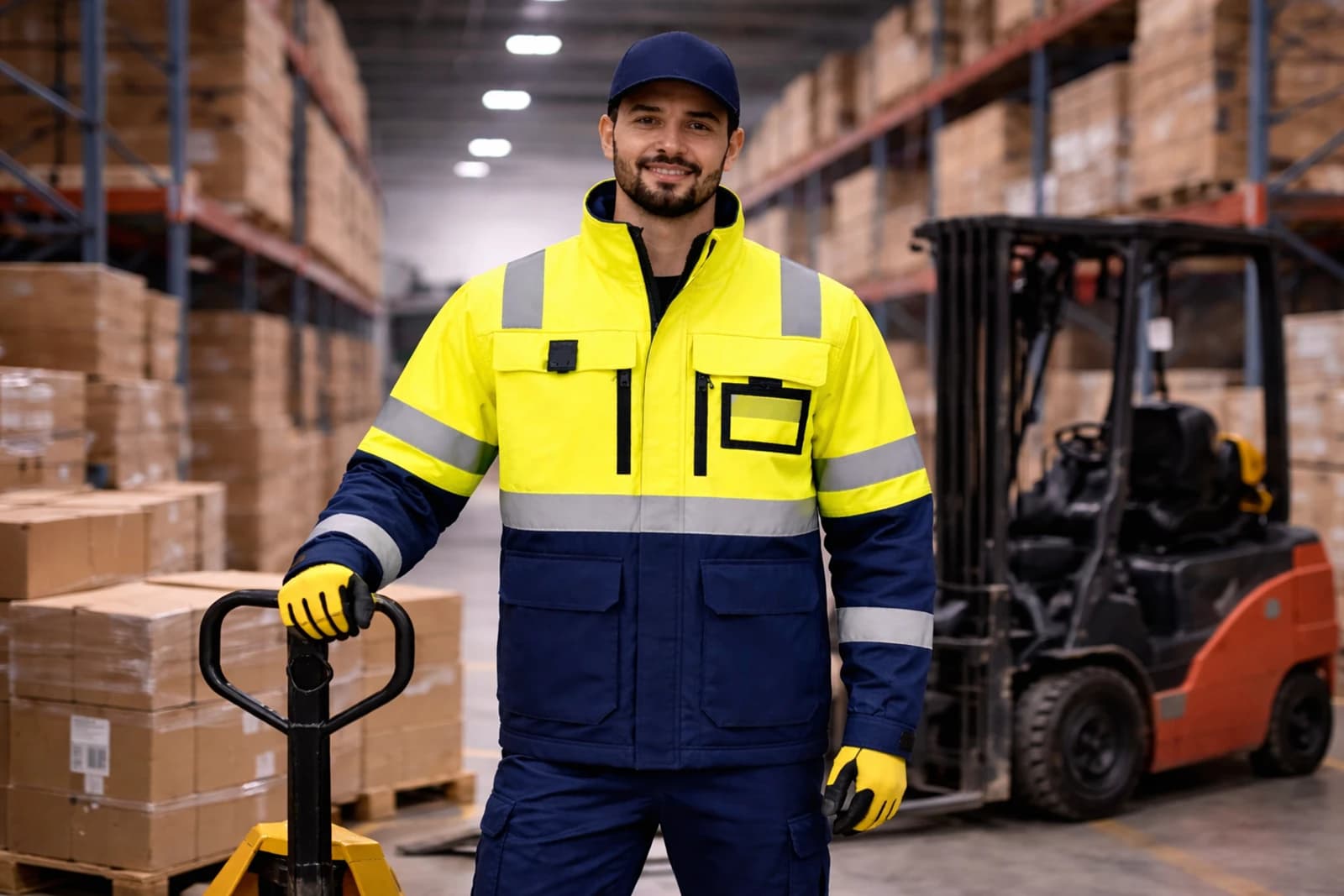
Safety Uniform
Hi-Vis Safety Jacket
Reflective safety jacket for high-visibility site operations and road work crews.

Industrial Workwear
Industrial Coverall Pro
Hard-wearing one-piece coverall for plant, maintenance, and heavy-duty operations.
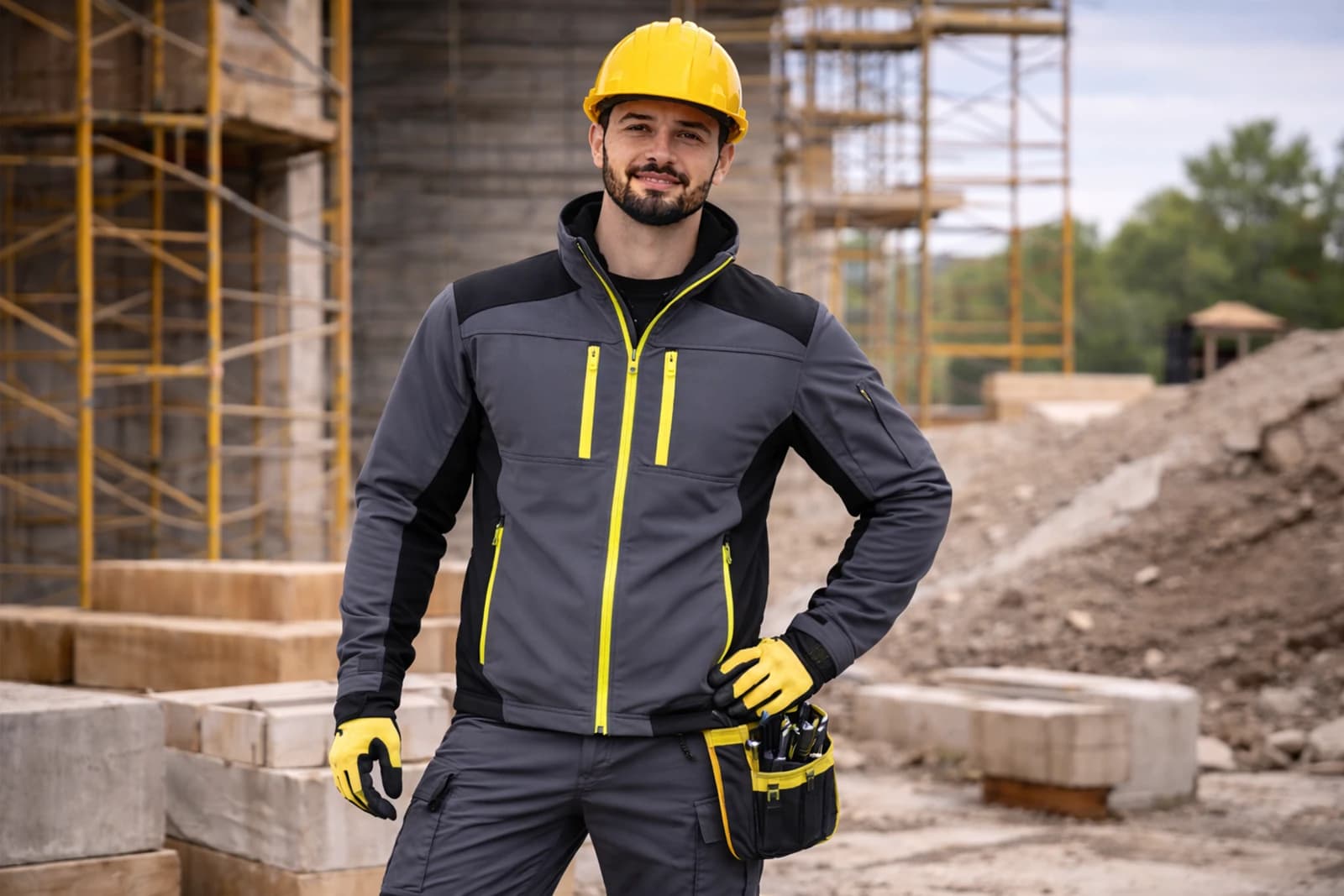
Construction Clothing
Construction Softshell Set
Flexible jacket and trouser set built for crews working across changing weather conditions.

Logistics Uniform
Logistics Polo Uniform
Breathable uniform polo for warehouse, delivery, and last-mile teams.