Fabric Selection for Workwear in the Middle East: Breathability, Durability, and Climate Considerations for B2B Buyers Sourcing from China
Middle East workwear buyers face a balancing act between breathability for 50°C outdoor conditions and durability for industrial use. This guide covers cotton vs. polyester vs. poly-cotton blends, fabric weights for different seasons, moisture-wicking technologies, and how to specify the right fabric for hi-vis jackets, polo uniforms, coveralls, and softshell sets when sourcing from a Chinese manufacturer.

Buyer context
What procurement teams run into
<p>A safety manager in Doha orders 500 hi-vis safety jackets for a summer roadworks project. The jackets he receives are made from 100% polyester with a bonded inner lining — the same specification his company has used for years in the UK. By 10:00 AM on site, workers are drenched in sweat. By noon, three workers have reported heat-related fatigue. The jackets are not worn zipped up for the rest of the summer, which means the reflective tape does not provide 360° visibility. The safety manager has the right certification — EN ISO 20471 Class 3 — but the wrong fabric for the climate.</p><p>In Abu Dhabi, a facilities management company orders 300 polo shirts for their airport terminal maintenance team. The polos are 65% polyester, 35% cotton in a 200 gsm pique knit. The team likes the feel in the air-conditioned terminal, but after six months of weekly industrial washing, the collars are curling, the fabric is pilling under the arms, and the corporate logo embroidery is puckering because the cotton component shrank at a different rate than the polyester. The procurement manager needs to replace the entire uniform within 8 months instead of the expected 18-month lifecycle.</p><p>Fabric selection is the single most consequential decision in workwear procurement — it affects worker safety, comfort, uniform lifespan, and total cost of ownership. For Middle East buyers sourcing from China, understanding fabric types, weights, blends, and finishing treatments is essential to specify the right garment the first time.</p>
Sourcing approach
How a factory partner can respond
<h2>Understanding Fabric Types for Workwear</h2> <h3>100% Cotton</h3> <p>Cotton is naturally breathable and comfortable against the skin, making it appealing for hot climates. However, 100% cotton workwear has significant drawbacks for Middle East industrial use: it absorbs sweat and stays wet, it shrinks 3–5% after the first industrial wash, it wears out quickly under abrasion, and it provides poor colour retention after repeated washing in high-temperature laundry conditions.</p> <p><strong>Best for:</strong> Office-based uniform shirts, lightweight dust coats, or short-duration indoor roles where industrial washing is not required. Not recommended for hi-vis safety garments — EN ISO 20471 requires background fabric to maintain its fluorescent properties after washing, and cotton does not hold high-visibility dyes as well as synthetic blends.</p> <h3>100% Polyester</h3> <p>Polyester is the standard fabric for industrial workwear globally and for good reason. It is strong, abrasion-resistant, dries quickly, maintains colour through industrial washing, and does not shrink. The trade-off is breathability — standard polyester does not allow moisture vapour to escape, which causes heat build-up in Middle East outdoor conditions.</p> <p><strong>Best for:</strong> Hi-vis safety jackets and vests where certification requirements and durability take priority over comfort. For outdoor use in GCC summers, look for polyester fabrics with moisture-wicking or air-textured finishes rather than standard flat filament yarns. Sidaier uses air-textured polyester for hi-vis jackets destined for Middle East markets — the textured yarn creates micro-channels that improve moisture transport compared to standard polyester.</p> <h3>Poly-Cotton Blends (65/35 or 50/50)</h3> <p>Poly-cotton blends combine the breathability and comfort of cotton with the durability and shape retention of polyester. A 65% polyester / 35% cotton blend is the most common workwear fabric worldwide — it breathes better than pure polyester, shrinks less than pure cotton, and holds colour well through 50–100 industrial wash cycles.</p> <p><strong>Best for:</strong> Polo uniforms, coveralls, and trousers where workers are in mixed environments (indoor/outdoor), or where a professional appearance matters. For Middle East buyers, a 50/50 blend offers even better breathability than 65/35 but with reduced durability — choose based on expected garment lifecycle and wash frequency.</p> <p><strong>Specify in your order:</strong> Exact blend ratio, fabric weight (gsm), and wash-test standard (ISO 6330 or AATCC). Request a fabric swatch that can be washed 10 times to verify shrinkage and colour retention before approving production.</p> <h2>Fabric Weight and Seasonal Considerations</h2> <p>Fabric weight, measured in grams per square metre (gsm), determines how a garment feels and performs. Middle East buyers should consider seasonal requirements:</p> <table> <tr><th>Garment Type</th><th>Summer Weight (gsm)</th><th>Winter Weight (gsm)</th><th>Notes for GCC</th></tr> <tr><td>Polo shirt</td><td>160–200</td><td>200–240</td><td>160–180 gsm pique knit for extreme heat; 200 gsm for year-round indoor</td></tr> <tr><td>Hi-vis safety jacket</td><td>120–150 (shell) with mesh lining</td><td>150–200 (shell) with quilted or fleece lining</td><td>Summer: insist on mesh body lining and vented back panels</td></tr> <tr><td>Coverall / boiler suit</td><td>180–220</td><td>240–300</td><td>Summer coveralls in 65/35 poly-cotton twill at 200 gsm are standard for most GCC industrial roles</td></tr> <tr><td>Softshell jacket</td><td>260–320 (2-layer without fleece backer)</td><td>320–400 (3-layer with fleece backer)</td><td>2-layer softshell without fleece backer is suitable for GCC winter (Nov–Feb) and air-conditioned environments</td></tr> </table> <p>For hi-vis safety jackets in Middle East summer conditions, specify a mesh polyester lining instead of a solid taffeta lining, and request pit vents or vented back panels. Sidaier offers hi-vis safety jackets with full mesh interior lining and zip-vent back options specifically designed for Middle East outdoor workwear buyers.</p> <h2>Moisture-Wicking and Cooling Technologies</h2> <p>Standard polyester traps heat. For Middle East outdoor workwear, consider specifying moisture-wicking or cooling finishes:</p> <ul> <li><strong>Moisture-wicking finish:</strong> A chemical treatment applied to polyester or poly-cotton fabric that pulls sweat away from the skin to the outer surface where it evaporates. The effect lasts 30–50 industrial washes depending on the quality of the treatment. Specify wicking finish on polo uniforms and hi-vis base layer shirts.</li> <li><strong>Air-textured yarn:</strong> Polyester yarn that has been mechanically textured to create a cotton-like surface with micro-pores for air circulation. More durable than chemical wicking treatments because the effect is in the yarn structure, not a surface coating.</li> <li><strong>Phase-change materials (PCM):</strong> Microcapsules embedded in the fabric that absorb excess body heat and release it when the body cools down. This technology adds cost (typically 15–25% premium) and is most appropriate for premium softshell jackets or high-heat environments like foundries and steel plants rather than general outdoor workwear.</li> </ul> <h2>Fabric Finishing Treatments for Middle East Conditions</h2> <p>Beyond the base fabric, finishing treatments significantly affect garment performance in GCC climates:</p> <ul> <li><strong>Anti-static finish:</strong> Essential for oil and gas, petrochemical, and flammable-environment workwear. Polyester is inherently static-generating — an anti-static finish or carbon-fibre grid is required for ATEX/IECEx environments.</li> <li><strong>UV-resistant finish:</strong> GCC sun exposure is intense. UV-resistant finishes prevent fabric degradation and colour fading. Important for hi-vis garments where the fluorescent background colour must remain vibrant for the garment's certified lifespan.</li> <li><strong>Anti-pilling finish:</strong> Prevents the formation of small fibre balls (pills) on the fabric surface, especially on poly-cotton blends. Specify for polo uniforms and softshell fabrics where appearance matters.</li> <li><strong>Water-repellent (DWR) finish:</strong> A durable water repellent coating is useful for softshell jackets and hi-vis outerwear during the brief GCC rainy season (December–February). Specify a DWR finish that meets your expected wash-cycle durability — standard DWR lasts 5–10 washes, while advanced DWR can last 20–30 washes.</li> </ul> <h2>Sizing and Fit Adjustments Based on Fabric</h2> <p>Fabric type and weight affect how a garment fits. Polyester and poly-cotton blends with elastane (spandex) content provide stretch for movement in hot conditions. For Middle East buyers sourcing from China, consider these fabric-specific sizing factors:</p> <ul> <li>100% cotton garments will shrink — order one size up or specify pre-shrunk fabric</li> <li>Poly-cotton blends are dimensionally stable — order true size based on your measurement chart</li> <li>Hi-vis safety jackets in lightweight summer fabric (120–150 gsm shell) should be cut slightly larger to allow airflow through the garment, not tight against the body</li> <li>Polo uniforms in 160–180 gsm pique knit have more body conformity — ensure the size chart accounts for the knit stretch</li> </ul> <h2>Quality Control: Fabric Inspection Checklist</h2> <p>When receiving a workwear shipment from China, inspect these fabric-specific points:</p> <ul> <li>Fabric weight (gsm) — measure a 10 cm × 10 cm sample and weigh it to confirm it matches the specification</li> <li>Fabric blend — perform a burn test or request a fibre composition certificate from the manufacturer</li> <li>Shrinkage — wash one garment per size at 60 °C and measure before/after dimensions; shrinkage should not exceed 2% for polyester-dominant blends or 4% for poly-cotton blends</li> <li>Colour fastness — rub a white cloth firmly against the fabric (wet and dry) to check for dye transfer; for hi-vis fabric, request a xenon-arc lightfastness test per ISO 105-B02</li> <li>Pilling resistance — after 10 wash cycles, check the fabric surface for pills; a rating of 3–4 on the Martindale pilling scale (ISO 12945-2) is acceptable for workwear</li> </ul> <p>Sidaier provides a fabric specification sheet with every bulk production order, including gsm, blend ratio, shrinkage test results, and colour fastness ratings. For Middle East buyers, we recommend ordering a pre-production sample on the actual production fabric and washing it five times before approving the bulk order — this single step prevents the majority of climate-related uniform failure.</p>
Recommended Products
Products that fit this use case
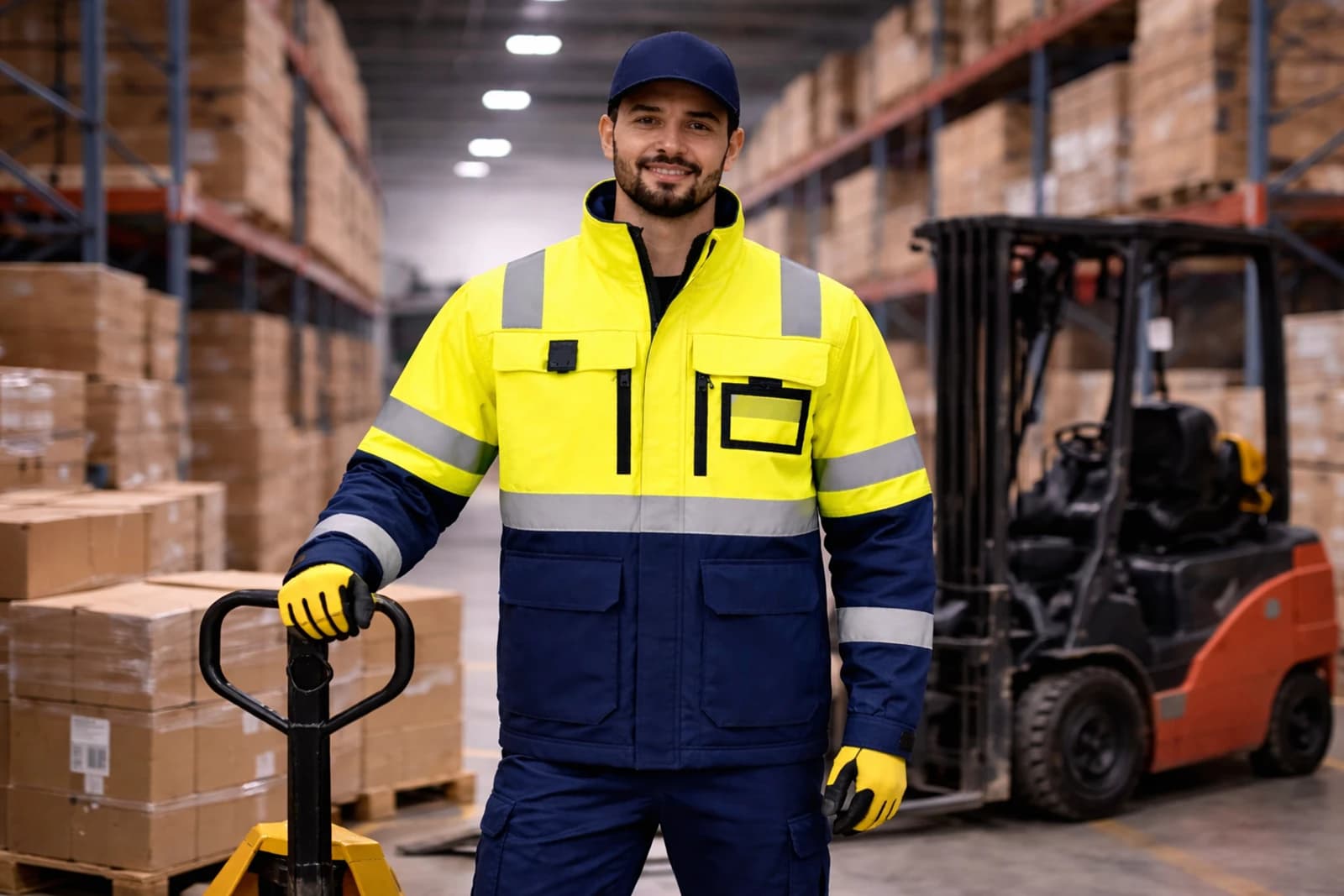
Safety Uniform
Hi-Vis Safety Jacket
Reflective safety jacket for high-visibility site operations and road work crews.

Logistics Uniform
Logistics Polo Uniform
Breathable uniform polo for warehouse, delivery, and last-mile teams.