Workwear Quality Control from China: An Inspection Guide for Middle East B2B Buyers
Middle East B2B buyers importing workwear from China face a persistent challenge: what you approve in a sample is not always what arrives in the container. This practical inspection guide covers AQL (Acceptable Quality Limit) sampling, critical defects to check on coveralls, hi-vis jackets, softshell sets, and polo uniforms, and how to work with third-party QC companies to protect your order before shipment leaves the factory.

Buyer context
What procurement teams run into
Middle East B2B buyers who source workwear from Chinese manufacturers often encounter a gap between the sample they approved and the bulk production they receive. Fabric colour shifts between batches, reflective tape alignment drifts, stitch quality degrades at scale, zipper pulls get substituted, button attachments loosen, and sizing becomes inconsistent — yet by the time the container arrives in Dubai, Dammam, or Doha, the payment has cleared and the only recourse is a difficult renegotiation. The root cause is almost always a lack of structured quality control (QC) during production. Many buyers do not know what AQL level to specify, which defects to prioritise during inspection, or how to read a third-party QC report. As a result, they either perform no inspection at all (and discover defects on arrival) or use inspection checklists designed for consumer apparel that miss the critical failure points unique to industrial workwear.
Sourcing approach
How a factory partner can respond
<h2>1. Start with an AQL Agreement, Not a Price Agreement</h2> <p>Before production begins, both buyer and manufacturer should agree in writing on the Acceptable Quality Limit (AQL) for the order. AQL is the maximum number of defective units allowed in a statistically sampled lot. It is expressed as a percentage or a defect level:</p> <ul> <li><strong>AQL 1.0 (critical standard):</strong> Used for hi-vis garments where reflective tape failure is a safety issue, and for FR coveralls where fabric integrity is non-negotiable. Only 1 defective unit per 100 sampled is tolerated.</li> <li><strong>AQL 2.5 (standard for industrial workwear):</strong> Acceptable for general industrial coveralls, construction softshell sets, and logistics polos. Up to 2.5 defective units per 100 sampled — this is the most common AQL for workwear categories.</li> <li><strong>AQL 4.0 (lenient):</strong> Only suitable for disposable or low-cost garments. Not recommended for any workwear that will be worn in safety-regulated environments.</li> </ul> <p>Specify AQL in your purchase order. If it is not there, most manufacturers default to AQL 4.0 or no inspection at all. For Middle East workwear buyers, always specify AQL 2.5 as the minimum, with AQL 1.0 for hi-vis and FR garments.</p> <h2>2. The Three-Stage Inspection Timeline</h2> <p>One inspection at the end of production is too late to fix problems. A better approach uses three checkpoints:</p> <p><strong>Stage 1: Raw Materials (before cutting starts)</strong><br> Inspect incoming fabric rolls, reflective tape rolls, zippers, threads, and trims before they enter the cutting room. Common findings at this stage: fabric shade mismatch between rolls (even from the same dye lot), reflective tape that arrived with a different backing adhesive than specified, zipper sliders that do not match the approved sample. This is the cheapest point to catch issues — stopping defective materials before they become cut garment pieces.</p> <p>For Middle East buyers sourcing remotely, request video or photo evidence of the raw materials alongside your approved colour card and spec sheet. Many third-party QC companies (SGS, Bureau Veritas, QIMA) offer raw material inspection as a standalone service.</p> <p><strong>Stage 2: In-Process (after cutting, during assembly)</strong><br> Inspect at 20–30% completion. By this point, the first sewing lines are running, and any pattern or assembly issues are visible. Key checks: stitch density matches spec (8–10 SPI for main seams), seam type is correct (flat-felled or lapped vs. open), bar tacks are present at all stress points, and the garment silhouette matches the approved fit sample.</p> <p>At this stage, defective garments can be reworked without a full production restart. If you wait until 100% completion, rework costs multiply because every garment must be individually undone and re-sewn.</p> <p><strong>Stage 3: Final Random (before packing/shipment)</strong><br> This is the standard AQL inspection performed on finished goods. The inspector randomly samples the agreed number of units from the packed cartons and checks against a defect list (see Section 4). Critical defects cause immediate rejection. Major defects beyond the AQL threshold trigger a sorting/rework requirement. Minor defects below the threshold are noted but accepted.</p> <h2>3. Sample Size: The ANSI/ASQ Z1.4 Table</h2> <p>The standard sampling table used by professional QC companies is ANSI/ASQ Z1.4 (identical to ISO 2859-1, MIL-STD-105E, and GB/T 2828.1 in China). For a typical workwear order:</p> <table> <tr><th>Order Quantity</th><th>Sample Size (Normal)</th><th>Accept/Reject at AQL 2.5</th></tr> <tr><td>51–90 pieces</td><td>13 pieces</td><td>Accept ≤ 0 major, Reject ≥ 1 major</td></tr> <tr><td>91–150 pieces</td><td>20 pieces</td><td>Accept ≤ 1 major, Reject ≥ 2 major</td></tr> <tr><td>151–280 pieces</td><td>32 pieces</td><td>Accept ≤ 2 major, Reject ≥ 3 major</td></tr> <tr><td>281–500 pieces</td><td>50 pieces</td><td>Accept ≤ 3 major, Reject ≥ 4 major</td></tr> <tr><td>501–1,200 pieces</td><td>80 pieces</td><td>Accept ≤ 5 major, Reject ≥ 6 major</td></tr> <tr><td>1,201–3,200 pieces</td><td>125 pieces</td><td>Accept ≤ 7 major, Reject ≥ 8 major</td></tr> <tr><td>3,201–10,000 pieces</td><td>200 pieces</td><td>Accept ≤ 10 major, Reject ≥ 11 major</td></tr> </table> <p>For reduced inspection (when the manufacturer has a consistent quality history), sample sizes may be lower. For tightened inspection (when problems occurred in previous orders), sample sizes are higher. Always specify "Normal Level II" unless there is a clear reason to use tightened or reduced.</p> <h2>4. Defect Classification for Workwear</h2> <p>Not all defects are equal. A structured QC report classifies each finding:</p> <p><strong>Critical defects</strong> — safety-related, immediately reject the lot:</p> <ul> <li>Reflective tape width below the EN 20471 minimum (50 mm for tape, 50 mm × 2 for combined performance material)</li> <li>Reflective tape adhesion failure (tape peeling from fabric under moderate finger pressure)</li> <li>Missing or wrong certification labels (CE, EN 20471, EN ISO 11611, SASO/ESMA marks)</li> <li>FR fabric failure — flame spread or afterglow outside certified limits</li> <li>Hardware (zippers, buttons, rivets) that fails to function or detaches under normal hand pressure</li> </ul> <p><strong>Major defects</strong> — functional or appearance failures that affect wearability:</p> <ul> <li>Colour deviation: more than 0.8 ΔE from approved colour standard (measured by spectrophotometer), or visible shade variation between panels of the same garment</li> <li>Seam failure: stitches per inch below 6 on any main seam, more than 2 skipped stitches in any 10 cm of seam, or open seams at critical areas (crotch, armhole, waistband)</li> <li>Zipper malfunction: slider does not lock, teeth do not mesh, or zipper opens from the bottom under light tension</li> <li>Sizing out of tolerance: garment dimensions differ from spec sheet by more than 1.5 cm for critical measurements (chest, waist, length) or 2 cm for non-critical measurements (sleeve length, leg opening)</li> <li>Fabric defects: holes, tears, broken yarns, or weaving flaws larger than 0.5 cm in visible areas</li> <li>Label errors: wrong size label, wrong care label, wrong brand label, or label placement outside the agreed position within 2 cm</li> <li>Reflective tape alignment: tape position deviating from the spec sheet by more than 1 cm (for safety garments, this affects visibility coverage)</li> </ul> <p><strong>Minor defects</strong> — cosmetic issues that do not affect function:</p> <ul> <li>Stray threads longer than 2 cm inside the garment (outside acceptable trim standards)</li> <li>Colour deviation between 0.5–0.8 ΔE from standard (noticeable on close inspection but not at arm's length)</li> <li>Slight puckering at seams visible only when the garment is laid flat</li> <li>Button thread tails longer than 1 cm</li> <li>Packaging damage or carton labeling inconsistencies that do not affect the garments</li> </ul> <h2>5. Special Attention: Workwear-Specific QC Pitfalls</h2> <p><strong>Coveralls (industrial use):</strong> The most common hidden defect is zipper-track binding — the fabric tape sewn alongside the zipper is pulled too tight during assembly, causing the zipper to bind or split under tension. Test every sample coverall by fully zipping and unzipping three times while the garment is laid flat. A smooth zipper action is non-negotiable for coveralls worn over other clothing in tight work spaces.</p> <p>Second most common: crotch seam blowout. On coveralls, the crotch seam bears the highest tensile stress of any seam. Check that the crotch has a gusset (a diamond-shaped reinforcement panel) and at least two rows of stitching with a bar tack at each end. If the coverall has no gusset, expect seam failure within 3–6 months of daily wear.</p> <p><strong>Hi-vis safety jackets:</strong> The single most common QC failure is reflective tape placed over a seam or pocket. Tape must be applied to a continuous flat fabric surface — if it bridges a seam, it will lift and peel within weeks. Check every jacket in the inspection sample: trace each piece of tape with your finger. If any tape section runs over a pocket edge, seam, or zipper track, mark it as a major defect.</p> <p>Second common issue: the shell fabric and lining fabric shrink at different rates. After one wash, the lining may protrude or pull the shell out of shape. Ask for a pre-production wash test on one finished garment before bulk production begins.</p> <p><strong>Construction softshell sets:</strong> The three most frequent defects are: (1) membrane delamination — the inner membrane layer separates from the outer shell, visible as bubbles or wrinkling when the fabric is stretched. Test by stretching the fabric 20% in both directions and looking for separation. (2) Zipper-to-seam misalignment on the jacket front — the two halves of the front zipper sit at different heights, causing the hem to sit crooked. (3) Pocket placement deviation — left and right pockets are at different heights or distances from the centre front, a surprisingly common production error on softshell jackets.</p> <p><strong>Logistics polo uniforms:</strong> The most overlooked defect is collar curl. After the first wash, the collar points curl upward instead of lying flat. This is caused by insufficient interfacing or the wrong interfacing weight for the pique knit fabric. Inspect collar construction during the in-process stage: the collar should have a fusible interfacing layer and at least 1.5 cm of stable fabric fold. A collar test: fold it 90 degrees and release — if it springs back flat, the interfacing is adequate.</p> <p>Second: button alignment. On polo uniforms, the buttons must align vertically within 2 mm of the centre placket. Misaligned buttons make the garment look sloppy when worn buttoned. Check with a straight edge laid along the centre line of the placket.</p> <h2>6. Working with Third-Party QC in China</h2> <p>For most Middle East B2B buyers, hiring a third-party inspection company is more practical than sending a staff member to China. The major providers active in Chinese garment industrial clusters (Jiangsu, Zhejiang, Shandong, Guangdong) include:</p> <ul> <li><strong>SGS:</strong> Most comprehensive but expensive. Good for high-value FR and hi-vis orders. Industry-specific inspectors with PPE knowledge. Expect $350–$600 per man-day depending on location and category.</li> <li><strong>Bureau Veritas (BV):</strong> Strong in textile inspection. Slightly lower cost than SGS. Good coverage in all major garment regions.</li> <li><strong>QIMA (formerly AsiaInspection):</strong> Digital-first platform with online booking and same-day reporting. Most cost-effective for smaller orders. Inspectors may have less workwear-specific training, so provide a detailed inspection checklist upfront.</li> <li><strong>TÜV Rheinland:</strong> Excellent for PPE certification verification. Use for hi-vis and FR garment inspections where certification trumps other features.</li> <li><strong>Intertek:</strong> Good general textile inspection. Strong lab testing capabilities for fabric and colour fastness.</li> </ul> <p><strong>Tips for working with QC companies effectively:</strong></p> <ul> <li>Send the QC company your approved sample + spec sheet + defect classification list at least 5 working days before the inspection date. Do not expect the inspector to know what a "good" hi-vis jacket looks like without a reference standard.</li> <li>Specify whether to use the approved photo sample (the one you signed off) or the sealed sample (the one the factory holds) as the reference. Inconsistent reference standards cause failed inspections and re-inspection fees.</li> <li>Request the inspection report in English (not Chinese) and specify that critical defects must be communicated by phone or WhatsApp immediately, not just in the PDF report.</li> <li>If the order is spread across multiple cartons, ask the QC company to sample from a larger number of cartons rather than concentrating the sample in a few cartons. This increases the chance of catching lot-to-lot variation within the order.</li> <li>For first-time orders with a new manufacturer, add a container loading supervision (CLS) service. This ensures the inspected and approved goods are the ones actually loaded into the container — not substituted with a lower-grade batch.</li> </ul> <h2>7. What to Do When QC Fails</h2> <p>If the final inspection rejects the lot (defects exceed AQL), you have three options:</p> <ul> <li><strong>Request sorting:</strong> The factory manually inspects every garment in the lot and removes defective units. This typically costs $0.50–$1.50 per garment depending on the defect type and volume. The sorted lot is re-inspected at a reduced sample size. Sorting is a practical solution for minor-to-moderate defect rates.</li> <li><strong>Request rework:</strong> The factory corrects the specific defect on all affected garments (e.g., replacing all zippers, re-sewing all collars). Rework takes longer than sorting and requires a full re-inspection after completion. For major defects, this is the minimum acceptable resolution.</li> <li><strong>Reject the lot:</strong> Full rejection gives you leverage to renegotiate price, demand a new production run, or cancel the order. However, for custom OEM workwear, rejecting the lot often means starting from scratch — and if the payment terms were unfavourable (e.g., 50% deposit), you may lose the deposit amount. This is why pre-production and in-process inspections are so important: they make rejection only necessary in extreme cases, not a routine response to end-of-line problems.</li> </ul> <p>Always write these resolution pathways into your purchase order terms before production starts. A manufacturer who agrees to "sorting at seller's cost" in the PO is different from one who only offered "negotiation in good faith."</p> <h2>Summary</h2> <p>Quality control for workwear imported from China is not complicated, but it requires structure. Agree on AQL before production. Inspect at three stages — raw materials, in-process, and final random. Use a defect classification that separates safety-critical issues from cosmetic ones. Hire a third-party QC company with workwear experience and provide them a clear reference standard. And always write quality terms into your purchase order, not just your email thread.</p> <p>A structured QC process typically adds 2–5% to the total order cost but prevents 80–90% of the defects that would otherwise arrive in your container. For Middle East B2B buyers managing uniform programs for oil & gas sites, construction projects, or logistics fleets, that return on investment is hard to beat.</p>
Recommended Products
Products that fit this use case

Industrial Workwear
Industrial Coverall Pro
Hard-wearing one-piece coverall for plant, maintenance, and heavy-duty operations.
Safety Uniform
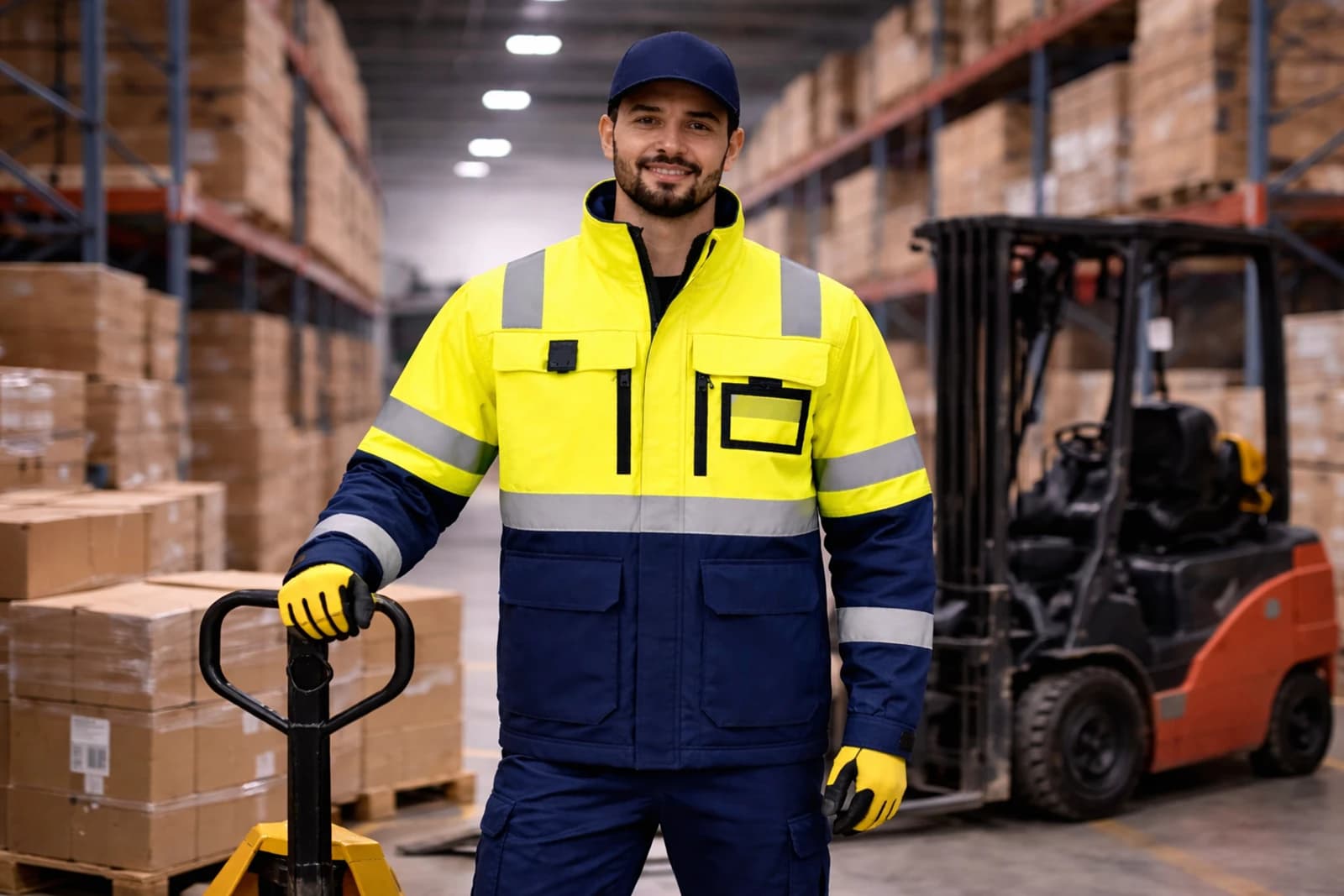
Hi-Vis Safety Jacket
Reflective safety jacket for high-visibility site operations and road work crews.
Construction Clothing
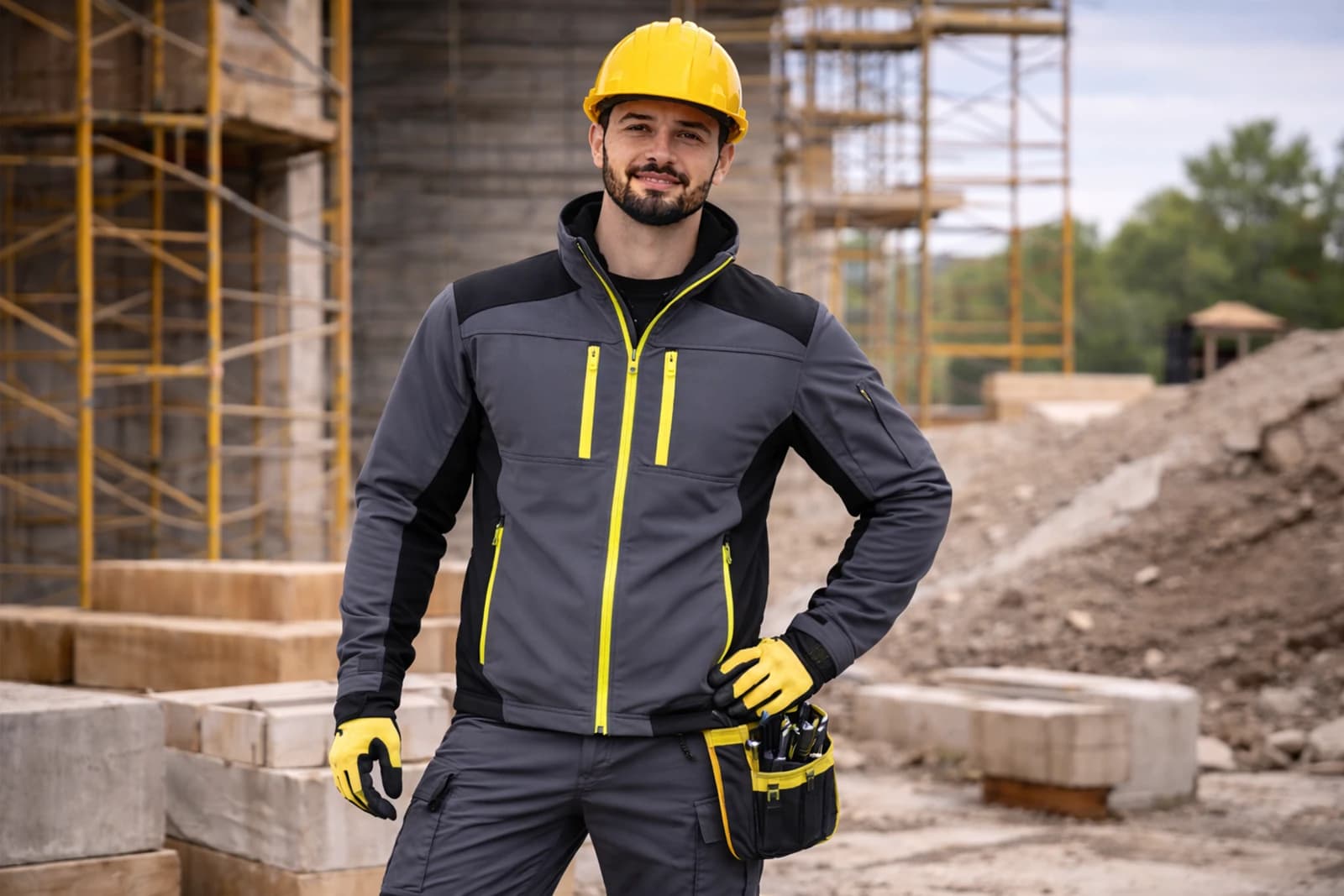
Construction Softshell Set
Flexible jacket and trouser set built for crews working across changing weather conditions.

Logistics Uniform
Logistics Polo Uniform
Breathable uniform polo for warehouse, delivery, and last-mile teams.