Quality Control and Factory Auditing for Workwear Sourced from China: A Guide for Middle East B2B Buyers
Middle East B2B buyers sourcing workwear from China need a structured quality control plan to protect their investment. This guide covers pre-production samples, in-line inspections during cutting and sewing, final random inspection (AQL 2.5), fabric testing, measurements, and how to audit a Chinese workwear factory's certifications, production capacity, and export experience before placing a bulk order.

Buyer context
What procurement teams run into
<p>A construction company in Jeddah orders 2,000 softshell jacket sets from a Chinese manufacturer they found on Alibaba. The sample they received in 12 business days looks excellent — the 280 gsm bonded softshell feels premium, the reflective tape is well aligned, and the zippers operate smoothly. They approve the bulk order via email based on the sample.</p><p>Forty-five days later, 2,000 sets arrive at the Jeddah warehouse. The production run was cut from a different fabric roll — the shell is 250 gsm instead of 280 gsm, the fleece backer is a lower grade, and the reflective tape on 340 jackets is misaligned or poorly heat-sealed at the seams. The stitching on 120 jackets has loose tension that will unravel within 10 wears. The client's brand logo is 3 cm lower on one sleeve than the other on 15% of the garments. The shipment is non-conforming, but the manufacturer invoices for 100% of the order and does not accept liability for what they call "acceptable manufacturing tolerances."</p><p>In Doha, an oil and gas procurement manager orders 1,500 industrial coveralls with FR treatment. The order includes 200 sets for a high-temperature zone where the flame-resistant properties are safety-critical. The coveralls arrive with an FR certification document, but the test report does not match the lot number on the garments. There is no fabric batch traceability. The safety officer refuses to issue any of the 1,500 coveralls to workers until independent testing is completed — a delay of three weeks that pushes the project schedule at a cost of USD 18,000 per day.</p><p>Both scenarios are preventable with a structured quality control plan. Middle East buyers sourcing workwear from China must understand what inspection points exist in the manufacturing process, how to specify them in the purchase contract, and what to expect when a qualified third-party inspector visits a Chinese workwear factory.</p>
Sourcing approach
How a factory partner can respond
<h2>The Four-Stage Quality Control Framework</h2> <p>Professional workwear buyers use a four-stage QC framework that covers the entire production lifecycle. Implementing all four stages is the standard for bulk orders above 500 units. For smaller orders (100–500 units), stages 1 and 4 are the minimum acceptable coverage.</p> <h3>Stage 1: Pre-Production Sample Approval</h3> <p>The pre-production sample (also called the PP sample or size-set sample) is produced on the actual production fabric using the actual production trims (zippers, buttons, reflective tape, thread, labels). It is not the same as the initial salesman sample or the lab dip sample.</p> <p><strong>What to check on the PP sample:</strong></p> <ul> <li>Fabric hand feel and weight — measure the gsm of a 10 cm × 10 cm cut from the sample to confirm it matches the specification ±5% tolerance</li> <li>Colour — compare the sample against the approved lab dip or Pantone reference under D65 daylight lamp; request a colour measurement report (CIE Lab or ΔE value) from the factory</li> <li>Stitching quality — check stitch density per inch (12–14 SPI for woven fabrics, 10–12 SPI for knits), thread tension, and seam allowance consistency</li> <li>Measurement check — measure every specified dimension (chest, waist, length, sleeve, shoulder) and record the variance from the size specification sheet</li> <li>Function check — operate every zipper, button, snap, Velcro closure, and drawcord at least ten times per garment in the sample set</li> <li>Reflective tape placement — for hi-vis garments, measure tape widths, gap dimensions, and placement distances from seams using the applicable standard (EN ISO 20471, ANSI/ISEA 107, or CSA Z96)</li> </ul> <p><strong>For Middle East buyers:</strong> Request the PP sample in the smallest and largest sizes of your size range. If ordering from XS to 4XL, get the PP sample in M and 4XL — the grade rule (the mathematical sizing scale between sizes) may not be consistent across the full size range, and only the PP sample reveals this. Sidaier provides PP samples within 12–15 working days of fabric confirmation for bulk orders and includes a measurement report with the sample.</p> <h3>Stage 2: In-Line Inspection (During Production)</h3> <p>An in-line inspection is performed when 20–30% of the production is complete but before any single operation is fully finished. This is the stage that catches problems while they can still be corrected without rejecting finished goods.</p> <p><strong>What the inspector checks during in-line inspection:</strong></p> <ul> <li>Cutting quality — verify that fabric plies are cut cleanly without fusing or shifting; check that pattern pieces match the marker plan and grain line direction</li> <li>Sewing line — inspect stitch quality at the needle and sewing machine level; check for skipped stitches, uneven tension, or thread breaks that exceed 2 per metre</li> <li>Fabric defects — scan cut pieces and partially sewn garments for weaving defects (slubs, holes, thick/thin yarns) and dyeing defects (shade variation, dye spots, colour patches)</li> <li>Trim compliance — verify that the reflective tape, zippers, buttons, elastic bands, and labels actually match the approved PP sample; this is where switching to a cheaper trim supplier is most frequently caught</li> <li>Size grading — measure a sample from each size being cut to confirm that the grade rules (the incremental increases between sizes) are correctly applied in the cutting die or computerised cutting machine</li> </ul> <p>A good third-party inspection company will photograph every defect found and tag it on the garment so the factory supervisor can see the issue directly. The inspection report will grade defects as critical, major, or minor per the ANSI/ASQ Z1.4 or ISO 2859-1 standard.</p> <h3>Stage 3: Final Random Inspection (FRI)</h3> <p>The final random inspection is performed when at least 80% of the production is packed and ready for shipment. It follows the ANSI/ASQ Z1.4 (AQL) sampling standard. For workwear, the most common acceptance level for bulk orders is AQL 2.5 for major defects and AQL 4.0 for minor defects, with zero critical defects.</p> <p><strong>Sampling plan example for a 1,500-piece order:</strong></p> <ul> <li>Inspection lot: 1,500 pieces (assume homogenous across sizes and colours)</li> <li>Inspection level: II (General, normal) per ANSI/ASQ Z1.4</li> <li>Sample size code letter: K → sample size of 125 pieces</li> <li>Accept/reject for major defects (AQL 2.5): Accept ≤ 7, Reject ≥ 8</li> <li>Accept/reject for minor defects (AQL 4.0): Accept ≤ 10, Reject ≥ 11</li> </ul> <p><strong>What the FRI covers:</strong></p> <ul> <li>Carton condition and packaging — check that cartons are clean, properly sealed, and labelled with correct shipping marks; check that individual garment polybags are sealed with correct size/colour labels</li> <li>Garment appearance — remove 125 pieces from different cartons and inspect each garment on a mannequin or flat table for overall appearance, colour, and shape</li> <li>Measurement verification — measure at least 10 pieces from the 125 sample across different sizes against the size specification sheet; reject if more than 5% of garments exceed +/− 1.5 cm on primary measurements (chest, length, sleeve)</li> <li>Functional testing — operate all closures on each sample garment</li> <li>Labelling check — verify that care labels, content labels, and size labels match what was approved; for Middle East export, check that labels include Arabic language if required by the importing country</li> <li>Accessories check — count spare buttons, zipper pulls, or other accessories to verify they match the packing list</li> </ul> <h3>Stage 4: Container Loading Inspection</h3> <p>Not all workwear buyers use this stage, but it is strongly recommended for first-time orders from a new Chinese manufacturer. The inspector arrives at the factory or warehouse when the final container is being loaded and verifies that the cartons being loaded match the packing list and purchase order, no short-shipping occurs (common issue: the manufacturer loads 980 cartons instead of 1,000), no moisture damage in the container, and the loading cartons are properly blocked and braced to prevent in-transit shifting.</p> <h2>How to Audit a Chinese Workwear Factory</h2> <p>Before placing a bulk order, Middle East buyers should verify the factory's credentials through an audit or desk review. Here is what to check:</p> <table> <tr><th>Checkpoint</th><th>What to Verify</th><th>Red Flags</th></tr> <tr><td>Business licence</td><td>Scope wordings that match garment manufacturing; legal name matches the trading counterparty</td><td>Licence only covers "garment trading" or "import/export" without "manufacturing"</td></tr> <tr><td>Factory address</td><td>Physical factory address matches where production happens; verify via Google Maps or Baidu Maps satellite view</td><td>Factory address is the same as a multi-tenant commercial building without visible warehouse/production</td></tr> <tr><td>Production capacity</td><td>Number of sewing lines, number of workers per line, monthly output in pieces; a standard workwear sewing line produces 60–80 jackets per 8-hour shift</td><td>Capacity claims cannot be supported by the visible factory floor area and worker count</td></tr> <tr><td>Export experience</td><td>Documented export to Middle East buyers; customs clearance records or bill of lading data</td><td>"Yes we can ship to Dubai" but cannot name any customer, project, or distributor in the Middle East</td></tr> <tr><td>Certifications</td><td>Certification body name and certificate number for ISO 9001, CE, or applicable product standards; verify each certificate online with the issuing body</td><td>Certificates are self-declared, expired, or from an unrecognised certification body</td></tr> <tr><td>Subcontractor control</td><td>List of which production stages are in-house vs subcontracted (embroidery, screen printing, reflective tape application, fabric finishing)</td><td>All critical processes are subcontracted with no QC at the subcontractor site</td></tr> <tr><td>Fabric sourcing</td><td>Fabric supplier list, fabric inventory on hand, and fabric test reports for each lot received</td><td>Factory cannot produce fabric traceability records or purchase receipts</td></tr> </table> <p>For Middle East buyers who cannot travel to China, a factory audit by a third-party inspection company (SGS, Bureau Veritas, TÜV Rheinland, or Intertek) is cost-effective — a social compliance audit plus quality management audit typically costs USD 800–1,500 depending on the factory location and scope. The inspector sends photographs, floor layout measurements, and survey results that give you a reliable picture of the factory's capability without leaving your office.</p> <h2>Including QC in Your Purchase Contract</h2> <p>A quality control plan is only enforceable if it is written into the purchase contract. Middle East buyers should include these clauses:</p> <ul> <li><strong>Approval condition:</strong> "This order is conditional on written approval of the pre-production sample. No bulk production will begin without written PP sample approval."</li> <li><strong>Inspection right:</strong> "Buyer or buyer's nominated third-party inspector has the right to access the factory during business hours to perform in-line inspection and final random inspection. The manufacturer must notify the buyer at least 5 working days before each inspection stage."</li> <li><strong>Acceptance standard:</strong> "Final acceptance of the shipment is per ANSI/ASQ Z1.4 (AQL), Inspection Level II, with AQL 2.5 for major defects, AQL 4.0 for minor defects, and zero critical defects."</li> <li><strong>Rejection and remedy:</strong> "If the shipment fails final random inspection, the manufacturer has 14 calendar days to sort, repair, and present the goods for re-inspection at the manufacturer's cost. If re-inspection fails, the buyer has the right to cancel the order and require a full refund."</li> <li><strong>Retention:</strong> "A retention of 10% of the order value will be held by the buyer and released upon receipt of conforming goods at the port of destination."</li> </ul> <h2>Common Quality Issues Specific to Middle East Orders</h2> <p>Chinese manufacturers who are new to the Middle East market may not be familiar with region-specific quality requirements:</p> <ul> <li><strong>Colour fastness in high UV:</strong> Request a xenon-arc lightfastness test (ISO 105-B02) for all coloured fabrics, especially for outdoor hi-vis garments. China's domestic market has lower UV exposure than the GCC.</li> <li><strong>Fabric shrinkage at high wash temperatures:</strong> GCC industrial laundries commonly wash at 70–85 °C. Chinese domestic standard washing tests are often at 40–60 °C. Specify wash temperature in your test conditions.</li> <li><strong>Sweat fastness:</strong> Acid perspiration fastness (ISO 105-E04) testing is relevant for Middle East outdoor workwear due to high sweat volume. Standard Chinese workwear testing often omits this.</li> <li><strong>Packaging for transit:</strong> Sea freight from Shanghai to Jeddah takes 15–20 days through the Red Sea in summer. Cartons must be double-walled corrugated with moisture barrier lining for container shipping in 40 °C ambient conditions.</li> <li><strong>Thermal stability of coatings:</strong> DWR finishes, reflective tape adhesives, and heat-transfer logos must be tested at 60–70 °C storage temperatures. A standard DWR finish that works in Shanghai summers may delaminate after 10 days in a Jeddah warehouse.</li> </ul> <h2>Choosing a Third-Party Inspection Company</h2> <p>For workwear sourced from China, the four major third-party QC providers all have offices in the major garment manufacturing hubs (Guangzhou, Shenzhen, Shanghai, Hangzhou, Qingdao):</p> <ul> <li><strong>SGS</strong> — Largest presence in China; offers social compliance audits, quality inspections, and lab testing in one package. Good for buyers consolidating multiple QC needs into one vendor.</li> <li><strong>Bureau Veritas</strong> — Strong in textile testing including specific fabric performance tests. Recommended when fabric QC is your primary concern.</li> <li><strong>TÜV Rheinland</strong> — Strong in PPE certification verification. Recommended for hi-vis, FR, and chemical protective workwear where the certificate itself needs verification against the standard.</li> <li><strong>Intertek</strong> — Competitive pricing for basic AQL inspections; good for cost-conscious buyers who need reliable standard inspections without extensive lab testing.</li> <li><strong>AsiaInspection (now part of QIMA)</strong> — Digital-first platform with online booking, real-time photo reports via app, and same-day report uploads. Good for buyers who want fast turnaround and digital dashboards.</li> </ul> <p>Building a quality control framework does not add significant cost to a workwear order — a single FRI for a 1,500-piece order costs approximately USD 350–500 including the inspector's travel. Compared to the cost of rejecting a non-conforming shipment at the destination port (storage, return freight, replacement order at airfreight rates, project delay penalties), the QC investment is the most cost-effective risk mitigation available to Middle East buyers sourcing workwear from China.</p>
Recommended Products
Products that fit this use case

Industrial Workwear
Industrial Coverall Pro
Hard-wearing one-piece coverall for plant, maintenance, and heavy-duty operations.
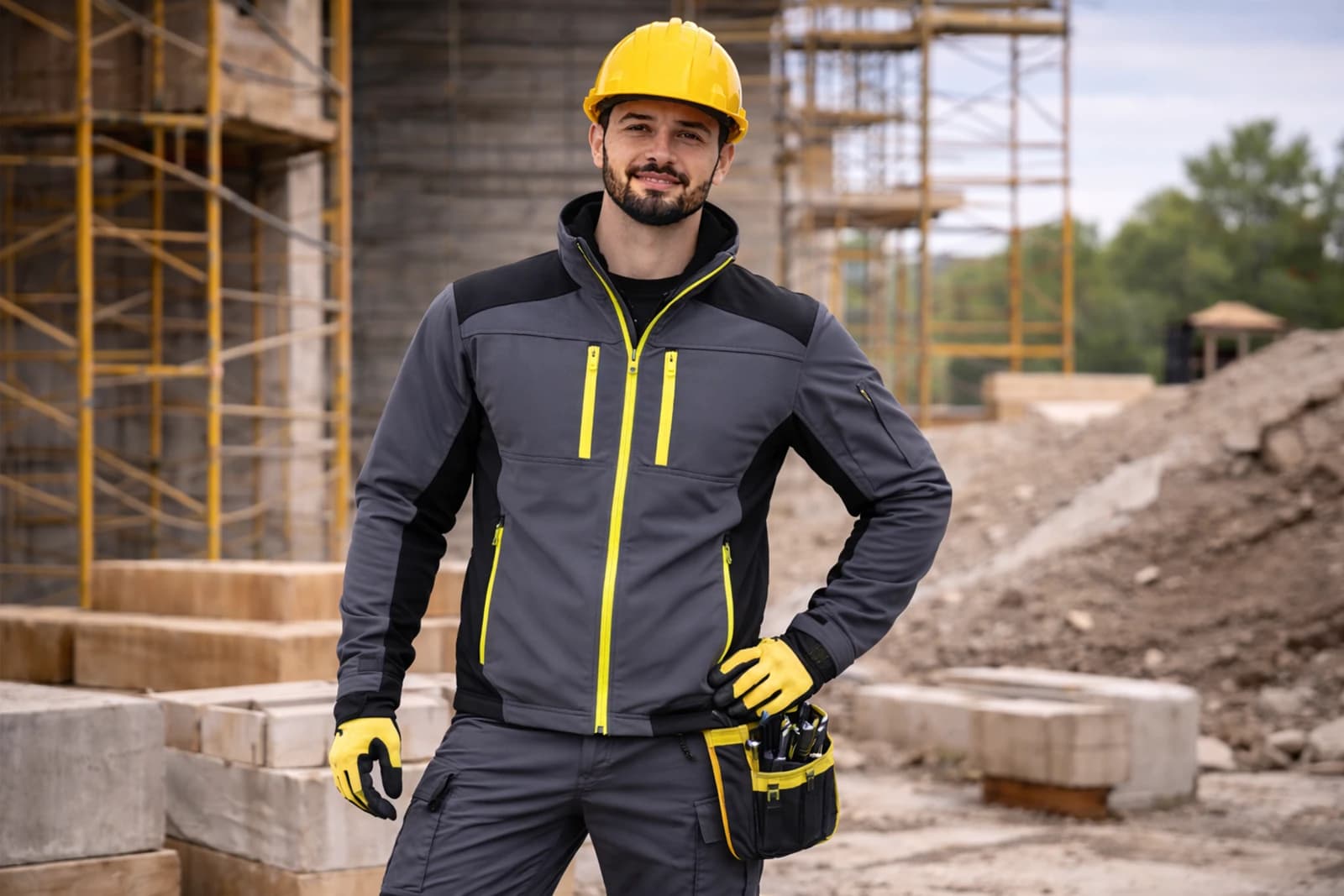
Construction Clothing
Construction Softshell Set
Flexible jacket and trouser set built for crews working across changing weather conditions.